


Minimum Viable Product MVP Development Timeline




Try Before you Buy Download Free Sample Product
 Impress Your
 Audience
 100%
100% Editable
 Save Hours
 of Time


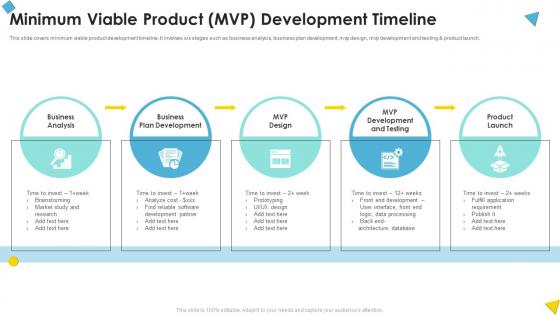
This slide covers minimum viable product development timeline. It involves six stages such as business analysis, business plan development, mvp design, mvp development and testing and product launch.
People who downloaded this PowerPoint presentation also viewed the following :
Minimum Viable Product MVP Development Timeline with all 6 slides:
Use our Minimum Viable Product MVP Development Timeline to effectively help you save your valuable time. They are readymade to fit into any presentation structure.





FAQs for Minimum Viable Product
So you'll need about 8-16 weeks total, broken into chunks. Start with 1-2 weeks validating your idea and mapping out core features. Design and prototyping takes another 2-3 weeks. Development is the big one - 4-8 weeks depending how complex you're going. Then testing and bug fixes, which honestly always drags on longer than the 1-2 weeks you plan for. Launch prep is usually just a week. Oh, and seriously - don't let yourself add "one tiny feature" mid-development. I've seen that derail so many timelines. Build buffer time into each phase because stuff comes up.
Look, figure out that one problem you're actually solving first - the thing people will open their wallets for. I swear, most teams just pile on features thinking more = better. Try the MoSCoW thing (Must have, Should have, etc.) because it'll force you to have those awkward conversations about what actually matters. Talk to real customers, not just your team sitting around guessing what users want. Map every feature to an actual outcome. If it doesn't prove your main idea? Cut it. Your MVP should feel almost embarrassingly simple - that's how you know you're probably on the right track.
User feedback is like your project's GPS - shows you when to pivot and what deserves your time. Here's the thing though: early feedback usually reveals you're building something nobody wants. Sucks scrapping weeks of work, but it beats wasting months on the wrong stuff. Build those feedback loops into your timeline from the start. I always plan for 2-3 rounds before launch, plus buffer about 20-30% extra time for changes. Because trust me, users will definitely want changes. Way better to expect those delays upfront than panic later when everything's behind schedule.
Oh dude, industry makes a huge difference - like 2-6 months easily. Healthcare and fintech are brutal because you can't skip the compliance stuff. HIPAA, PCI requirements, all that garbage has to be built in from the start. E-commerce is way faster since everyone's basically copying the same playbook at this point. SaaS tools move quick too. But manufacturing? Forget about it. Hardware integration takes forever with all the testing cycles and physical limitations. I learned that one the hard way on a previous project. Just make sure you're upfront with stakeholders about these timelines from day one.
For your MVP, I'd focus on velocity first - how many story points you're actually knocking out each sprint. Track your feature completion rate against whatever roadmap you've got planned. Bug density matters too since you don't want to ship garbage. Time-to-market is obviously huge here. Watch for team burnout though - I've seen way too many projects crash because everyone's fried by month three. User feedback volume from early testing tells you a lot, plus keep an eye on burn rate. Honestly, don't overcomplicate it. Five solid metrics beat having some crazy dashboard with twenty different charts.
Honestly, agile is a game changer for MVP timelines. You're doing 2-week sprints instead of planning forever upfront - way less stressful. Build something, test it, then iterate fast. I've seen teams get stuck for months just trying to make everything perfect from day one (total waste). Short sprints mean you'll have working features every couple weeks. If users hate something? Pivot immediately. The feedback happens constantly so you catch problems early and only build stuff people actually want. Your team won't get bogged down overthinking everything either. Start with 2-week cycles and keep that feature list super tight.
Honestly, feature creep will destroy you - I've watched it happen so many times. You'll think "oh just one tiny addition" but suddenly you're three months behind. Skip the perfectionism too. Test with real users early, not at the end when it's too late to pivot. I made that mistake once and built something totally useless. Set a deadline that actually scares you a little. Your MVP should feel almost embarrassingly simple - that's how you know you're doing it right. Cut everything that isn't absolutely core. Ship it, then improve it.
Start by writing down your absolute must-haves and cut everything else - seriously, everything. Focus on core functionality that proves your main idea works. I know you'll want to add "just one more thing" but don't do it! Your essentials need to be solid though. Buggy core features destroy user trust way faster than missing fancy stuff ever will. Time-box your sprints and use automated testing so you catch problems early. Oh, and quality gates are clutch here. List your top 3 features and ask yourself: what's the most basic version that actually functions?
Honestly, tons of good options out there. Asana and Trello are super user-friendly for breaking down tasks. Monday.com's pretty solid too. If your team's technical, Jira's great for sprint planning - though it can feel overkill sometimes. I've actually seen teams crush it with just Google Sheets, but that gets chaotic quick. For visualizing timelines, Gantt charts help tons - Smartsheet's good, or TeamGantt if you want free. Really though, pick whatever your team won't ignore after week two. That's the real key.
Dude, team composition is huge for MVP timelines. Full-stack devs who can do both frontend and backend? You'll ship way faster than coordinating between specialists doing handoffs. Domain knowledge matters too - having someone who gets your space beats developers figuring it out as they go (trust me on this one). Keep it small though, like 2-4 people max. More people = more meetings and slower decisions, which is death for MVPs. Oh and go for versatile people over specialists initially. You can always hire your dream team later once you've got something working.
Honestly, 2-4 months is the sweet spot for most MVPs. Depends on how complex your thing is and team size obviously. Don't rush some half-baked 2-week version - I've watched teams do that and it's just embarrassing when nobody can actually use it. But you also can't take forever or you'll burn through your money before learning anything useful. Focus on the core features that actually solve a real problem. Not just whatever's easiest to build first, you know? Once it's out there, users will tell you what sucks and you can fix it from there.
Honestly, it goes both ways. Do your research upfront and you'll build the right stuff from the start - no expensive do-overs later. But I've seen teams get totally stuck just researching for months without shipping anything (kind of drives me crazy tbh). Set yourself a hard deadline for research and actually stick to it. You really just need enough data to confirm your main assumptions aren't completely wrong. Then build something fast and get it in front of real users. That's where you'll learn the most anyway. Save all the fancy deep-dive research for when you've got actual feedback to work with.
Dude, you've gotta overcommunicate like crazy and be super clear about expectations from the start. Make a shared timeline everyone can see, then do regular check-ins weekly or whatever works for your sprints. Honestly, I've watched so many MVPs go off the rails because someone's random relative suggests adding a chatbot or something halfway through - it's wild. Be really explicit about what's in and what's out. Visual progress tracking helps stakeholders actually see you're moving forward, and don't hesitate to remind people why you cut certain features. Oh, and give them input on priorities early so they feel involved from day one.
Honestly, plan for post-MVP to eat up like 60-70% of your dev time. That's where you'll actually figure out what works. Launch your MVP, then you're basically doing weekly or bi-weekly updates for months based on what users tell you. Usually takes 3-6 months depending how complex your thing is. User feedback will mess with your head every single time - I swear they'll want stuff you never even considered. Budget way more time than you think. The pre-launch part feels huge but the iteration phase after? That's the real grind.
Dude, waiting too long is basically handing your competitors a free win. They'll snatch up all the attention while you're still tweaking features. Tech timing is brutal - I've seen great products flop just because someone else got there first. Your users will find other solutions or honestly just forget about the problem entirely. Here's the thing though - you actually NEED that messy early feedback to build something people want. My take? Ship it even if it's kinda rough around the edges. You can fix bugs, but you can't buy back those crucial first months in the market.
-
I can say with full confidence that all your business, academic, or professional work requirements will be sufficed with SlideTeam. Their gallery is as rich as 2Million+!!
-
Great quality product.