


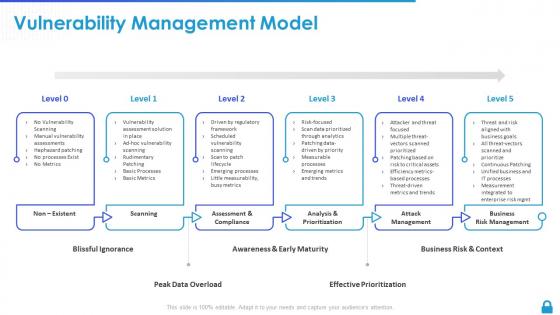
Enterprise vulnerability management vulnerability management model




Try Before you Buy Download Free Sample Product
 Impress Your
 Audience
 100%
100% Editable
 Save Hours
 of Time


Our Enterprise Vulnerability Management Vulnerability Management Model are topically designed to provide an attractive backdrop to any subject. Use them to look like a presentation pro.
People who downloaded this PowerPoint presentation also viewed the following :
Enterprise vulnerability management vulnerability management model with all 6 slides:
Use our Enterprise Vulnerability Management Vulnerability Management Model to effectively help you save your valuable time. They are readymade to fit into any presentation structure.





FAQs for Enterprise vulnerability management
Key components of an effective enterprise vulnerability management program include automated scanning tools, risk assessment frameworks, patch management systems, threat intelligence integration, and continuous monitoring capabilities. These technologies streamline security operations by identifying vulnerabilities quickly, prioritizing remediation efforts based on business impact, and maintaining compliance standards, with many organizations finding that comprehensive programs reduce breach risks while optimizing resource allocation.
Organizations prioritize vulnerabilities by combining CVSS scores, asset criticality ratings, threat intelligence feeds, business impact assessments, and exploitability data into comprehensive risk matrices. Through automated risk scoring platforms, enterprises can focus remediation efforts on high-value systems like payment processors or customer databases, ultimately reducing exposure windows while optimizing security resource allocation across their infrastructure.
Automation accelerates vulnerability scanning by continuously monitoring systems, prioritizing threats based on severity, and deploying patches across networks without manual intervention. Through automated workflows, organizations streamline remediation processes, reduce response times from weeks to hours, and minimize human error, with many enterprises finding that automated systems ultimately deliver faster threat resolution and enhanced security posture.
Threat intelligence integration enhances vulnerability management by providing real-time context about active exploits, prioritizing critical vulnerabilities based on actual threat actor behavior, and enabling proactive defense strategies. Through automated threat feeds and risk scoring, organizations can focus remediation efforts on vulnerabilities being actively exploited, ultimately reducing exposure time and strengthening security posture.
Continuous vulnerability assessment faces challenges including resource constraints, alert fatigue from false positives, integration complexities across diverse IT environments, skilled personnel shortages, and balancing security with operational continuity. These obstacles often overwhelm security teams, with many organizations finding that implementing automated scanning tools, risk-based prioritization frameworks, and cross-functional collaboration ultimately streamlines processes while maintaining comprehensive security coverage.
**INPUT**: How do regulatory compliance requirements influence vulnerability management strategies? **OUTPUT**: Regulatory compliance requirements significantly shape vulnerability management strategies by mandating specific timelines for patching, requiring documented risk assessments, and establishing audit trails for remediation activities. Frameworks like SOX, HIPAA, and PCI-DSS drive organizations to prioritize critical vulnerabilities, implement automated scanning across environments, and maintain comprehensive reporting, with many financial services and healthcare institutions finding that compliance-driven approaches ultimately enhance their overall security posture and operational efficiency. [Word count: 60 words]
Key metrics include mean time to detection, patch deployment rates, vulnerability aging, risk score trends, and remediation effectiveness across asset categories. These measurements enable organizations to assess program maturity, optimize resource allocation, and demonstrate security improvements to stakeholders, with many enterprises finding that tracking these indicators significantly enhances their overall security posture and compliance readiness.
Organizations foster security awareness culture through regular training programs, simulated phishing exercises, clear security policies, employee recognition systems, and leadership commitment to security practices. These initiatives enhance vulnerability reduction by empowering staff to identify threats, encouraging proactive reporting of suspicious activities, and creating accountability across departments, with many enterprises finding that engaged employees become their strongest defense against cyber risks.
Essential vulnerability management tools include vulnerability scanners, patch management systems, asset discovery platforms, threat intelligence feeds, and security information and event management (SIEM) solutions. These technologies streamline security operations by automating threat detection, prioritizing critical vulnerabilities, and accelerating remediation processes, with many enterprises finding that integrated platforms ultimately deliver enhanced operational efficiency and stronger security postures.
Third-party vendor relationships significantly expand an organization's attack surface by introducing external systems, applications, and access points that may contain unpatched vulnerabilities or weaker security controls. Through comprehensive vendor risk assessments, continuous monitoring, and contractual security requirements, organizations can minimize supply chain risks, ensure timely vulnerability remediation across their ecosystem, and maintain stronger overall security posture while leveraging external partnerships strategically.
Vulnerability management in DevSecOps integrates security scanning directly into development pipelines, enabling continuous identification and remediation of code vulnerabilities throughout the software lifecycle. This approach transforms security from a bottleneck into an automated process, with development teams addressing issues in real-time rather than post-deployment, ultimately delivering faster, more secure releases while reducing costly security debt.
Organizations should approach patch management through risk-based prioritization, automated testing environments, and coordinated deployment schedules that balance security needs with operational stability. Through centralized patch management systems, enterprises can streamline vulnerability assessment, accelerate critical updates, and maintain comprehensive audit trails, while establishing rollback procedures and maintenance windows, ultimately delivering enhanced security posture and regulatory compliance.
Best practices for documenting vulnerabilities include standardized classification systems, detailed risk assessments, clear remediation timelines, stakeholder notification protocols, and comprehensive tracking databases. Through centralized reporting platforms, organizations streamline communication between security teams, IT departments, and management, while maintaining audit trails and regulatory compliance, ultimately enabling faster response times and more strategic resource allocation across enterprise infrastructure.
Organizations balance security and business continuity by implementing risk-based prioritization, staged remediation schedules, and compensating controls during patching windows. Through strategic vulnerability management platforms, enterprises can coordinate maintenance windows, deploy temporary mitigations, and maintain operational workflows, while ensuring critical security gaps are addressed without disrupting essential business services.
Vulnerability management adapts to emerging threats through continuous threat intelligence integration, machine learning-powered risk prioritization, automated patch deployment, and real-time security monitoring across cloud and hybrid infrastructures. These adaptive approaches enable organizations to proactively identify zero-day vulnerabilities, respond to novel attack patterns, and maintain robust security postures in an increasingly dynamic threat landscape.
-
Great experience, I would definitely use your services further.
-
Easily Editable.