

Healthcare Minimum Viable Product MVP Development Plan




Try Before you Buy Download Free Sample Product
 Impress Your
 Audience
 100%
100% Editable
 Save Hours
 of Time


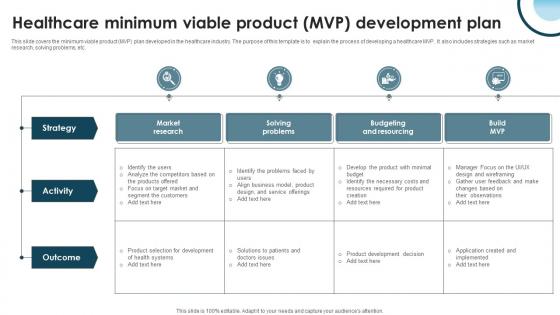
This slide covers the minimum viable product MVP plan developed in the healthcare industry. The purpose of this template is to explain the process of developing a healthcare MVP. It also includes strategies such as market research, solving problems, etc.
People who downloaded this PowerPoint presentation also viewed the following :
Healthcare Minimum Viable Product MVP Development Plan with all 6 slides:
Use our Healthcare Minimum Viable Product MVP Development Plan to effectively help you save your valuable time. They are readymade to fit into any presentation structure.





FAQs for Healthcare Minimum Viable Product
Start with the boring stuff that actually matters - patient registration, scheduling appointments, and letting people message their doctors securely. Don't try building the next WebMD right away (trust me, it's harder than it looks). Basic profile management is fine too. Skip the fancy AI diagnosis features for now. Load times need to be fast, navigation super simple, and security bulletproof since it's health data. Get real patients and healthcare workers testing early - they'll tell you what sucks before you waste months building features nobody wants.
Dude, build HIPAA stuff right into your foundation from the start. Encryption, access controls, audit logs - all that needs to be there day one. Trust me, I got burned trying to add compliance later on my last project and it was a nightmare. Get a healthcare consultant involved early even if money's tight. Yeah it hurts the budget but retrofitting this stuff costs way more. Document everything as you build it. Oh and definitely get a compliance review done before any real users touch the system - learned that one the hard way too.
Definitely hit up some healthcare workers first - like 10-15 docs, nurses, or patients who'd actually use this thing. Don't ask if they'd buy it (everyone lies about that), focus on what sucks about their current process. Mock up some basic wireframes to show them, get real feedback on the workflow. Oh and healthcare regulation is brutal, so check that stuff early before you build something that'll never get approved. If you can swing it, find a clinic or hospital to test with. Honestly, proving the problem exists matters way more than proving your solution works at this stage. Skip surveys - actual phone calls tell you everything you need to know.
Start with security from the beginning - seriously, adding it later is such a pain. HIPAA compliance means encrypting data everywhere, proper access controls, and audit trails for everything. AWS or Azure are your friends here since they already have healthcare certifications. Rolling your own infrastructure? Don't. Also keep data collection minimal - only grab what you absolutely need for your MVP. Less sensitive data = less headaches down the road. I've watched teams try the "we'll secure it later" approach and it never ends well.
Dude, personas are a game-changer for healthcare MVPs. Interview like 5-10 people from each user group first - patients, docs, nurses, whoever. Healthcare folks are NOT your typical app users, trust me. A surgeon's workflow is completely different from some random consumer scrolling Instagram. Build detailed profiles covering their pain points and how comfortable they are with tech. This stuff will drive literally every decision you make, from which features to build first to how the interface should look. You don't want to guess wrong in high-pressure medical situations. Actually pretty fascinating how different their needs are.
Set up feedback sessions with each group separately - doctors, nurses, patients, and admins all care about totally different things. Don't just ask "what do you think?" because that gets you nowhere. Give them actual scenarios to test instead. I'd do a mix of watching them use it, quick surveys, and follow-up chats. Healthcare people are swamped, so keep sessions under 30 minutes and be flexible with timing. Write everything down right after because you'll definitely forget the good details later. Oh, and start scheduling now - getting on anyone's calendar in healthcare is like pulling teeth.
Focus on the absolute must-haves first - forget the fancy stuff for now. Don't build everything from scratch, seriously. Use existing frameworks and APIs for auth, payments, all that boring infrastructure work. I've watched so many teams blow their entire budget trying to reinvent the wheel. Cloud services are your friend here since you won't need massive upfront costs. Maybe try some no-code tools just to get prototypes running quickly? The biggest thing though - talk to actual users super early. You don't want to spend months building features that nobody cares about. Start small, test it out, then build based on what people actually tell you.
Adding telemedicine basically transforms your MVP from a simple app into a full care platform. Users can do remote consultations, check symptoms, manage prescriptions - all in one spot. Makes people way more likely to stick around honestly. Plus you're reaching rural patients and folks who can't easily get to clinics. Video calls and chat are perfect starting points (don't overcomplicate with AI stuff yet). The best part? Clear revenue opportunities through consultation fees, and you'll get tons of usage data. Oh, and your addressable market just got way bigger.
For your healthcare MVP, you'll want three main areas. User engagement stuff - daily actives, how long people stay on, which features they actually use. Clinical impact is where things get interesting though - patient outcomes, whether people stick to treatments, diagnosis speed improvements. Don't forget the boring operational stuff like support tickets and system uptime. Honestly, it's easy to get caught up in vanity metrics that look good but don't mean much. Pick 2-3 KPIs that actually connect to what your MVP does best, then build everything around those. The clinical impact piece is usually the hardest to measure but most important.
Honestly? Just pick one thing and do it well. Maybe start with symptom checking or appointment booking - something simple but useful. Google Cloud Healthcare and AWS HealthLake have APIs you can plug into without too much hassle. Blockchain sounds cool but most healthcare startups don't actually need it. Unless you're dealing with patient data sharing between different providers, skip it for now. The consent management angle could work though. Here's the thing - don't chase shiny tech just because everyone's talking about it. Figure out what's actually breaking for your users first, then find the tech that fixes that specific problem. Way too many people build backwards from the technology instead of forward from the pain point.
Don't overbuild - seriously, healthcare folks actually want simple stuff that just works. HIPAA compliance isn't something you can slap on later either, that'll cost you big time. Build security in from the start. The real kicker though? You absolutely need to test with actual healthcare workers, not just random people. Their workflows are weird and specific in ways you won't expect. I learned this the hard way on my last project. Keep your MVP super focused and get it in front of real users fast. They'll tell you if you're even solving the right problem.
Honestly, go modular from the start - you'll save yourself so much pain later. AWS or Azure can handle the auto-scaling stuff pretty well. Your database needs proper indexing, maybe sharding eventually if you blow up. Don't hardcode everything even though it's faster right now (I've been there, it sucks to untangle later). Microservices work great for patient data and scheduling. Oh and write down why you made certain architecture choices - sounds boring but trust me, you'll forget your own logic in six months when things get crazy.
Focus on three partnership types for your healthcare MVP. Start with local healthcare providers - clinics are way more approachable than big hospital systems for pilot programs. Academic medical centers are amazing too since they bring research credibility that investors eat up. The regulatory maze is honestly brutal without help, so get healthcare consultants or legal firms who know medical tech early on. Trust me, compliance mistakes get expensive fast. Also worth hitting up academic medical centers - oh wait, already mentioned those. But seriously, their innovation programs can be game-changers for getting real user feedback and validation.
Dude, patient feedback is everything for healthcare MVPs. You can't just wing it like with other apps - healthcare is too messy and personal for guesswork. Get patients involved from the start through testing sessions, surveys, whatever works. They'll spot the stuff your team totally misses - workflow headaches, confusing buttons, features that sound smart but are actually useless. I learned this the hard way on a project once. Their input should drive what you build next. Short feedback loops are key, otherwise you're just building in the dark and hoping it works.
Start with your patient journey data - that's where the real problems hide. Check your EHRs, patient complaints, workflow issues. Claims data is honestly the best thing you've got since it shows what's actually bleeding money and time. Most healthcare places are drowning in useful data they never touch. Find where patients bail out or where your staff waste hours on manual stuff. Then build your MVP around fixing those exact problems. Don't just wing it based on hunches - the data will literally show you what needs fixing first. Way better than guessing what patients want.
-
Best Representation of topics, really appreciable.
-
Love the template collection they have! I have prepared for my meetings much faster without worrying about designing a whole presentation from scratch.