

High Level Project Plan For Product Development




Try Before you Buy Download Free Sample Product
 Impress Your
 Audience
 100%
100% Editable
 Save Hours
 of Time


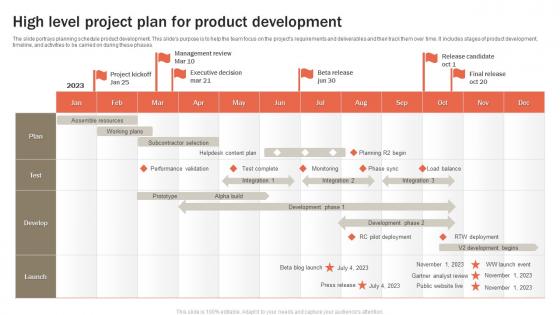
The slide portrays planning schedule product development. This slides purpose is to help the team focus on the projects requirements and deliverables and then track them over time. It includes stages of product development, timeline, and activities to be carried on during these phases.
People who downloaded this PowerPoint presentation also viewed the following :
High Level Project Plan For Product Development with all 6 slides:
Use our High Level Project Plan For Product Development to effectively help you save your valuable time. They are readymade to fit into any presentation structure.





FAQs for High Level Project Plan
Honestly, most people think it's just: idea → research → prototype → launch, but it's way messier than that. You'll bounce between market research and concept development constantly. Testing usually sends you back to tweak prototypes (sometimes multiple times - learned that the hard way). The tricky part? All these stages connect to each other, so when one shifts, everything else can get thrown off. I'd map out how each phase impacts the others early on. Otherwise you're gonna hit delays you didn't see coming. Oh, and don't skip the user testing phase even if you're behind schedule.
Honestly, market research is your best friend here - it'll save you from building something nobody actually wants. Start with surveys and user interviews to figure out what problems people really have and which features they'd pay for. You can also scope out competitors to see what they're missing (or doing better than you thought). The whole point is getting that reality check before you're in too deep. I learned this the hard way on my first project - wish I'd talked to more users upfront instead of just assuming I knew what they needed. Way easier to pivot early than watch something flop after months of work.
Customer personas are like your compass for building stuff people actually want. Before any big product decision, check your personas first. They'll help you pick which features matter most and figure out how users should move through your product. Short story - I watched a startup burn months on this "revolutionary" dashboard feature that literally no one used because they never checked if their users even wanted dashboards. Don't be that team. When you're arguing about what to build next, personas end those debates fast. They keep you focused on solving real problems instead of just building cool tech for the sake of it.
Honestly, I'd focus on three things: user impact, business value, and how hard it is to actually build. Score each feature based on how many people it helps and how much pain it solves. Then look at revenue potential and your bigger strategy stuff. Technical complexity is huge though - sometimes an easy "nice-to-have" beats a "must-have" that'll eat up six months. Skip the fancy frameworks and just use a simple scoring matrix. Get your whole team to vote quarterly, and seriously don't be afraid to axe features that aren't working out.
So there's a bunch of stuff that can help with product planning. Scrum or Kanban work great for iterative development, and design thinking keeps you focused on users. Tools like Jira, Asana, or Linear are solid for tracking progress. Honestly, the key is just picking something and not switching every few months - I've seen teams waste so much time doing that. ProductPlan's pretty good for roadmapping if you need to visualize timelines. My advice? Start with whatever your team already uses. You can always add more complex stuff later once everyone's comfortable.
Roadmaps are your "what and when" - basically showing which features you're shipping and rough timing. Development plans get into the messy details: resources, dependencies, tech specs, all that fun stuff. Here's the thing - execs love those pretty roadmap charts for presentations, but your dev team needs the actual nitty-gritty plan to build anything. I always do roadmap first to get everyone aligned on priorities (way easier to change things at this stage), then flesh out the detailed development plan once you know what you're actually committing to. Makes the whole process less painful.
Track three main things: how you're doing on timeline, budget, and quality. Timeline stuff is honestly the worst - watch your milestone completion rates and development speed, plus any scope creep. Budget's easier - just compare actual vs planned spending at each phase. For quality, measure defect rates, user acceptance results, and customer satisfaction after launch. Oh and definitely set up some simple dashboard you can review weekly with the team. Trust me, the timeline metrics will give you the most headaches, but don't slack on quality tracking either.
Honestly, the biggest thing is getting everyone on the same page from the start. Have each team lead explain what they actually do and what slows them down - sounds basic but it's huge. Regular check-ins are clutch for catching problems early (way better than scrambling at the end, obviously). You'll want some shared doc or dashboard so people aren't working blind. Oh and make sure everyone gets how their stuff affects the next person down the line. Breaking down those weird departmental walls is half the battle really.
Dude, the
-
Been using SlideTeam for some time now…can’t imagine why I wasted all that time in front of the screen trying to make the perfect presentation.
-
Use of different colors is good. It's simple and attractive.