

Minimum Viable Product MVP Cost Plan




Try Before you Buy Download Free Sample Product
 Impress Your
 Audience
 100%
100% Editable
 Save Hours
 of Time


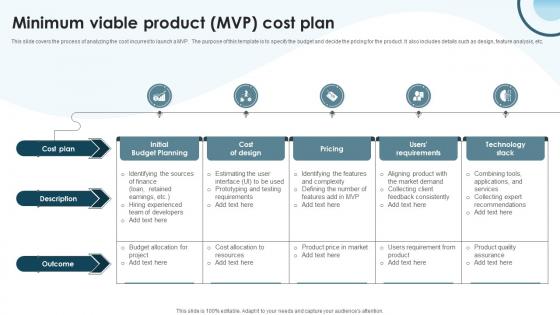
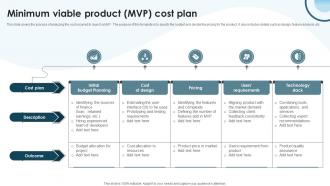
This slide covers the process of analyzing the cost incurred to launch a MVP. The purpose of this template is to specify the budget and decide the pricing for the product. It also includes details such as design, feature analysis, etc.
People who downloaded this PowerPoint presentation also viewed the following :
Minimum Viable Product MVP Cost Plan with all 6 slides:
Use our Minimum Viable Product MVP Cost Plan to effectively help you save your valuable time. They are readymade to fit into any presentation structure.





FAQs for Minimum Viable Product
Honestly, there's three big things that'll make or break your MVP budget. Development complexity is huge - like how many features you're cramming in and what tech you need. Your team setup matters too. Hiring devs vs freelancers vs agencies? Completely different price ranges. Timeline's the third killer - rush jobs always cost way more than you think. Oh, and don't forget the boring stuff like design work and testing. Those add up fast. My take? Write down your absolute must-have features first, then get quotes from different types of developers. That'll give you a reality check on what you're actually looking at money-wise.
Dude, definitely do your homework first - market research will save you so much money later. Look at what your competitors are actually building and where they're falling short. That way you're not wasting budget on random features nobody wants. Research shows you what users truly need vs. the "cool" stuff that sounds good but isn't essential. I've seen this cut development costs by like 30-40%, which is huge. You'll also figure out smart pricing from the start instead of guessing. Trust me, spending a few grand upfront on research beats throwing away tens of thousands building the wrong thing.
So for your MVP budget, break it down into dev hours (frontend, backend, testing), design work, and infrastructure like hosting plus any APIs you'll need. Project management time too - that adds up fast. Post-launch is where things get expensive though, because bug fixes and tweaks are inevitable. I learned this the hard way lol. Third-party tools and licenses can sneak up on you cost-wise. Always add at least 20% buffer because something will cost more than you think. Keep it detailed enough to catch problems early but don't go crazy with the spreadsheet updates. Adjust based on whatever tech stack you're using.
Yeah, so development approach totally affects MVP costs. Agile seems pricier upfront - you're doing these iterative sprints with feedback loops and pivots. Waterfall looks cheaper because everything's mapped out beforehand. But here's what I've seen happen: when your MVP assumptions are off (which, let's be real, happens a lot), waterfall means rebuilding huge sections. That's where costs explode. Agile catches expensive mistakes early. You can pivot without scrapping months of work. I'd budget maybe 15-20% more for agile initially, but the ROI is usually way better down the road.
User feedback is like your reality check for MVP budgeting - shows you what's actually worth the money vs what you *thought* mattered. Love when users obsess over feature A but totally ignore feature B? Time to move that budget around. Honestly, it's pretty humbling sometimes! Their input helps you figure out what to build next, what to kill, and where to throw more resources. Otherwise you're just guessing and probably burning cash on stuff nobody cares about. Oh, and definitely start collecting feedback early - I'd say review your spending monthly based on what you're hearing. Trust me on this one.
Honestly, just strip everything down to your absolute core idea and ignore the rest for now. Figure out the bare minimum features that actually prove your concept works - I know you'll want to add way more stuff, but resist that urge. Better to nail a few things than half-ass everything. Lean on existing tools instead of building custom solutions wherever you can. Your main features need to be solid, but the extras can be pretty rough around the edges. Define what "good enough" means so you don't chase perfection forever. Test constantly so you're not burning cash on the wrong priorities.
Oh man, there's so much stuff people don't think about after launch. Hosting costs go crazy when you actually get users, plus Apple literally takes 30% of everything. Security audits aren't cheap either. Your app will need tons of changes once real people start using it - mine needed like 15 bug fixes in the first month alone. Then there's all the boring legal stuff, customer support tools, the works. Honestly the maintenance time is what kills you though. I'd add at least 25% to whatever budget you're thinking.
Look, your tech choices will make or break your MVP budget. React and Django? Smart picks - tons of devs know them, development moves fast, and there's existing code everywhere. But that new trendy framework everyone's buzzing about? Total budget killer. Fewer developers, steep learning curves, everything built from scratch. I watched one startup burn through 50% extra cash because they HAD to use some bleeding-edge thing (never did figure out why). Just use boring, proven stuff for now. You can play with the cool toys later when you're not counting every dollar.
Look, outsourcing will save you like 30-70% upfront which is tempting when you're bootstrapping. But here's the thing - you lose control and those timezone delays are brutal when you're trying to ship fast. Building in-house costs way more initially (salaries, equipment, all that fun stuff), but you can pivot instantly when users inevitably hate your first version. And trust me, they will. If your MVP is pretty straightforward and budget's tight, outsourcing works fine. But honestly? If you need to iterate quickly based on feedback, just build it yourself. The flexibility is worth the extra cash.
Honestly, I'd go with 10-20% of your total budget for marketing, but I've seen people pull it off with way less if they're creative about it. Skip the expensive ads for now - content marketing and just reaching out to people directly works better anyway. You mainly want to figure out if anyone actually wants this thing and get some real feedback. Maybe start with like $2-5K if you're working with a $25-50K budget? Oh, and definitely track how much it costs to get each customer - that number will tell you everything. You can always spend more later once you know what's working.
Track your CAC and LTV first - that ratio should hit 3:1 minimum. Monthly recurring revenue is obvious but don't sleep on daily active users. Conversion from free trial to paid? That's honestly make-or-break for most SaaS stuff. Time to break-even matters too, plus when you'll recover development costs. Here's the thing though - pick maybe 3-4 metrics max. I see people get totally buried in analytics and miss the actual important stuff. Start tracking from day one so you've got something to compare against later. Oh, and user engagement tells you way more than vanity metrics ever will.
Check your MVP budget every 2-3 weeks or when you hit big milestones. I've watched too many teams crash and burn because they set it once and never looked back - seriously, don't do that. Your first estimates will definitely change once you actually start building and talking to users. Quick budget reviews during sprint retros work great. Just compare what you spent vs what you planned, spot any issues, then tweak the remaining budget. Nothing fancy needed. Oh and those technical challenges always pop up out of nowhere, so the regular check-ins really save you from nasty surprises later.
Honestly, budget at least 20-30% extra from the start - projects always cost more than you think. Get your requirements nailed down first and make stakeholders actually sign off on scope before anyone touches code. Fixed-price contracts work great with outside devs, just build in regular check-ins so you can course-correct. The hardest part? Saying no to "quick additions" halfway through. I'm terrible at this myself, but those small features add up fast. Oh, and start tracking time vs your estimates early - you'll spot where you're consistently off and actually get better at guessing timelines.
Okay so basically grab a spreadsheet and plot everything by cost vs impact. Quick wins are your best friend - high impact but cheap to build. After those, go for the expensive stuff that's actually crucial to your core product. Most people get paralyzed here and debate forever, but honestly? Just be brutal about cutting the fluff. Users don't care about your fancy bells and whistles if the main thing doesn't work well. Save all the low-impact features for later - doesn't matter if they're easy or hard to build. Check your list weekly since you'll learn tons once real people start using it.
Dude, prototype first - trust me on this one. You'll catch expensive screw-ups before they happen and validate your ideas for like hundreds instead of thousands. I've watched so many teams burn through their whole budget building stuff nobody actually wanted (painful to see honestly). Start with basic wireframes and test them with real users. Get their feedback, iterate fast, then only code once you know you're headed in the right direction. It's basically cheap experiments to figure out what's worth building. Way better than gambling your entire MVP budget on assumptions.
-
The website is jam-packed with fantastic and creative templates for a variety of business concepts. They are easy to use and customize.
-
SlideTeam offers so many variations of designs and topics. It’s unbelievable! Easy to create such stunning presentations now.