


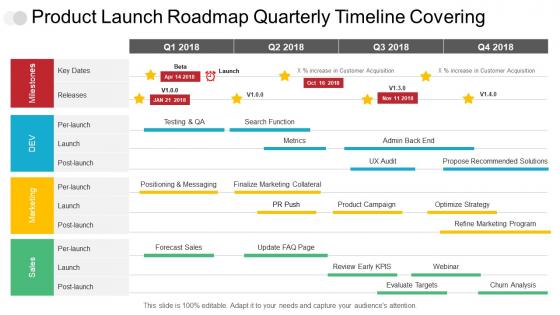
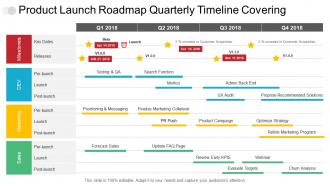
Product launch roadmap quarterly timeline covering milestone marketing and sales





Try Before you Buy Download Free Sample Product
 Impress Your
 Audience
 100%
100% Editable
 Save Hours
 of Time


Your thoughts and our Product Launch Roadmap Quarterly Timeline Covering Milestone Marketing And Sales will get along famously. They will forge a durable bond.
People who downloaded this PowerPoint presentation also viewed the following :
Product launch roadmap quarterly timeline covering milestone marketing and sales with all 5 slides:
Our Product Launch Roadmap Quarterly Timeline Covering Milestone Marketing And Sales are an effective helpline. Get immediate access to any assistance.

FAQs for Product launch roadmap quarterly timeline covering milestone
Honestly, break it into five main chunks: discovery/research, building the actual product, pre-launch prep, launch day, and analyzing what happened after. Discovery is where you figure out if people actually want this thing and nail down your MVP. Then you build it (duh), but don't rush into launch yet - you need time for marketing prep, beta testing, getting your whole go-to-market thing sorted. Launch day is when everything happens at once with your big marketing push. After that, track your numbers and see what users are actually saying. Oh, and definitely pad your timeline between each phase. Trust me, stuff always takes way longer than you think it will. Set clear goals for finishing each phase so you're not just wandering around wondering when to move on.
Market research is honestly your secret weapon for the whole launch. It helps you nail your target audience and find messaging that actually hits. You'll know exactly where your customers spend their time online too. The best part? Spotting problems before they blow up - trust me on this one. Customer pain points basically write your pricing and positioning strategy for you. Oh, and don't just collect all this data and forget about it sitting in some folder. Reference it every time you're making big decisions. Sounds obvious but you'd be surprised how many people skip this step.
Honestly, you can't do a product launch roadmap without cross-functional teams - I learned this the hard way. Engineering will catch technical stuff you'd never think of. Marketing sees timing issues. Sales knows what customers actually want (sometimes). Get input from support and operations too because they deal with the aftermath. I used to try planning solo and it was a disaster every time. Pull everyone in during the planning phase, not after you've already mapped everything out. Otherwise you'll just end up redoing half of it anyway when reality hits.
Start with your launch date and work backwards - that's the move. Map out beta testing, marketing kickoff, final QA, all that stuff. Honestly, I learned this the hard way but always add like 20-30% buffer time because something WILL break or get delayed. Break it into chunks: development, testing, pre-launch marketing, then actual launch. Get everyone involved early so you're not scrambling later. Oh and be super specific about who's doing what by when - none of that "work on stuff" nonsense on your timeline. Trust me, vague timelines are project killers.
Look, I'd zero in on four main buckets: acquisition stuff (downloads, signups, traffic), how engaged people actually are (daily/monthly users, which features they're using, session time), conversions (trial to paid rates, how many complete your funnel), and the money side (revenue, acquisition costs, churn). Here's the thing though - don't go overboard tracking every single metric you can think of. I learned this the hard way on my last launch. Pick maybe 3-5 that actually matter for what you're trying to achieve. Check them daily for the first couple weeks, then dial it back to weekly. Oh, and set up your dashboards beforehand because launch day gets hectic fast.
Look, your positioning basically drives everything else in your launch timeline. Premium product? You'll need way more time for all that sales training and analyst stuff. But if you're going budget-friendly, you can move much faster with simpler messaging. The tricky part is figuring out who you're targeting first - early adopters vs mainstream totally changes your game plan. Honestly, I've seen too many teams try to pivot positioning halfway through and it's just chaos. Map out your key positioning points first, then work backwards to set your dates. Trust me on this one - getting positioning locked down early saves you so much headache later.
For your launch deck, I'd go with Canva or Figma - both are solid for visuals. Pitch and Beautiful.ai work well too if you want help with flow. But honestly? Don't get sucked into spending hours on fancy transitions (I've totally been there). Get your messaging right first using something like problem-solution-benefits. Andy Raskin's narrative framework is clutch for this stuff. Grab some product screenshots, maybe film a quick demo. Google Sheets works fine for basic charts - you don't need Tableau unless you're going crazy with data. Story first, then make it look good.
Honestly, just build feedback checkpoints right into your timeline from the start. Get people testing your alpha, beta, whatever - but here's the thing, you actually have to DO something with what they tell you. I've seen so many teams collect feedback then completely ignore it. Set up regular team meetings to go through everything and figure out what's worth fixing. Oh, and this is huge - leave yourself some wiggle room in your schedule so you can make changes without everything falling apart. Survey people, do interviews, test prototypes early. The earlier the better.
Honestly, spot your biggest risks super early and pad your timeline like crazy. I'd break them down by how likely they are vs how much they'd screw you over. Then actually make plans for the scary probable ones - we got totally burned by a supply chain mess we literally saw coming but just... didn't prep for. Ugh. Weekly check-ins on your risk list are clutch since everything shifts constantly during launch mode. Also have backups for anything critical - integrations, key people, whatever. Start with your top 5 risks right now and figure out what you'd actually do if they hit.
Wait like 2-4 weeks after launch, then do your review. Fresh data but not so fresh you're still panicking about bugs lol. Sales people will roast you the hardest but they're usually right about what's broken. Compare your original goals to what actually happened - it's never pretty but super useful. Don't go crazy trying to fix everything though. Pick maybe 2-3 things that'll make the biggest difference and focus there first. You'll burn out if you tackle the whole list at once.
Hey! So for launch, nail down your messaging first - that's huge. Build some buzz beforehand with teasers or early access stuff. PR can get you tons of free coverage if you do it right. Don't sleep on your email list either, those people already know you so they'll convert way easier. Get testimonials ASAP once you have customers - social proof is everything. Honestly though? Most people try to be everywhere at once and it backfires. Pick like 2-3 things you can actually do well instead of half-assing ten different tactics. Quality over quantity always wins.
Dude, storytelling is a game-changer for product launches. Instead of boring people with feature lists, you're hitting them emotionally. Start with the customer's problem, walk through how you discovered it, then boom - your product saves the day. Our brains literally remember stories 10x better than bullet points (weird but true). Real customer struggles work way better than "Today I'll present..." - that opening makes me want to check my phone immediately. Build some tension, show the resolution. I know it sounds cheesy, but people need to *feel* something about your product, not just understand it.
Oh man, biggest mistake is definitely rushing out there without testing anything first. Trust me on this one - I've watched teams crash and burn because they skipped user feedback. Your messaging needs to be crystal clear too, otherwise people won't even get what you're selling. Also? Make sure your whole team actually knows what's happening. When sales, marketing, and support are all saying different things, it's a mess. Don't forget to plan for changes after launch either. Honestly, just build in way more testing time than you think you need.
Dude, competitive analysis is everything for your launch strategy. It shows you what messaging will actually set you apart and what pricing won't tank you. You'll find gaps competitors totally missed - or realize you're about to launch into a bloodbath market. Timing becomes way clearer too. Should you rush to beat them or hang back and learn from their screwups? I've watched so many teams skip this and then scramble later when they realize they're the fifth app doing the exact same thing. Just pick your top 5 direct competitors and dig deep into their recent launches.
Look, digital marketing is pretty much everything for a product launch now. Pre-launch you're doing teaser stuff and collecting emails. Then at launch it's all about social media campaigns and content. After that you're retargeting people who didn't convert the first time. Without it you're basically screwed - like nobody will even know your product exists. Map out which channels your audience actually hangs out on first though. Don't just blast everywhere and hope something sticks. Each phase of your launch needs different digital tactics, but honestly the whole thing falls apart if you skip this part.
-
Awesome
-
Use of different colors is good. It's simple and attractive.
-
Easily Editable.