


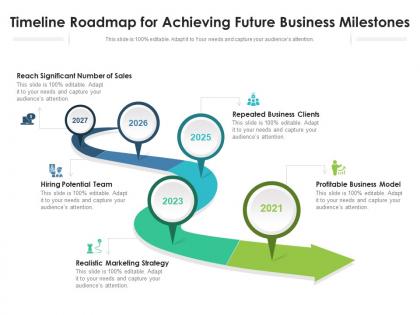
Timeline roadmap for achieving future business milestones




Try Before you Buy Download Free Sample Product
 Impress Your
 Audience
 100%
100% Editable
 Save Hours
 of Time


Our Timeline Roadmap For Achieving Future Business Milestones are topically designed to provide an attractive backdrop to any subject. Use them to look like a presentation pro.
People who downloaded this PowerPoint presentation also viewed the following :
Timeline roadmap for achieving future business milestones with all 2 slides:
Use our Timeline Roadmap For Achieving Future Business Milestones to effectively help you save your valuable time. They are readymade to fit into any presentation structure.

FAQs for Timeline roadmap for achieving
Honestly, focus on proving people want your thing and will actually pay for it - that's the whole game. Try to validate product-market fit in your first 3-4 months, then get paying customers by month 6. By month 9, you want some recurring revenue happening. Keep your team tiny at first, maybe 2-5 people max. The legal stuff is boring but do it early so you don't hate yourself later. I know everyone talks about growth hacking and all that, but revenue milestones matter way more than anything else in year one.
Honestly, just pick something visual that you'll actually use - Gantt charts in Asana work great, or even a basic shared spreadsheet if you're not fancy. The trick is updating it regularly because I've watched so many gorgeous tracking systems die after two months lol. Do monthly check-ins where you compare what actually happened versus what you planned. Super helpful for catching patterns early. Short sentences work too. Make sure your whole team can see and understand whatever system you choose, otherwise you're basically tracking milestones for an audience of one.
Look, milestones are basically proof you're not just another dreamer with a deck. Investors want to see you actually hit your targets - whether that's user numbers, revenue goals, whatever. It builds trust because they know you can execute. Past wins matter huge here. Show them your track record. But honestly? Future milestones might be even more important - gives them something concrete to evaluate instead of vague promises about being "disruptive." Most founders just throw around buzzwords, so real data makes you stand out. Just don't oversell what you can't deliver.
Honestly, I've learned to plan milestones more like guidelines than hard deadlines. Do quarterly check-ins instead of setting everything in stone for the whole year. Markets shift constantly - maybe your launch gets delayed because customers suddenly want different features, or you're scrambling to hire faster than expected because demand exploded. I treat milestones like GPS directions... you know how it recalculates when you take a wrong turn? Same concept. Regular team check-ins help you spot when reality doesn't match your original plan. Then you just adjust the timeline to fit what's actually happening instead of forcing some arbitrary deadline.
For milestone timelines, I'd probably go with Gantt chart tools first - Asana, Monday.com, or Smartsheet are all pretty solid. Trello and Notion work great too if you like that visual board vibe better. Honestly though? I've seen teams do amazing work with just Google Sheets or PowerPoint. Sometimes you don't need all the bells and whistles, you know? Start with whatever your team's already comfortable using. You can always level up later if you need fancy stuff like dependencies or auto-reports. No point learning a whole new system if your current setup works fine.
So tech companies usually chase stuff like beta launches, hitting 10K users, or closing Series A funding. Retail's totally different though - they're tracking first store openings, seasonal sales numbers, inventory turnover. Tech moves crazy fast since everything's digital validation. Retail takes forever because, well, physical world problems take time. E-commerce is kinda blurring these lines now but whatever. Your milestones really depend on how much capital you need and how your customers actually behave. Honestly? Just look at 3-5 companies doing well in your exact space and copy their milestone roadmap instead of some generic template.
Honestly, SMART criteria are a game-changer for turning fuzzy goals into something you can actually track. Your team won't be guessing what "good performance" means anymore. Break down each milestone so it's Specific, Measurable, Achievable, Relevant, and Time-bound – sounds corporate-y but it works. You'll know if you're crushing it or need to pivot way before things go sideways. I'd grab your current milestones and test them against each letter. Bet you'll find most are too vague or missing deadlines. Way better than shooting in the dark though.
Honestly, having clear milestones is a game-changer for teams. Everyone knows what they're working toward and when stuff needs to get done. You'll see people actually get excited when they hit those targets - it's like checking boxes but way more satisfying. Plus you can catch problems early instead of everything blowing up at the end (been there, not fun). When teams can see their progress mapped out instead of just wandering around aimlessly? Total different energy. Try breaking your next quarter into 3-4 solid milestones. The change in team vibe will surprise you.
Honestly, the worst thing you can do is set crazy unrealistic deadlines - your team will hate you and nobody will trust the timeline anymore. Also don't be super vague with milestones. Like "launch marketing campaign" tells me nothing, but "finish email sequences and schedule social posts" actually means something. Buffer time is everything because stuff always breaks (learned this the hard way). Get your team involved when you're setting dates instead of just telling them what's happening. I'd start with maybe 3-5 big milestones, then chop those up into smaller tasks with actual deadlines that make sense.
Mix public shoutouts with personal stuff that actually hits different. Company announcements and bonuses are solid for big wins. But honestly? A handwritten note from your boss or surprise PTO day will stick with people way longer than some cheesy plaque. Just don't wait forever to celebrate - do it right after they crush the goal. Oh, and plan this stuff ahead of time so you're not panic-googling "team celebration ideas" at 9pm. Authenticity beats fancy every time. People can smell fake appreciation from a mile away.
Oh yeah, customer feedback will totally mess with your timeline - but that's actually good! Like, if people are telling you the MVP sucks or they want completely different features, you gotta pivot. I thought I'd launch in Q2 once, but feedback made me realize I needed three more months of tweaking. Sometimes you'll add whole new phases too - extra testing rounds, feature changes, whatever. The trick is padding your original timeline with buffer weeks (learned this the hard way). That way when customers give you those "oh shit" insights, you're adjusting instead of completely scrambling.
Okay so this is huge - you've gotta map out all your legal stuff first or you're screwed. Business registration, permits, licenses, tax deadlines... miss any of these and they'll literally shut you down. My friend's restaurant? Three weeks behind schedule because of permit delays (government moves like molasses, I swear). Start researching what your industry needs way early. Then work backwards from your launch date and add extra time. Trust me, everything takes longer than you think it will.
Honestly, just pick 2-3 metrics that actually matter to your business goals. More than that and you'll drown in data - trust me on this one. Look for stuff that predicts future success, like how many customers you're getting each month or your conversion rates. Don't just track backward-looking things like total revenue. Your team needs to understand what moves these numbers too, otherwise what's the point? Set up something simple to track them - doesn't have to be fancy. Then actually review the damn thing monthly so you can course-correct when needed.
Honestly, it's all about speed and how much risk you can handle. Startups move crazy fast - like 3-6 month sprints where you're launching MVPs and chasing funding rounds. Break things, pivot, whatever. Established companies? They take forever. We're talking 12-18 months because they've got way more on the line and can't just blow up their existing stuff. Sometimes I think they overdo the market research thing, but I get it. Just match your timeline to your situation. Startup life means quarterly chaos. Bigger company means you actually validate before jumping in.
Look, things move crazy fast in business - market shifts, priorities change, unexpected stuff pops up. I made this mistake once where I clung to some outdated timeline for months (dumb move). Your milestones need regular check-ins or you'll end up chasing goals that don't even matter anymore. Quarterly reviews work well, but honestly? Anytime something big changes in your space, revisit everything. Don't treat your timeline like it's carved in stone - it's more like a GPS that needs to recalculate when you hit traffic.
-
Very unique and reliable designs.
-
The Designed Graphic are very professional and classic.
-
Appreciate the research and its presentable format.
-
Enough space for editing and adding your own content.
-
Illustrative design with editable content. Exceptional value for money. Highly pleased with the product.
-
Helpful product design for delivering presentation.
-
Very unique and reliable designs.
-
Perfect template with attractive color combination.
-
Innovative and attractive designs.