

Quarterly product roadmap with multiple project activities




Try Before you Buy Download Free Sample Product
 Impress Your
 Audience
 100%
100% Editable
 Save Hours
 of Time


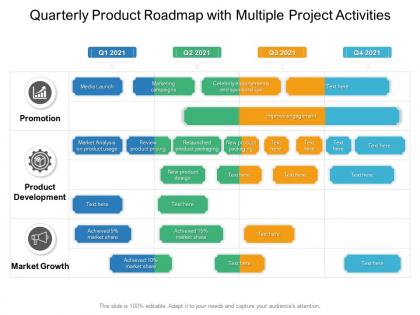
Utilize our pre build Quarterly Product Roadmap With Multiple Project Activities to present your plan of action in the most effective way. Reduce the paperwork and showcase how different activities are linked to each other by incorporating this attention grabbing PowerPoint theme. This completely editable roadmap PPT layout is suitable to fit all your needs and to have a structured outline of the entire process flow using color coding. Provide guidelines to your teammates about the progression process by employing our PPT theme. Team members can easily be designated into teams by accessing the work milestones to be accomplished within the timeframe. You can easily modify the PowerPoint slide according to real time situations. Download our stunning Quarterly Product Roadmap With Multiple Project Activities, and you are good to go to prove your expertise in strategic planning.
People who downloaded this PowerPoint presentation also viewed the following :
Quarterly product roadmap with multiple project activities with all 2 slides:
Use our Quarterly Product Roadmap With Multiple Project Activities to effectively help you save your valuable time. They are readymade to fit into any presentation structure.

FAQs for Quarterly product roadmap with
Honestly, just pick three things this quarter: fix the annoying UX stuff that's been piling up, stabilize whatever keeps breaking, and choose ONE growth project. Don't do more than one big initiative - I learned that the hard way lol. Those little user complaints add up fast and suddenly everyone's frustrated. Nothing kills your momentum like features that don't work properly. Scope creep will destroy you, so be brutal about saying no. Look back at last quarter first though - what actually worked vs what just ate up time?
So we score features on three things: customer impact, business value, and dev effort. Scale of 1-10 for each, then multiply them together for rankings. Honestly, it's saved us from building random "wouldn't it be cool if..." features that nobody actually needs. Your PM should have a roadmap doc with this quarter's scored stuff. The tricky part? You gotta define what "impact" means first - revenue bump, engagement, strategic whatever. Get aligned on that definition or your scores will be all over the place. Not perfect but it works.
Honestly, you need three types of metrics to not completely mess this up. Track delivery stuff first - did you actually ship what you said you would? Feature completion rates, hitting milestones, that kind of thing. Then measure real impact: user engagement, conversions, whatever actually matters for your business (not just vanity numbers that look pretty in slides). Team velocity is the third one - helps you figure out if you're being realistic about what's possible. Oh, and don't wait until the quarter's over to check these. Monthly reviews will save your ass when things start going sideways.
Build feedback into your roadmap planning from the start. I block off the first two weeks each quarter for customer interviews, surveys, and competitive research - sounds boring but it's actually pretty interesting once you dig in. Create a scoring system that weighs customer pain against market opportunities. Then map those to what your team can actually handle. Document why you made each decision so you can see later if you were right (spoiler: you won't always be). Cross-reference everything with market data. The whole process becomes way smoother once it's routine.
Honestly, cross-department collab is what keeps your roadmap from being total garbage. Sales knows what customers actually want (not what we think they want). Support deals with angry users daily - they've got the real pain points. Marketing needs lead time for launches, and Engineering will tell you if your timeline is completely delusional. Finance jumps in for budget stuff too, which is always a blast. The trick is getting everyone together early in the quarter. Wait too long and you'll miss crucial insights. Your roadmap ends up being wishful thinking instead of something that actually makes business sense. Schedule those planning sessions ASAP.
Honestly, I'd do quick checks weekly during sprint planning, then deeper dives every 2-4 weeks depending on how crazy things get. The weekly stuff catches small issues before they blow up. But those deeper reviews? That's where you actually reassess if your priorities still make sense. I've watched teams wait too long and suddenly they're in Q2 realizing their entire Q1 plan was garbage. Pretty painful to watch, honestly. You don't want to flip-flop constantly and confuse everyone, but you can't just ignore reality either. Start with bi-weekly deep reviews - you'll figure out your rhythm from there.
For quarterly roadmaps, I'd check out **Productboard** or **Roadmunk** first - they're built specifically for this stuff and look professional when you're presenting to executives. **Miro** and **Figma** are solid too if you want more creative control, plus your design team probably already has these. Honestly though, **Notion** databases work fine for simpler setups. **Airtable** has a decent timeline view too. My advice? Start with whatever tool your team's already comfortable with. You can always upgrade later if you need something fancier for stakeholder meetings. The best roadmap tool is the one people will actually keep updated - I've seen too many beautiful roadmaps that were months out of date.
Honestly, just nail three basics: make it visual, update regularly, and talk to people in their language. Build a simple timeline that shows what depends on what - everyone loves seeing the whole picture laid out. Quarterly check-ins are way better than random meetings because people can actually plan for them. Here's the thing though - you gotta switch up your pitch. Executives care about business impact, engineers want the technical stuff, sales teams want customer features. Oh, and always throw in a "things that might change" section so you're not defending outdated plans later. Set those meetings up now and actually stick to them.
So our roadmap's actually hitting those Q3 priorities pretty well. We're throwing 60% of sprint capacity at the features sales won't stop bugging us about, plus those security upgrades for enterprise renewals. The rest goes toward technical debt that's been killing our deployment speed - honestly, it's about time we tackled that mess. Your dashboard work? That's one of our biggest shots at the 15% engagement bump we need. Check out that goal alignment doc from last week if you haven't already. It'll help you see how your stuff connects to the bigger wins we're chasing.
Honestly, I'd group your risks first - tech stuff, resource problems, market changes, whatever. Add way more buffer time than you think you need because literally everyone sucks at estimating. Have backup plans for the must-have features and know exactly when you'll cut scope or pivot. Keep a running list of "nice-to-have" stuff you can swap in when things get blocked (and they will). Check in with stakeholders constantly since priorities change overnight. The main thing is being super honest about trade-offs when you're talking timelines with the higher-ups.
Honestly, personas are a game-changer for cutting through feature bloat. Map every potential feature back to your top 3 personas' actual pain points - not just what sounds flashy. Those "wouldn't it be cool if we added..." meetings? Yeah, personas shut that down real quick. Focus on what moves the needle for their daily workflows. I've seen teams get so caught up in shiny features that they forget users just want their basic problems solved. Which features actually make your personas' lives easier? Start there. You'll ship stuff people genuinely need instead of just ticking boxes on some random wishlist.
Look, competitor roadmaps are basically a goldmine for figuring out their next moves and what they think customers actually want. You can spot gaps in their features and see what market trends they're betting big on. But here's the thing - don't just copy what they're doing because you'll always be playing catch-up that way. Use their plans to test whether your own assumptions make sense. Like, if everyone's suddenly pushing AI features next quarter, there's probably real demand brewing. Take what you learn but build something that plays to your strengths instead.
Honestly, I'd say aim for like 20-30% of your quarterly stuff to be experimental. Block out time during sprint planning or it'll just get crushed by whatever fire needs putting out that week. We do these "tech radar" sessions where everyone brings cool things they've seen - helps separate actual useful tech from the latest JavaScript framework du jour (there's always another one, right?). Don't get me wrong, staying current matters. But pick things that actually solve problems for your users and make sure you can measure if they're working.
Honestly, our biggest mess-ups have been saying yes to everything and then acting shocked when we're drowning. Buffer time is your best friend - like 20-30% extra each quarter. Dependencies between teams will absolutely wreck you if you don't map them out first. Trust me, engineering never lets us forget when we miss this stuff! Start every quarter by hunting down cross-team blockers. Weekly check-ins help catch problems before they explode. Oh, and mid-quarter reviews are clutch for cutting scope when things go sideways.
Honestly, I'd go with something like a 70-30 split. Most of your roadmap should be quick wins and incremental stuff that keeps users happy and money coming in. But save about 30% for the bigger strategic moves - the ones that actually move you toward where you want to be in a few years. Quick wins are great because they make everyone feel good about shipping regularly (stakeholders love that), but if you ignore the long-term bets you'll be scrambling to catch up later. Each quarter I try mapping things back to both immediate goals and my bigger north star. Works pretty well, though sometimes the percentages get a bit wonky depending on what's happening.
No Reviews