


Project charter manager project management professional toolkit ppt introduction




Try Before you Buy Download Free Sample Product
 Impress Your
 Audience
 100%
100% Editable
 Save Hours
 of Time


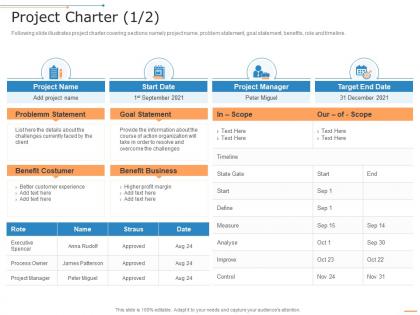
Following slide illustrates project charter covering sections namely project name, problem statement, goal statement, benefits, role and timeline.
People who downloaded this PowerPoint presentation also viewed the following :
Project charter manager project management professional toolkit ppt introduction with all 2 slides:
Use our Project Charter Manager Project Management Professional Toolkit Ppt Introduction to effectively help you save your valuable time. They are readymade to fit into any presentation structure.

FAQs for Project charter manager project management professional
Your project charter needs the basics: purpose, scope, stakeholders, timeline, budget, and success metrics. Don't skip the risks section - I know it feels negative but trust me on this one. Make sure you nail down who's actually making decisions upfront. Scope is huge - be super clear about what's NOT included or you'll get endless feature creep. Major milestones matter too. Honestly, think of it like a contract everyone can point to when things inevitably get messy later.
Dude, project charters are lifesavers. They make everyone agree on what you're actually building before you start - like the purpose, scope, all that stuff. No more "wait, I thought we were doing Y instead of X" drama halfway through. Honestly, half the battle is just getting people to read the thing and sign off on it upfront. But once you do? It's your golden ticket. Someone starts asking for random additions or questioning why you prioritized something? Just point to the charter. Saves so much headache later - trust me on this one.
Honestly, the worst mistake is being vague about what you're actually trying to do - everyone ends up with totally different expectations and it's a nightmare. Also don't skip over stakeholder mapping because you'll inevitably forget someone important. Timelines are tricky too... I get wanting to promise the moon to get approval, but you'll hate yourself later. Make your success metrics actually measurable instead of some wishy-washy "improve user satisfaction" nonsense. Oh and definitely spell out what's NOT included in scope - people assume everything's fair game otherwise. Get a couple people to look it over before you send it off.
Okay so think of a project charter as your team's shared reality check. When meetings start going sideways because everyone has different ideas about what you're building, that's where it saves you. Defines roles, what you're delivering, how you'll know if you succeeded - all that stuff upfront. Super helpful when someone new joins halfway through or when stakeholders get amnesia about the whole point. Honestly though, it only works if you actually use it in meetings and keep it somewhere people can see. Those documents that disappear into shared drives are basically useless.
Honestly, a solid project charter is like your insurance policy against chaos. You're defining scope and objectives upfront, which makes risks way easier to spot before they bite you. Stakeholders know what to expect, so you won't get blindsided by random requests later. The charter also captures your assumptions and success metrics - super helpful when things get messy and you need to remember what you originally agreed on. I can't tell you how many projects I've watched crash because teams thought they could wing it without one. When risks do pop up (and they will), your charter becomes the thing you point to when making hard calls about what's actually in scope.
Okay so the project charter is basically your foundation for everything scope-related. It captures the big picture stuff - why you're doing this project, what you're delivering, major constraints. Without it, you're just guessing what stakeholders actually want (and trust me, they'll all have different ideas). Get everyone to agree on the charter first before you dive into detailed planning. Yeah it might feel like extra work upfront, but it's your lifeline when people start asking for random additions later. You can literally point back to it and say "nope, that wasn't in scope." Pretty much saves your sanity down the road.
Start with real data, not dreams. I've watched so many projects blow up because people estimate everything perfectly with zero wiggle room - it's painful. Talk to whoever's actually doing the work before you finalize anything. Check what similar projects cost and took timeline-wise. Be honest about your team's bandwidth too, because overcommitting is worse than underpromising. Don't forget dependencies will mess you up if you're not careful. Build in buffer time and actually mean it when you do the math on constraints.
Start with workshops where everyone can brainstorm together - those are gold for getting initial ideas flowing. Then do one-on-one stakeholder interviews because people always reveal the weirdest requirements when you talk to them privately. Seriously, you'll be amazed what comes up. Try affinity mapping to organize all the ideas into themes. For bigger groups, surveys work better than trying to wrangle everyone into meetings. Draft reviews are crucial too - let people comment on versions as you go. The whole point is making sure nobody feels left out of the process, so plan multiple check-ins throughout.
So the charter is like your "why we're doing this" doc - gets you approval and alignment from the big shots. Project plan? That's where you actually figure out how to do the work. Charter comes first and honestly, it's kinda boring but you need it as your official green light. Don't skip this step or you'll regret it later. The plan is where things get interesting - all your tasks, timelines, who's doing what, dependencies, the whole mess. Just get that charter locked down before you waste time planning out every little detail.
Get your sponsor involved first, then pull in key team members and anyone who'll be affected. Honestly, I'd skip the email route and do an actual meeting - people zone out when it's just another doc in their inbox. Focus hard on scope, objectives, and how you'll measure success. Those three things will bite you later if they're fuzzy now. Don't rush getting everyone to sign off either. Yeah, it takes longer upfront, but trust me - it's way better than dealing with "oh wait, I thought we were doing X" halfway through. Once it's approved, send it everywhere so nobody can claim they didn't know.
So for agile project charters, think lean and flexible. You don't want all that rigid scope stuff traditional projects love - honestly, that kills the whole agile vibe. Start with your core vision and high-level goals, then add key stakeholders and success criteria. Skip the detailed timelines though. The charter should be more like a north star guiding your sprints, not some strict contract nobody can change. Leave room for discovery - that's literally the point of agile. You'll update it as you learn what users actually want. Keep it simple so it stays useful.
Honestly, just find a good template instead of building one from nothing - way easier. Check if your PMO already has standard ones floating around. If not, PMI's website has some you can grab. I'm a fan of simple one-page formats that hit the basics: objectives, scope, who's involved, success metrics, rough timeline. For tools, Google Docs works great, or even PowerPoint if people need to collaborate. Don't get hung up on fancy software though. The content matters way more - keep it clear so everyone actually gets it. Oh, and definitely start with whatever your company uses first, then tweak it.
Check your project charter every 2-4 weeks, or whenever something big shifts - scope changes, timeline moves, stakeholders start asking different questions. Honestly, most teams just write it once and never look back, which is why projects go sideways. I'd review it during sprint meetings or when you're thinking "wait, are we even solving the right problem anymore?" It's your project's compass, so don't let it collect dust. Oh, and put these reviews on your calendar from day one - you'll definitely forget otherwise. Short sprints might need weekly check-ins.
Honestly? Check if people actually use the thing. When big decisions come up, do stakeholders pull out your charter for guidance? That's the real test right there. Also watch for scope creep - a solid charter should keep that in check. Your team members need to get the project's purpose too, not just nod along in meetings. I've watched so many charters just sit there doing nothing! The best ones help settle arguments fast because everyone knows what you're trying to accomplish. If nobody's treating it like their roadmap, then something's off and you'll need to fix it.
Your project charter is basically your sanity-saver when juggling multiple projects. It sets clear boundaries for scope, objectives, and resources so your projects don't start stealing from each other. Stakeholders can actually understand what's happening at a glance - execs especially eat this stuff up. When priorities inevitably get shuffled around (because they always do), you've got a solid foundation for deciding what gets paused or scrapped entirely. Oh, and keep them somewhere people can find them easily. Sounds obvious but you'd be surprised how often they disappear into some random folder.
-
Innovative and attractive designs.
-
Awesome use of colors and designs in product templates.
-
Easily Editable.
-
Very well designed and informative templates.
-
Graphics are very appealing to eyes.