


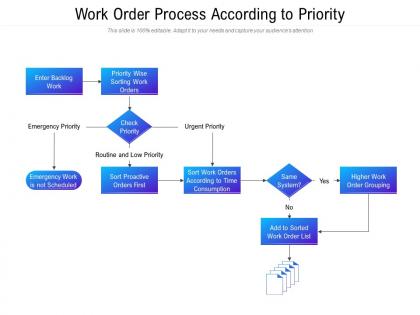
Work order process according to priority




Try Before you Buy Download Free Sample Product
 Impress Your
 Audience
 100%
100% Editable
 Save Hours
 of Time


Our Work Order Process According To Priority are topically designed to provide an attractive backdrop to any subject. Use them to look like a presentation pro.
People who downloaded this PowerPoint presentation also viewed the following :
Work order process according to priority with all 2 slides:
Use our Work Order Process According To Priority to effectively help you save your valuable time. They are readymade to fit into any presentation structure.

FAQs for Work order process
Work order prioritization should consider urgency levels, resource availability, project dependencies, budget constraints, and strategic business impact. These factors enable project managers to streamline workflows by balancing critical deadlines, optimizing team allocation, and maintaining quality standards, with many organizations finding that systematic prioritization delivers improved efficiency and competitive advantage.
Effective communication influences work order prioritization by establishing clear criteria, sharing real-time updates, and ensuring transparent decision-making processes across teams. Through collaborative platforms and regular briefings, organizations streamline resource allocation, minimize conflicts over competing priorities, and enhance operational efficiency, with many manufacturing and facilities management teams finding that structured communication protocols ultimately deliver faster response times and improved service quality.
Resource availability serves as a critical constraint in work order prioritization, determining which tasks can realistically be completed based on workforce capacity, equipment access, spare parts inventory, and budget allocations. Organizations typically prioritize high-impact work orders that align with available resources, while deferring complex maintenance requiring specialized skills or unavailable materials, ultimately optimizing operational efficiency and preventing costly delays.
Customer needs and deadlines significantly reshape work order prioritization by introducing urgency matrices, service level agreements, and customer tier classifications that override standard scheduling protocols. Organizations increasingly balance operational efficiency with customer satisfaction, using automated systems to weigh contract obligations, revenue impact, and relationship value, ultimately delivering faster response times while maintaining strategic customer partnerships.
Techniques for assessing work order urgency include risk-based scoring matrices, asset criticality rankings, safety impact evaluations, operational downtime costs, and customer service level requirements. These prioritization methods streamline resource allocation by categorizing requests through automated scoring systems, real-time monitoring data, and business impact analysis, ultimately enabling organizations to minimize operational disruptions while maximizing efficiency.
Organizations balance short-term tasks with long-term goals by implementing strategic frameworks that categorize work orders by urgency, impact, and alignment with business objectives, while allocating dedicated resources for both immediate needs and future initiatives. Through portfolio management approaches, companies in manufacturing and healthcare streamline operations by maintaining separate tracks for critical maintenance and strategic projects, ultimately delivering operational stability and sustained growth.
Key metrics include task completion rates, average cycle times, resource utilization percentages, deadline adherence rates, and workflow bottleneck frequency. These measurements enable organizations to assess prioritization effectiveness by tracking reduced project delays, improved resource allocation, and enhanced operational efficiency, with many manufacturing and service companies finding that systematic metric analysis delivers measurable productivity gains and competitive advantage.
Technology and software tools aid work order prioritization through automated scheduling algorithms, real-time asset monitoring, predictive maintenance analytics, mobile workforce management platforms, and integrated inventory tracking systems. These solutions streamline operations by analyzing equipment criticality, resource availability, and maintenance histories, with many manufacturing and facilities management organizations finding faster response times and significantly reduced operational downtime.
Common pitfalls include neglecting equipment criticality assessments, failing to consider interdependencies between tasks, overlooking resource availability constraints, and prioritizing based solely on urgency rather than impact. These missteps often result in reactive maintenance cycles, increased downtime costs, and suboptimal resource allocation, with many organizations finding that balanced prioritization frameworks ultimately deliver improved operational efficiency and strategic maintenance outcomes.
Team collaboration enhances work order prioritization by combining diverse expertise, improving resource visibility, and enabling real-time communication across departments. Through collaborative platforms and cross-functional input, teams can better assess urgency, allocate skilled personnel efficiently, and coordinate schedules seamlessly, ultimately delivering faster resolution times and improved operational efficiency.
Continuous improvement strategies include regular performance metrics analysis, feedback loop integration, priority criteria refinement, staff training programs, and technology system updates. Through data-driven assessments and cross-departmental collaboration, organizations streamline maintenance workflows, reduce equipment downtime, and enhance resource allocation efficiency, with many manufacturing and facility management teams finding that systematic review processes ultimately deliver measurable operational improvements and cost reductions.
Historical data informs work order prioritization by revealing patterns in equipment failures, seasonal maintenance demands, and resource allocation effectiveness. Through predictive analytics, maintenance teams can identify high-risk assets, optimize scheduling workflows, and allocate resources proactively, with many manufacturing facilities finding that data-driven prioritization reduces downtime costs while improving overall operational efficiency.
Categorizing work orders into priority levels enables organizations to allocate resources strategically, minimize downtime, and enhance operational efficiency by addressing critical issues first. This classification should consider safety risks, equipment criticality, production impact, and regulatory compliance, with many manufacturing and healthcare facilities finding that structured prioritization reduces emergency repairs by 30-40% while improving overall asset reliability.
Work order priorities require re-evaluation when emergency breakdowns occur, regulatory compliance deadlines shift, resource availability changes significantly, or customer demands escalate unexpectedly. These scenarios are common in manufacturing facilities, hospitals, and retail operations, where dynamic conditions demand flexible prioritization systems that streamline operations, minimize downtime, and ultimately deliver enhanced service reliability while maintaining competitive advantage.
Organizational structures significantly influence work order prioritization through decision-making hierarchies, resource allocation methods, and communication flows. Centralized organizations typically prioritize through management tiers, while decentralized structures enable department-level decisions, with matrix organizations balancing both approaches to streamline operational efficiency and enhance response times across diverse business units.
No Reviews