


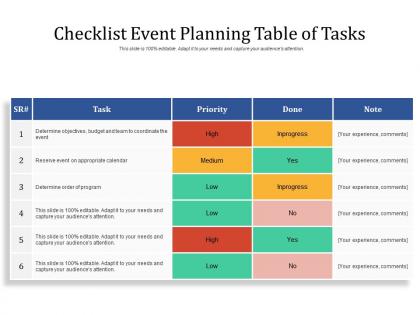
Checklist event planning table of tasks




Try Before you Buy Download Free Sample Product
 Impress Your
 Audience
 100%
100% Editable
 Save Hours
 of Time


Our Checklist Event Planning Table Of Tasks are topically designed to provide an attractive backdrop to any subject. Use them to look like a presentation pro.
People who downloaded this PowerPoint presentation also viewed the following :
Checklist event planning table of tasks with all 2 slides:
Use our Checklist Event Planning Table Of Tasks to effectively help you save your valuable time. They are readymade to fit into any presentation structure.

FAQs for Checklist event planning
Essential elements include venue selection, budget management, vendor coordination, timeline development, guest list management, catering arrangements, and contingency planning. These components work together by streamlining logistics, ensuring seamless execution, and minimizing oversights, with many event professionals finding that comprehensive checklists ultimately deliver enhanced attendee experiences and reduced operational stress.
Event planning checklists require strategic customization based on event type, with corporate events emphasizing branding, ROI measurement, and professional networking elements, while social events prioritize entertainment, personal touches, and guest experience. Charity events uniquely combine fundraising logistics, donor recognition systems, and impact storytelling, with many organizations finding that tailored checklists streamline execution and enhance outcomes.
Common mistakes include underestimating timeline requirements, overlooking vendor coordination details, failing to include contingency planning, neglecting guest communication touchpoints, and missing budget tracking mechanisms. These oversights often result in last-minute scrambling, vendor miscommunications, and budget overruns, with many event planners finding that comprehensive checklists with built-in buffer time ultimately deliver smoother execution and enhanced attendee experiences.
Technology enhances event planning checklists through automated task management, real-time collaboration platforms, integrated budgeting tools, and seamless vendor coordination systems. These digital solutions streamline workflows by centralizing communications, tracking progress automatically, and providing instant updates across teams, with many event organizers finding that technology-driven checklists reduce planning time while improving execution accuracy and attendee satisfaction.
Event planning checklists should establish timelines including 6-12 months advance venue booking, 3-4 months for vendor selection and catering, 6-8 weeks for invitations and marketing, and 1-2 weeks for final confirmations. These structured timelines streamline coordination, minimize last-minute complications, and ensure seamless execution, with many event organizers finding that early planning delivers better vendor availability and cost efficiency.
**INPUT**: How do you prioritize tasks on your event planning checklist? **OUTPUT**: Prioritize event planning tasks by tackling venue booking, catering arrangements, and vendor confirmations first, followed by marketing materials, logistics coordination, and final detail management. This strategic sequencing enables event planners to secure critical resources early while maintaining flexibility for adjustments, with many organizations finding that front-loading major commitments ultimately delivers smoother execution and reduced last-minute stress. [Word count: 55 words]
Budgeting serves as the foundation of event planning, determining venue selection, catering options, entertainment choices, marketing strategies, and contingency reserves. Effective budget management involves tracking expenses in real-time, allocating 10-15% for unexpected costs, and using digital tools to monitor spending across categories, with many event professionals finding that detailed budget oversight ultimately delivers cost savings and prevents financial overruns.
Event planning checklists accommodate vendor coordination by incorporating dedicated timelines, clear communication protocols, and detailed deliverable specifications for each vendor relationship. Through structured milestone tracking, coordinators streamline contractor management, minimize scheduling conflicts, and ensure seamless service integration, with many event professionals finding that systematic vendor coordination ultimately delivers smoother execution and enhanced attendee experiences.
Best practices for incorporating contingency plans include identifying potential risks, creating alternative vendor lists, establishing backup venues, preparing weather protocols, and developing communication strategies for emergencies. These proactive measures streamline crisis management by ensuring seamless transitions, minimizing disruptions, and maintaining attendee satisfaction, with many event organizers finding that comprehensive contingency planning ultimately delivers greater client confidence and competitive advantage.
Event success measurement involves comparing actual outcomes against your original checklist objectives, tracking attendance rates, budget adherence, timeline compliance, and participant satisfaction scores. Post-event analysis should evaluate each checklist item's execution effectiveness, with many event planners finding that systematic comparison reveals areas for improvement while demonstrating ROI and strategic value to stakeholders.
Event planning software includes Eventbrite, Asana, Trello, Monday.com, and Cvent, which automate task management, vendor coordination, and timeline tracking. These platforms streamline operations by centralizing communications, automating reminders, and providing real-time collaboration features, with many event professionals finding that integrated solutions reduce planning time significantly while enhancing overall execution efficiency.
An event planning checklist facilitates better team collaboration by establishing clear task ownership, deadlines, and dependencies while providing real-time visibility into project progress. Through shared digital platforms, event teams streamline communication, minimize miscommunication, and ensure accountability across vendors, venues, and internal stakeholders, ultimately delivering seamless coordination and successful events.
Outdoor event checklists require weather contingency plans, permits, power sources, restroom facilities, and backup venues, while indoor events focus on capacity limits, lighting, acoustics, and venue-specific restrictions. Many event planners find that outdoor events demand more logistical coordination and vendor management, though they often deliver more memorable experiences and greater flexibility for creative layouts.
Cultural differences significantly impact event planning checklists through varying dietary restrictions, religious observances, communication styles, gift-giving protocols, and venue accessibility requirements. These considerations require planners to adapt schedules, catering options, and logistics accordingly, with many international corporations finding that culturally-sensitive planning enhances attendee engagement and delivers more successful cross-cultural business outcomes.
Post-event evaluation provides crucial insights for measuring success against original checklist objectives, identifying areas for improvement, and capturing lessons learned for future events. This systematic review process enables event planners to assess budget adherence, attendee satisfaction, vendor performance, and operational efficiency, ultimately refining their planning methodologies and delivering increasingly successful events that maximize ROI and stakeholder value.
No Reviews