

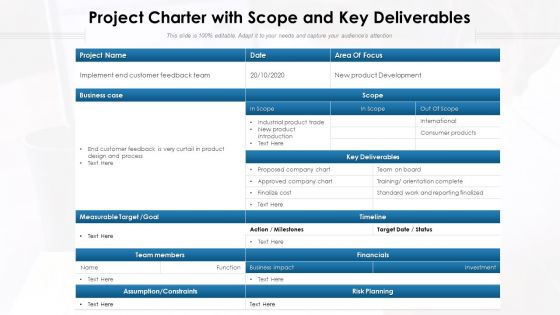
Project charter with scope and key deliverables





Try Before you Buy Download Free Sample Product
 Impress Your
 Audience
 100%
100% Editable
 Save Hours
 of Time


Our Project Charter With Scope And Key Deliverables are topically designed to provide an attractive backdrop to any subject. Use them to look like a presentation pro.
People who downloaded this PowerPoint presentation also viewed the following :
Project charter with scope and key deliverables with all 2 slides:
Use our Project Charter With Scope And Key Deliverables to effectively help you save your valuable time. They are readymade to fit into any presentation structure.
FAQs for Project charter with scope
A project charter should include project objectives, scope definition, key stakeholders, success criteria, timeline milestones, budget parameters, and risk assumptions. These components work together by establishing clear accountability, defining resource requirements, and setting measurable expectations, with many organizations finding that comprehensive charters streamline project execution and enhance stakeholder alignment throughout the project lifecycle.
A project charter differs from a project proposal by serving as the formal authorization document that officially launches an approved project, while a project proposal is a preliminary document used to request approval and funding. The charter includes detailed scope, objectives, stakeholder roles, and success criteria, ultimately providing the project manager with authority to proceed and allocate resources effectively.
A project charter establishes clear stakeholder alignment by defining project objectives, scope, deliverables, roles, and success criteria upfront, ensuring everyone understands expectations and commitments. Through documented agreements and structured communication frameworks, organizations streamline decision-making processes, minimize scope creep, and enhance collaboration across departments, with many teams finding that early alignment significantly reduces conflicts and accelerates project delivery timelines.
A well-written project charter contributes to project success by establishing clear objectives, defining scope boundaries, identifying key stakeholders, and securing formal authorization from leadership. This foundational document streamlines decision-making processes, minimizes scope creep, and enhances team alignment, with many organizations finding that comprehensive charters ultimately deliver improved resource allocation and higher completion rates.
Common pitfalls include vague objectives, unrealistic timelines, inadequate stakeholder involvement, insufficient resource allocation, and lack of clear success metrics. These oversights can derail projects by creating confusion, misaligned expectations, and scope creep, with many organizations finding that investing time in comprehensive charter development ultimately delivers smoother execution and higher success rates.
A project charter can be effectively communicated through structured presentations, collaborative workshops, digital distribution platforms, and regular reference points during meetings. These approaches streamline understanding by ensuring clear role definitions, accessible documentation, and ongoing reinforcement, with many organizations finding that combining visual presentations with interactive sessions enhances stakeholder buy-in and team alignment throughout project execution.
Defining project scope within a project charter establishes clear boundaries, deliverables, objectives, timelines, and resource requirements, preventing scope creep and misaligned expectations. This strategic foundation enables project managers to maintain focus, control costs, and deliver measurable outcomes, with many organizations finding that well-defined scope significantly reduces project delays and budget overruns.
Unclear objectives in project charters create confusion around deliverables, success metrics, and team responsibilities, leading to scope creep, misaligned stakeholder expectations, and wasted resources. Organizations frequently find that vague goals result in teams working toward different outcomes, ultimately causing budget overruns, missed deadlines, and project abandonment despite significant initial investment.
Methodologies that enhance project charter creation include PMBOK guidelines, Agile frameworks, Lean Six Sigma principles, PRINCE2 standards, and stakeholder analysis techniques. These approaches streamline charter development by establishing clear scope boundaries, defining measurable objectives, and ensuring stakeholder alignment, with many project managers finding that combining multiple frameworks delivers stronger project foundations and improved success rates.
External factors like regulatory requirements significantly shape project charter content by mandating specific compliance measures, risk assessments, stakeholder approvals, and documentation standards that must be integrated from the outset. These requirements influence scope definition, resource allocation, timeline planning, and deliverable specifications, with many organizations in healthcare, finance, and manufacturing finding that proactive regulatory alignment streamlines project execution and reduces costly compliance issues later.
A project charter can evolve through scope refinements, timeline adjustments, resource reallocations, stakeholder changes, and risk updates as new information emerges. While maintaining core objectives, organizations increasingly find that adaptive charters enable better alignment with changing business priorities, enhanced stakeholder engagement, and ultimately deliver improved project outcomes and strategic value.
The project sponsor plays a critical role in project charter development by providing strategic direction, securing resources, defining business objectives, and ensuring organizational alignment. Through their executive authority, sponsors facilitate stakeholder buy-in, resolve conflicts, and maintain project visibility at leadership levels, ultimately delivering the political support and resource commitment essential for project success and charter approval.
Project charter effectiveness can be tracked through stakeholder alignment scores, scope change frequency, timeline adherence rates, budget variance percentages, and decision-making speed metrics. Organizations across industries, from manufacturing to financial services, increasingly find that charters with clear success criteria deliver 30% faster project approvals and significantly reduced scope creep, ultimately enhancing operational efficiency.
Project charter relevance requires regular reviews and updates through structured change management processes, stakeholder feedback loops, and milestone assessments. Many organizations establish quarterly charter reviews, incorporating lessons learned, shifting market conditions, and evolving business priorities, while maintaining core project objectives and deliverables that ultimately preserve strategic alignment and stakeholder commitment throughout project execution.
Project charters have significantly transformed industries like healthcare, where they streamline clinical trial management and hospital system implementations, and financial services, where they enhance regulatory compliance projects and digital transformation initiatives. Construction and IT sectors particularly benefit from clear project governance, with many organizations finding that well-defined charters reduce project delays by 30-40%, ultimately delivering faster implementations and improved stakeholder alignment.
-
Informative design.
-
Great designs, Easily Editable.
-
Enough space for editing and adding your own content.
-
I discovered this website through a google search, the services matched my needs perfectly and the pricing was very reasonable. I was thrilled with the product and the customer service. I will definitely use their slides again for my presentations and recommend them to other colleagues.
-
Great product with effective design. Helped a lot in our corporate presentations. Easy to edit and stunning visuals.