


Team Charter With Meeting And Communication Guidelines




Try Before you Buy Download Free Sample Product
 Impress Your
 Audience
 100%
100% Editable
 Save Hours
 of Time


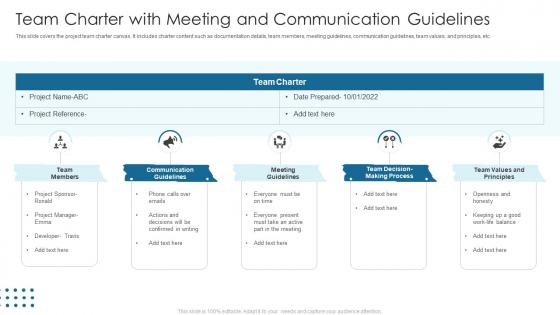
This slide covers the project team charter canvas. It includes charter content such as documentation details, team members, meeting guidelines, communication guidelines, team values, and principles, etc.
People who downloaded this PowerPoint presentation also viewed the following :
Team Charter With Meeting And Communication Guidelines with all 6 slides:
Use our Team Charter With Meeting And Communication Guidelines to effectively help you save your valuable time. They are readymade to fit into any presentation structure.





FAQs for Team Charter With Meeting
**INPUT**: What are the key components of an effective team charter? **OUTPUT**: Effective team charters include clear mission statements, defined roles and responsibilities, communication protocols, decision-making processes, and measurable success metrics. These components streamline collaboration by establishing accountability frameworks, minimizing conflicts through structured guidelines, and enabling consistent progress tracking, with many organizations finding that well-structured charters ultimately deliver enhanced productivity and stronger team alignment across diverse projects.
A team charter enhances collaboration and communication by establishing clear roles, shared objectives, decision-making processes, and communication protocols from project initiation. This structured approach minimizes conflicts, streamlines workflow coordination, and ensures all members understand expectations, ultimately delivering improved project outcomes and stronger team cohesion across diverse organizational environments.
A team charter clarifies roles by defining each member's specific duties, decision-making authority, accountability measures, reporting structures, and cross-functional dependencies. This structured approach streamlines collaboration by eliminating role confusion, reducing workflow bottlenecks, and establishing clear escalation paths, with many organizations finding that well-defined charters significantly enhance project efficiency and team productivity.
**INPUT**: What strategies can be used to ensure all team members contribute to the development of the charter? **OUTPUT**: Effective contribution strategies include structured brainstorming sessions, rotating facilitation roles, anonymous input collection, individual stakeholder interviews, and collaborative workshop formats. These approaches streamline participation by accommodating different communication styles, ensuring quieter members engage meaningfully, and creating psychological safety, with many project teams finding that diverse input mechanisms ultimately deliver more comprehensive charters and stronger team buy-in. **Word count: 58 words**
A team charter helps manage conflicts by establishing clear communication protocols, decision-making processes, and conflict resolution procedures upfront. These frameworks enable teams to address disagreements constructively through predefined channels, maintain focus on shared objectives, and resolve differences efficiently, with many organizations finding that structured approaches ultimately deliver stronger collaboration and faster project outcomes.
A team charter establishes clear, measurable goals by defining specific success metrics, timelines, deliverables, and performance indicators that align with organizational objectives. It creates accountability frameworks through documented responsibilities and milestones, enabling teams to track progress systematically, measure outcomes against defined benchmarks, and ultimately deliver quantifiable results that support strategic business initiatives.
Team charters should be reviewed quarterly and updated whenever significant changes occur, such as new team members, shifting project scope, or evolving organizational priorities. Regular reviews ensure the charter remains relevant and effective, with many organizations finding that consistent updates enhance team alignment, improve accountability, and maintain strategic focus throughout project lifecycles.
Teams can employ regular progress reviews, peer feedback systems, milestone tracking, and performance metrics tied to charter objectives to ensure accountability. By establishing clear reporting structures, implementing collaborative monitoring tools, and conducting quarterly charter alignment assessments, organizations enhance transparency and commitment, with many finding that structured accountability frameworks significantly improve project outcomes and team cohesion.
A team charter supports vision and mission statements by establishing clear operational frameworks, defining roles and responsibilities, outlining decision-making processes, and creating accountability measures that translate high-level aspirations into actionable workflows. Through structured goal-setting and performance metrics, teams can align daily activities with strategic objectives, while maintaining focus and momentum, ultimately delivering measurable progress toward their mission with enhanced collaboration and organizational clarity.
Common pitfalls include creating overly vague objectives, excluding key stakeholders from the development process, setting unrealistic timelines, and failing to establish clear accountability measures. Teams can avoid these challenges by involving all relevant members in charter creation, defining specific measurable goals with realistic deadlines, and regularly reviewing their charter to ensure it remains aligned with evolving project needs and organizational priorities.
Technology tools facilitate team charter creation through collaborative platforms like Microsoft Teams, Slack, and Google Workspace, which enable real-time editing, version control, and stakeholder input. These platforms streamline charter development by automating workflow tracking, centralizing communication, and providing templates, with many organizations finding that digital collaboration reduces charter creation time while enhancing team alignment and accountability.
A well-defined team charter significantly improves project outcomes by establishing clear roles, expectations, and communication protocols from the outset, reducing confusion and conflicts that typically derail timelines. Through structured accountability and shared objectives, teams deliver projects 25-30% faster while maintaining quality standards, with many organizations finding that upfront charter development ultimately streamlines decision-making and enhances overall project success rates.
Remote team charters require enhanced communication protocols, digital collaboration tools, virtual meeting cadences, flexible time zone considerations, and clear accountability frameworks. These adaptations streamline remote workflows by establishing structured check-ins, defining response timeframes, and creating shared digital workspaces, with many distributed teams finding that explicit communication guidelines and outcome-based performance metrics ultimately deliver stronger cohesion and productivity.
Effective team charters include Google's cross-functional project teams with defined roles and decision-making protocols, Microsoft's product development teams with clear success metrics and communication cadences, and Amazon's two-pizza teams with specific ownership boundaries and deliverable timelines. These frameworks streamline collaboration by establishing accountability structures, minimizing role confusion, and accelerating decision-making processes, with many organizations finding that well-defined charters reduce project delays by up to thirty percent.
Team charters integrate seamlessly with project management frameworks by establishing foundational agreements that support methodology-specific processes, timelines, and deliverables. Whether using Agile, Waterfall, or hybrid approaches, the charter provides consistent team structure, communication protocols, and decision-making authority that enhances framework effectiveness, with many organizations finding that this strategic combination streamlines project execution and delivers improved outcomes.
-
Qualitative and comprehensive slides.
-
Great designs, Easily Editable.