

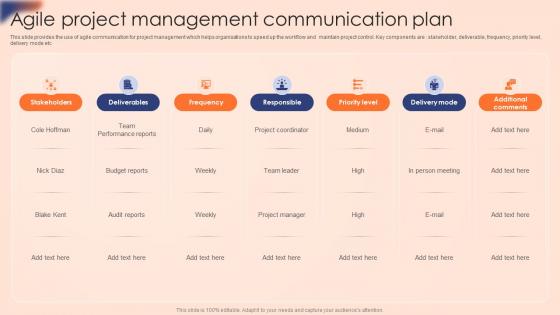
Agile Project Management Communication Plan




Try Before you Buy Download Free Sample Product
 Impress Your
 Audience
 100%
100% Editable
 Save Hours
 of Time


This slide provides the use of agile communication for project management which helps organisations to speed up the workflow and maintain project control. Key components are stakeholder, deliverable, frequency, priority level, delivery mode etc.
People who downloaded this PowerPoint presentation also viewed the following :
Agile Project Management Communication Plan with all 6 slides:
Use our Agile Project Management Communication Plan to effectively help you save your valuable time. They are readymade to fit into any presentation structure.





FAQs for Agile Project
So basically Agile is all about talking more and documenting less. You're doing quick daily check-ins instead of those endless email threads that nobody reads anyway. Face-to-face conversations become your thing, plus you're constantly showing actual working stuff to people rather than just talking about it. Honestly took me a while to adjust but it's way better once you do. Requirements change constantly so your communication has to roll with it. Oh and forget rigid processes - everything's designed to be flexible. Start having shorter but more frequent team meetings. Trust me on this one.
Dude, remote work makes communication so much harder than people think. You've gotta schedule way more touchpoints - not just standups but like quick 15-minute syncs or those async video updates. Seeing actual faces helps a ton. Slack's convenient but honestly kills all the nuance in conversations. Save video calls for complex stuff or anything that might get messy. Your retros should focus on communication breakdowns, not just delivery problems. Set clear response time expectations so people aren't wondering if you're ignoring them. Oh, and over-communicate everything - assume half your message got lost.
Feedback is what makes Agile actually work - you catch problems early instead of discovering them at the worst possible moment. Daily standups and retrospectives create these loops where everyone can say what's broken or what's going well. Trust me, it's the difference between teams that gel and ones that fall apart. The trick is being specific, not just "nice work" but like "your documentation saved me three hours of confusion." Course correction happens constantly rather than... well, never. Short feedback works better than long rambling sessions too.
Honestly, those regular meetings are lifesavers for keeping everyone on the same page. Stand-ups catch problems before they turn into disasters - you know how one tiny blocker can derail everything if nobody mentions it? Reviews let stakeholders see what's actually happening so they can freak out early instead of at launch (kidding, but not really). Retrospectives are where you can finally call out the stuff that's been bugging everyone. The trick is making them feel like real conversations, not just going through the motions. Try asking "what do you need from us today?" instead of the usual boring updates.
Honestly, stick with what you already know. Slack/Teams for daily chat, Jira for tracking your backlog - that stuff works fine. Video calls are still king for standups and retros, way better than trying to do async everything. Miro's pretty solid for when you need to brainstorm together. Don't overthink it though - I've seen teams waste weeks debating tools instead of just shipping code. Pick whatever your team will actually use every day. You can always swap later if something's genuinely broken, but most problems aren't tool problems anyway.
So basically, information radiators are just ways to make project stuff visible to everyone all the time. You know those Kanban boards or burndown charts? That's it. Instead of hiding updates in endless email chains (ugh), you're putting everything out there where people can actually see it. Feels weird at first - kinda like you're being watched constantly. But honestly, it kills the whole "nobody told me" drama and keeps everyone on the same page. I'd say start simple though. Just stick your sprint board somewhere people walk by every day and see what happens.
Honestly, daily standups are a game changer - but make them about actually solving problems, not just boring status updates. Get everyone looking at the same visual boards so there's no confusion about who's doing what. If you can sit together, do it. Remote? Keep those cameras on and use tools like Miro. Oh, and please just walk over and talk instead of sending seventeen emails back and forth - I swear that drives me crazy. Pick one thing from this list and try it this week. You'll be surprised how much it helps.
Dude, visual aids totally change the game for Agile teams. Story maps show user journeys super clearly. Burndown charts track your progress. Kanban boards reveal workflow bottlenecks instantly. During planning sessions, sketch out user flows instead of just talking - it's amazing how much faster people get it. Wireframes work great for demos too. I swear, complex ideas suddenly click when your team can actually see what you're discussing. Even simple diagrams during retros help. Oh, and definitely try sketching your next user story on a whiteboard first. Trust me on this one.
Dude, active listening is huge in Agile. You're always bouncing ideas around in standups and retros, right? When you actually listen - like really listen - you pick up on stuff that gets lost in Slack or emails. Half the time what sounds like a "quick fix" is actually this massive undertaking once you start digging. I've learned to repeat back what I think I heard before diving into solutions. Sounds weird but it prevents those awful moments mid-sprint where everyone realizes we're building totally different things. Those follow-up questions you ask? They'll save you from so much rework later.
Honestly, you gotta switch up how you communicate with different people. Some folks love talking things out in standups, others need everything written down to actually absorb it. I've watched teams completely fall apart when they only use Slack or only do meetings - it's brutal. Visual boards work great for some people, detailed docs for the analytical types, quick chats for those who think out loud. Just pay attention to who actually participates and when. Oh, and here's a wild idea - literally ask each person how they want to get updates and give feedback. Works way better than guessing.
Oh man, the classic trap is talking too much in meetings but never following up after. Teams will spend 30 minutes in standup going in circles, then someone's still blocked three days later. Super annoying. I've also seen the opposite - people assume everyone gets it without actually checking. Those daily syncs just become boring status updates instead of solving real problems. What works better? Keep agendas tight, use Slack or whatever for regular updates, and literally ask "wait, does this make sense to everyone?" Don't let remote people get left out of random conversations either. Makes a huge difference honestly.
Try switching from boring lists to actual user stories in your retros. Like, instead of "login broke," tell them how it affected real people. Stakeholders eat this stuff up - they'd rather hear "Sarah from accounting couldn't access her reports" than some dry technical rundown. Your sprint reviews will be way more interesting too. Daily standups work better when you frame blockers as mini-stories. Honestly, it just makes everyone care more when they can picture the actual person using what you built. Next retro, ask everyone to share one user story they heard during the sprint. Game changer.
Oh man, cultural stuff can totally derail your Agile ceremonies. Some team members from high-context cultures won't speak up in standups, while others expect super direct updates. Time zones suck but honestly, communication styles are way worse to deal with. Conflict-avoidant cultures make retros pointless, and some teams need way more structure than Agile typically offers. Hierarchy issues too - certain people won't talk if their "senior" is there. I'd set clear communication rules upfront, rotate meeting times so it's fair, and throw in some async check-ins. Gives everyone a comfortable way to actually contribute.
So agile coaches are like communication detectives, honestly. They watch your standups and retros to catch where things go sideways - stuff you can't see because you're too close to it. Mine spotted that our team was basically talking past each other during planning (embarrassing but true). They create that safe space vibe so people actually speak up about roadblocks instead of staying quiet. But here's the thing - they won't fix problems for you. They're teaching your team to get better at talking and working together. I'd start by having yours sit in on a ceremony and just... observe. You'll be surprised what they catch.
Honestly, just steal Lean's "cut the waste" idea for your comms. Share info only when people actually need it - those marathon email threads are brutal and nobody reads them anyway. Quick standups work way better, plus visual boards where everyone can see what's happening. For tricky stuff, just hop on a call instead of typing novels back and forth. Before you communicate anything, ask yourself: does this help the sprint or help someone decide something? If not, don't bother. Oh, and definitely audit what you're doing now - I bet you'll find meetings that could've been a Slack message.
-
Keep doing the good work guys. Surpass the needs and expectations always!!
-
The PPT layout is great and it has an effective design that helps in presenting corporate presentations. It's easy to edit and the stunning visuals make it an absolute steal!