


Agile Project Management Delivery Plan




Try Before you Buy Download Free Sample Product
 Impress Your
 Audience
 100%
100% Editable
 Save Hours
 of Time


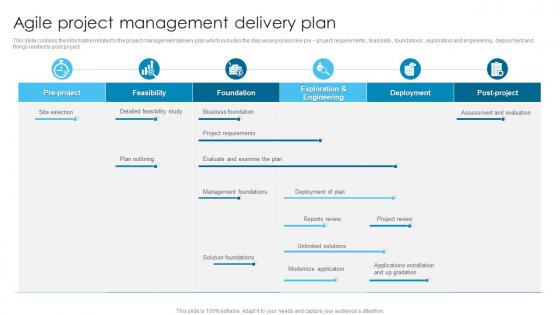
This slide contains the information related to the project management delivery plan which includes the step wise process like pre project requirements , feasibility , foundations , exploration and engineering , deployment and things related to post project.
People who downloaded this PowerPoint presentation also viewed the following :
Agile Project Management Delivery Plan with all 6 slides:
Use our Agile Project Management Delivery Plan to effectively help you save your valuable time. They are readymade to fit into any presentation structure.





FAQs for Agile Project
So Agile is basically four things: people matter more than rigid processes, actually working software beats tons of documentation, collaborate with customers instead of just contract stuff, and adapt to changes rather than following some ancient plan. It's way more human than that old waterfall mess - honestly can't believe we used to do it that way. Short sprints are your friend here, maybe 2-4 weeks. Get feedback constantly from whoever's using this thing. Figure out your bare minimum viable product first, then build from there. The whole point is staying flexible and delivering value fast.
So basically, Agile chops everything into these short 2-week chunks called sprints instead of planning the whole thing upfront like old-school waterfall. Way less overwhelming tbh. You're constantly getting feedback and tweaking stuff rather than being stuck with whatever you decided at the beginning. Traditional methods are like "plan everything perfectly, then execute" - which honestly never works because requirements always change anyway. With Agile you're collaborating with people throughout the process, not just dumping requirements on them at the start. If your project has any unknowns, definitely try the sprint approach first.
So you've got three main roles to worry about. Product Owner handles what gets built and ranks everything by business value. Development Team does the actual building - usually 3-9 people who organize themselves. Then there's the Scrum Master who runs meetings and clears roadblocks (they're more like a coach than your typical boss, which is honestly refreshing). Don't stress too much about strict boundaries though. Everyone collaborates a ton anyway. Just make sure each person knows what they're accountable for while you're all working toward the same sprint goals.
Oh totally! Agile's way more flexible than most people realize. Software teams usually stick with standard 2-week Scrum sprints, but marketing or research projects? You can stretch those out or go with more of a Kanban flow instead. The main thing is keeping the good stuff - getting feedback regularly, working together as a team, delivering things in chunks. Then just mess with the meeting schedules and sprint lengths until it fits what you're actually doing. I'd honestly just start basic and change whatever feels weird for your situation. Way less rigid than it seems at first!
Jira, Trello, and Azure DevOps are the main ones everyone uses. Trello's kanban boards are honestly so satisfying - might just be me but I love moving those cards around. Jira has all the fancy reporting stuff if you need that, though it takes forever to learn. For teams just starting out? Monday.com or Asana are way less overwhelming. Here's the thing though - doesn't matter how "perfect" the tool is if your team won't actually use it. I'd grab free trials of like 2-3 options and just see what feels right with how you guys work. Better to have everyone consistently using something decent than fighting with the ideal setup.
Stand-ups should be 15 minutes tops - just cover what you did yesterday, today's plan, and any blockers. Don't let them become boring status updates for your manager. They're actually for the team to stay in sync. Retros are where the real magic happens though. You need people to feel safe being honest about what sucks. Try "start, stop, continue" or those sticky note things to get everyone talking. But here's the thing - if you don't actually act on what comes up, people will check out fast. Someone has to own each improvement item and you've got to review progress next time around.
Honestly, the hardest part is getting people to drop their old habits. Your team will want those detailed plans mapped out forever, and managers freak out about trusting teams to self-organize. Stakeholders hate the iterative thing too - they want to see everything upfront instead of waiting for pieces. Daily standups feel super awkward at first (still remember our first ones being painfully quiet). Start with just one team though. Get some quick wins, then slowly bring others in while you coach everyone through it. The mindset shift is brutal but it clicks eventually.
Get your stakeholders into sprint reviews - that's honestly the biggest game changer. They need to see working software regularly, not just get surprised at the end (I've watched that trainwreck too many times). Also pull them into story refinement when you can. Between sprints, shoot them quick updates with screenshots or whatever. Maybe set up a backlog they can actually peek at and mess with priorities. The trick is making it super easy for them but keeping it regular. Oh, and those informal check-ins between sprints? Gold. Start small - just grab one stakeholder for your next review.
So here's the thing - Agile basically forces you to get better every few weeks. After each sprint, you sit down and ask "what sucked and how do we fix it?" It's this constant feedback loop that actually works because you're not waiting forever to make changes. Short cycles mean you can pivot quickly when something isn't clicking. I love that you can experiment without blowing up the whole project - mess up small, learn fast, move on. Honestly, just try picking one tiny thing to improve in your next retro and see what happens.
Honestly, velocity is your best friend here - track how many story points you're knocking out each sprint. Burn-down charts are solid too for seeing what's left. But here's the thing - I've seen teams with perfect numbers who were absolutely miserable, which defeats the whole point, right? Cycle time matters (how long from start to finish), plus customer satisfaction and defect rates. Oh, and don't sleep on those retrospective sessions - they'll tell you way more than spreadsheets sometimes. Pick maybe 3-4 metrics max though. Otherwise you'll drown in data and lose focus. Start tracking from day one so you've got something to compare against later.
So agile basically gets everyone talking way more - daily standups, retrospectives, all that stuff. People start helping each other out instead of just doing their own thing. The transparency is honestly weird at first since everyone knows what you're working on, but it builds trust super fast. Your team gets really good at pivoting when things change. Plus people naturally cross-train more because you're all chasing the same sprint goals. I'd say just try daily standups first - like 15 minutes max or people will hate it. You'll notice the difference right away.
Yeah, remote Agile definitely works! Daily video standups are clutch - way better than just chat. Digital boards like Jira or Trello keep everyone on the same page. Your sprint ceremonies can all go virtual, no problem. The tricky part is you can't just walk over to someone's desk anymore, so you have to be way more deliberate about talking. Make sure your team has overlapping hours. Document stuff fast or it gets forgotten. Oh, and don't ditch retrospectives - honestly they're more important when you're all scattered. Hash out your communication rules during that first sprint planning and you'll be golden.
MoSCoW is your friend here - just bucket everything into Must have, Should have, Could have, or Won't have. Value vs effort matrices work too, though honestly they can get a bit messy with stakeholders who think everything's urgent. Story mapping's another route if you want to visualize the user journey first. Get your PO to define what "business value" actually means for each item (good luck with that). Then rank by impact and how much of a pain it'll be to build. Pick whatever method doesn't make your team's eyes glaze over and stick with it.
So here's the thing - Agile is built for changes, not against them. You do these short 2-4 week sprints which makes pivoting way easier when stuff shifts around. The backlog gets reprioritized constantly based on feedback instead of trying to nail everything down from day one. Way better than waterfall where one change request feels like the world's ending, honestly. After each sprint your team reviews what's working and what isn't. Those change requests? They're actually chances to make the product better, not some nightmare scenario.
Oh man, customer feedback is huge in Agile - like, it literally drives everything you do. You're always showing demos and running sprint reviews to make sure you're not building something nobody wants. Way different from waterfall where you'd just... hope for the best until the end, which was terrifying honestly. Quick pivots happen when feedback shows you're off track. Regular touchpoints are key - don't wait for big milestones. I learned this the hard way on my last project. Short feedback loops save you from wasting months on the wrong features.
-
Content of slide is easy to understand and edit.
-
The best part about SlideTeam is their meticulously prepared presentations (complete-decks and single-slides both), infused with high-quality graphics and easy to edit. All-in-all worthy products.