


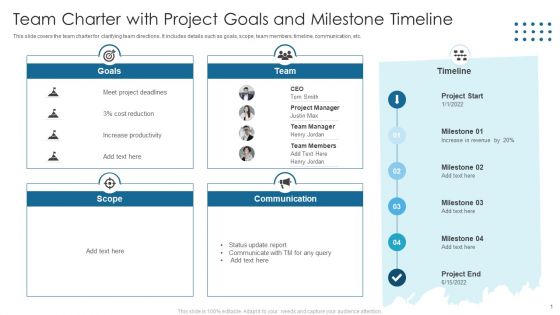
Team Charter With Project Goals And Milestone Timeline




Try Before you Buy Download Free Sample Product
 Impress Your
 Audience
 100%
100% Editable
 Save Hours
 of Time


This slide covers the team charter for clarifying team directions. It includes details such as goals, scope, team members, timeline, communication, etc.
People who downloaded this PowerPoint presentation also viewed the following :
Team Charter With Project Goals And Milestone Timeline with all 6 slides:
Use our Team Charter With Project Goals And Milestone Timeline to effectively help you save your valuable time. They are readymade to fit into any presentation structure.





FAQs for Team Charter With Project Goals
Honestly, you need five things nailed down: purpose/goals, who does what, how you'll communicate, decision-making process, and how you'll measure success. Communication is where most teams totally mess up though - figure out meeting frequency, which channels to use, conflict resolution stuff. Goals have to be specific or you'll just argue about what you're actually doing later. Oh, and make everyone literally sign off on it! Sounds cheesy but when things go sideways (they will), that buy-in becomes super important. Short sentences work. Don't overcomplicate the whole thing.
Okay so a team charter is basically like setting ground rules before you start working together - who's doing what, how you'll make decisions, when you meet, all that stuff. Honestly, it's kind of like making a roommate agreement but for work lol. The whole point is avoiding those annoying situations where nobody knows who's supposed to handle something or people just ghost on Slack. When you hash out communication styles upfront, there's way less confusion later. I'd say bring it up in your next team meeting and just draft something together. Sounds boring but it actually saves so much headache down the road.
So a team charter is basically your project's roadmap - tells everyone what you're actually trying to accomplish and why it matters. Without one, you'll have half the team thinking they're building a Ferrari while the other half's making a pickup truck (trust me on this one). Draft it together with everyone so they feel invested from the start. Make sure you nail down the specifics: what success looks like, what you're delivering, where the project stops. Yeah, it feels like extra work upfront, but it'll save you so many headaches later when scope creep hits.
Think of a team charter like having ground rules everyone agreed on from day one. Roles, communication, decision-making - it's all mapped out. So when drama hits (and it will), you literally just point back to what everyone signed off on. No awkward "well I thought YOU were handling that" moments. Plus it shows how to actually deal with conflict instead of pretending everything's fine while people silently seethe. Honestly, it's like having a neutral referee when things get heated. Just whip out the charter and boom - you've got your starting point for sorting things out.
Honestly, you've gotta make sure everyone actually contributes, not just nods along to your ideas. Run a workshop where you ask open-ended questions and let them do most of the talking - I've seen way too many "team" charters that were just one person's vision with tiny edits. Break into smaller groups for different sections so the quiet people speak up too. Oh, and don't try to finalize everything in one sitting. Draft it together, then schedule another session to review and tweak it. That's when you'll catch the stuff that doesn't actually work for everyone.
Check it every 2-3 months or when big stuff changes - new people join, scope gets weird, processes break down. Honestly? Most teams write it week one then totally forget about it. That's when you actually need the thing though! Pull it out during retros or when people start bickering about who does what. Oh, and set a calendar reminder or it'll just sit there gathering digital dust. If it feels outdated compared to what you're dealing with now, time for a refresh. Keep tweaking it as you go.
Honestly, don't just email the charter and call it a day - that's where most teams mess up. Walk through it in a real meeting first, then create some kind of visual summary afterward. People hate reading long documents (I mean, who has time?). Post it somewhere obvious like your shared drive so folks can actually find it later. Mix up how you communicate it - maybe a presentation, then a one-pager highlighting the big stuff. Oh, and definitely circle back in a few weeks to see if anyone's confused. Repetition is your friend here.
Honestly, team charters work because people actually get to help build them instead of just following orders from management. Creates real buy-in, you know? Plus everyone can see how their work fits into the bigger goal - that connection matters way more than you'd think. Having everything written down also stops those annoying situations where half the team is going one direction and the other half is doing something completely different. Oh, and don't just write it once and forget about it. Bring it up in meetings sometimes to keep everyone on the same page.
So basically, your team charter is all about the *who* and *how* - like who does what, how you'll make decisions, communication stuff. It's your team's operating manual, honestly. Project plans are totally different - they map out the actual work, deadlines, what you're delivering. Both matter, but I'd start with the charter first since it sets up how you'll work together. The plan handles the nuts and bolts of getting stuff done. You really can't skip either one - the charter keeps relationships smooth while your plan keeps the actual project moving. Does that help?
Honestly, team charters are lifesavers because they stop all that "wait, whose job was this?" confusion before it starts. Everyone knows their role and what success looks like. When your team actually helps write it together, they're way more likely to stick to it - people hate backing out of stuff they agreed to. I always tell people to review theirs monthly (though let's be real, sometimes it's more like every other month). You can reference it during meetings or when projects start going off the rails. It's basically your team's rulebook that everyone signed off on.
So basically a team charter stops all that "wait, wasn't that your job?" drama by spelling out who does what. Write down everyone's main responsibilities and who gets to make which calls. Honestly, I've seen projects crash just because nobody knew who was supposed to handle the big decisions. Be specific enough that there's zero confusion, but don't make it so rigid that people can't adjust when things change - and trust me, they will. Oh, and update the thing when roles shift or you'll be back to square one.
Track your charter with the obvious stuff first - deadlines, scope, quality metrics. That shows if it's actually working. But honestly? The team vibes matter way more than people think. Survey everyone about role clarity and whether they actually use the charter when making decisions. If it's just sitting there collecting digital dust, you've got problems. Quick tangent - I've seen so many teams create these elaborate charters then never look at them again. Also watch how often people reference it during conflicts. Do a health check every quarter or so.
Honestly, visuals are a game-changer for team charters. Nobody wants to slog through paragraphs of text. I'd go with infographics that show roles and goals super clearly. Flowcharts work great too - especially for decision-making stuff. Templates keep everyone on the same page without reinventing the wheel each time. One team I know made this colorful role map that people actually reference during meetings (shocking, right?). The visual format just clicks better. People get their part in the bigger picture instantly. Try doing a one-page visual summary instead of some dense document. You'll be amazed how much more engagement you get.
Honestly, the hardest part is getting people to actually engage instead of just sitting there nodding. Plus everyone wants to debate these big philosophical values rather than talking about real situations you'll face. Communication styles are where things get messy though - like some people expect instant responses while others need time to think. It gets awkward fast! What works better is jumping straight into specific scenarios instead of abstract stuff. Oh and don't just collect everyone's thoughts - you need actual back-and-forth discussion. Better to hash out the uncomfortable stuff now than discover you're totally misaligned when something important happens.
Just bake agility right into your charter from the start. Add stuff like "we'll adjust our working agreements as we go" and "quick conversations beat endless email threads." Monthly retrospectives to revisit everything work well. Most teams overthink this honestly - the best charters feel alive, not like some corporate document gathering dust. Make transparency non-negotiable and focus on shipping working stuff fast. Your charter should evolve with your team anyway. Treat it like any other agile artifact that gets better over time. Don't get precious about it.
-
Great designs, really helpful.
-
Enough space for editing and adding your own content.