

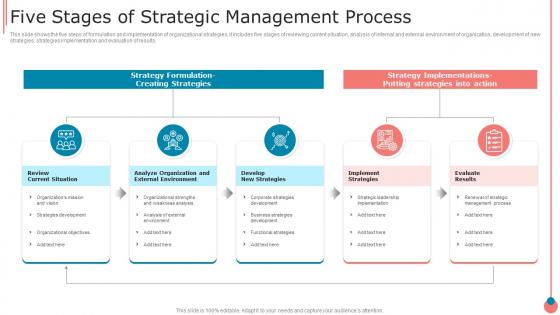
Five Stages Of Strategic Management Process




Try Before you Buy Download Free Sample Product
 Impress Your
 Audience
 100%
100% Editable
 Save Hours
 of Time


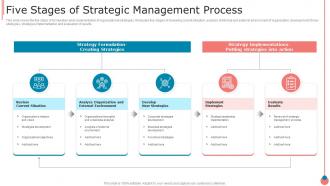
This slide shows the five steps of formulation and implementation of organizational strategies. It includes five stages of reviewing current situation, analysis of internal and external environment of organization, development of new strategies, strategies implementation and evaluation of results.
People who downloaded this PowerPoint presentation also viewed the following :
Five Stages Of Strategic Management Process with all 6 slides:
Use our Five Stages Of Strategic Management Process to effectively help you save your valuable time. They are readymade to fit into any presentation structure.





FAQs for Five Stages Of
You need vision/mission statements first - get leadership on the same page there or you're screwed from the start. Then do your environmental analysis (internal and external stuff), set clear objectives, and build implementation plans with actual timelines. Resource allocation and risk assessments matter too. Honestly, I've watched so many strategic plans just sit there collecting dust because nobody bothered with regular monitoring. Your team has to understand their roles or it won't work. The vision gives direction, analysis shows where you are now, objectives set your targets. Implementation? That's where the magic happens.
So strategy is your big picture stuff - where you're headed long-term, how you'll beat competitors, major money decisions. Operations? That's the daily grind of actually getting things done. Strategy asks "where should we go and how do we win?" Operations is more like "how do we handle this efficiently right now?" You might make strategic calls quarterly or yearly (new markets, whatever), but operational decisions are constant - scheduling, quality checks, workflow tweaks. Honestly, I've seen too many companies get caught up in busy work that doesn't connect to their actual goals. Your day-to-day stuff should support the bigger vision, otherwise you're just spinning wheels.
Think of environmental scanning like having a strategic radar - you're monitoring industry changes, competitor moves, tech trends, regulations, all that stuff before it hits you. It's way better than just randomly scrolling news (though we all do that anyway). Set up regular processes to gather info from different sources. The trick is actually using what you find to tweak your strategy ahead of time. You don't want to be the company that gets blindsided by obvious shifts everyone saw coming. Make it systematic so you can spot opportunities and dodge threats early.
Okay so first thing - take those big strategic goals and break them down into stuff each department can actually do. Map out your processes and see where they clash with what you're trying to achieve (this is usually a hot mess tbh). Set up KPIs that connect daily work to your bigger picture. Your team leads need to get how their stuff fits the vision - like really get it, not just nod along. Oh and don't forget to review regularly. Rigid strategy dies fast when reality hits.
SWOT and PESTEL are the big ones you'll run into constantly. SWOT covers your internal strengths/weaknesses plus external opportunities/threats - though honestly everyone uses it so much it's almost cliché at this point. PESTEL breaks down all the external stuff (political, economic, social, tech, environmental, legal). Porter's Five Forces is solid for understanding your competitive landscape. Then you've got BCG Matrix for portfolio decisions, Value Chain for operations, Ansoff for growth planning. Don't go crazy trying to use everything though - just pick 2 or 3 that actually make sense for what you're dealing with.
Look, competitive analysis is basically your reality check - shows you exactly where you stand and what openings exist. Map out what your competitors nail vs where they totally bomb. You'll spot gaps they're missing or ways to stand out differently. Honestly, it's like getting insider intel for your strategy. Makes pricing decisions way clearer, plus product development and positioning become less of a guessing game. I'd track maybe 3-5 direct competitors every few months - sounds boring but it actually clarifies your options fast. You stop flying blind, which is huge.
So basically you've got all these different groups pulling you in opposite directions. Shareholders want money, employees want stability, customers have their own demands - honestly it gets messy fast. Your strategy ends up being this constant balancing act between what everyone wants. Like if you slash costs, investors are happy but your team gets stressed and service might tank. What I've learned is you really need to figure out who matters most and what they absolutely won't budge on before making any big moves. Otherwise you'll just piss everyone off trying to please everyone.
So basically your competitive advantage comes down to two things - what you've got and what you can do with it. Resources are your assets (cash, tech, people, brand reputation). Capabilities? That's how well you actually use those resources compared to competitors. The real win is when your stuff is rare and hard to copy. Netflix is perfect here - sure they had content, but their real superpower was using data to nail personalized recommendations way better than anyone else. Honestly, most companies overlook this part. Start by listing your unique resources, then figure out which capabilities make you genuinely hard to replicate.
So you'll want to track both the money stuff and the softer metrics. ROI, revenue growth, market share - those are your bread and butter numbers. But don't sleep on employee engagement and customer satisfaction scores either. I'm a big fan of the balanced scorecard method since it hits all four angles: financial, customer, internal processes, and learning. Pick maybe 5-7 metrics that actually tie to your goals though - I've seen companies go overboard and track like 20 things which gets messy fast. Set up quarterly check-ins to see how you're doing and pivot if something's not working.
Oh man, where do I start? Vague goals are death - nobody knows what they're actually working toward. Also, if you don't get the right people involved from day one, good luck getting anyone to care later. I've watched so many teams just... analyze everything to death instead of making actual decisions. It's wild. Don't skip implementation planning either - "we'll figure it out later" never works. Build in check-ins so you can pivot when things go sideways (they will). Keep timelines realistic, start simple, and honestly? Execution beats a perfect plan every single time.
Look, digital transformation isn't just slapping new tech onto what you're already doing. It completely changes how you think about strategy. Your whole approach to creating value and serving customers? That needs a total rethink. Those 5-year strategic plans are basically useless now - honestly, who can predict anything that far out anymore? You need shorter cycles and way more flexibility. Use real data to pivot quickly when things change. Start by figuring out where digital trends could mess with your current strategy, then build in room to adapt. The companies that can't do this get left behind fast.
So globalization totally changes the game - you're not just competing locally anymore. Your rivals are international now, supply chains cross like 5 countries, and customers want completely different things depending on where they are. The regulatory stuff alone is a nightmare tbh. But honestly? The opportunities are huge if you can pull it off. Market expansion, better costs, all that good stuff. You just need to stay flexible and figure out what parts of your strategy should be the same everywhere vs. what needs to change for each market. Start by mapping that out first.
Think of ethics like speed bumps for business decisions - they slow you down just enough to avoid crashing later. Bad choices spread crazy fast on social media now, so you really can't afford to mess up. Sure, ignoring ethics might boost profits short-term, but then you're dealing with angry employees, lawsuits, or customers boycotting you. I've seen companies tank their reputation over one dumb move. Build those ethical check-ins right into your planning process. You'll sleep better knowing you won't wake up to a PR nightmare.
Honestly, ditch those huge annual plans - they're basically useless now. Do quarterly check-ins instead and get people from different departments working together so you can actually move fast when things change. Scenario planning helps a ton too - just think through a bunch of "what if this happens" situations beforehand. Real-time data is clutch for catching trends early. Oh, and give your middle managers way more power to make calls without waiting around for approvals from up top. That approval chain stuff will kill you. Build a team that expects change instead of freaking out about it.
So scenario planning is basically stress-testing your strategy with different "what if" situations. Pick 3-4 realistic futures your industry might face - economic crashes, new tech disrupting everything, regulation changes, whatever keeps you up at night. Then see how your current plans would survive each one. Honestly, most companies skip this step and regret it later. The whole point is finding weak spots before they bite you and building some flexibility into your approach. Just grab your team next quarter and workshop through the biggest uncertainties you're facing. Way better than crossing your fingers and hoping.
-
Very well designed and informative templates.
-
My presentations were a bit amateur before I found SlideTeam’s designs. I’ve been able to find slides for nearly every topic I’ve had to present. Thanks, Slideteam!