


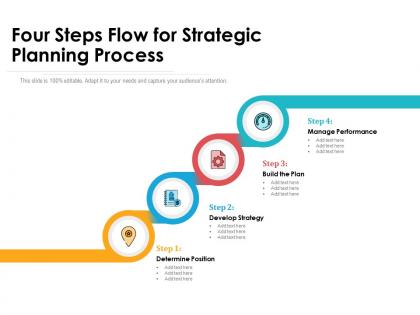
Four steps flow for strategic planning process




Try Before you Buy Download Free Sample Product
 Impress Your
 Audience
 100%
100% Editable
 Save Hours
 of Time


Our Four Steps Flow For Strategic Planning Process are topically designed to provide an attractive backdrop to any subject. Use them to look like a presentation pro.
People who downloaded this PowerPoint presentation also viewed the following :
Four steps flow for strategic planning process with all 2 slides:
Use our Four Steps Flow For Strategic Planning Process to effectively help you save your valuable time. They are readymade to fit into any presentation structure.

FAQs for Four steps flow for
So you'll want to start with figuring out where you actually are right now - like a real audit, not just wishful thinking. Then map out your vision and goals, plus how you're gonna get there. Build in solid timelines with actual people owning each piece. Here's the thing though - most plans just die in someone's desk drawer because nobody checks on them. Set up regular reviews to see what's working and what isn't. Oh, and get input from your stakeholders throughout the whole thing, not just at some initial meeting. The plan's gonna change anyway once real life kicks in, so make it flexible from the start.
Honestly, first thing you gotta do is actually write down your core values - and I mean really spell them out, not just some vague poster nonsense. When you're planning your big goals, straight up ask yourself: "does this match what we stand for?" It sounds obvious but most people skip this step. If you can't connect a goal back to your values, that's your red flag right there. I'd literally make a little chart or something mapping each goal to specific values. Otherwise you'll just assume it all works out somehow (spoiler: it doesn't).
Look, data analysis is what separates real strategic planning from just wishful thinking. It shows you where you actually are vs where you think you are. Use it to spot market trends, figure out what customers really want, and see how you stack up against competitors. I can't tell you how many businesses I've watched crash because they went with their gut instead of the numbers. The data helps you set goals that aren't completely unrealistic and pick initiatives that'll actually make a difference. Oh, and check what data you already have first - most companies are sitting on goldmines they don't even know about.
Okay so first thing - figure out who actually matters for this project. Don't wait until you've already decided everything to ask for input (learned that the hard way). Start with some quick surveys or interviews, then do workshops if you need to go deeper. Honestly, the hardest part is actually being willing to change course when someone brings up a good point. Oh and definitely circle back to tell people how you used their feedback - they'll hate you if you don't. A simple spreadsheet tracking who you've talked to helps too.
Honestly, the worst thing you can do is be super vague or go totally overboard with unrealistic goals. Teams also love creating these gorgeous plans while completely ignoring what competitors are actually doing - like, why? Get the right people involved from day one or you'll be scratching your head later wondering why no one cares. And here's the thing that drives me nuts: don't treat your plan like it's set in stone once you're done. Check in regularly. Markets change, stuff happens, and you gotta be ready to pivot when needed.
Set up your KPIs from day one - revenue growth, customer satisfaction, market share, whatever matches your goals. Track both leading stuff (pipeline growth) and lagging (actual revenue). Most companies totally blow this part and can't figure out if anything's working later. Check progress quarterly instead of waiting a whole year - you need time to fix things that aren't working. Oh and make sure someone actually owns each metric and reports on it. Without that accountability piece, people just ignore the numbers.
So I've found a few things that actually work. Get everyone to write ideas on sticky notes first - stops that annoying groupthink thing. Mind mapping's solid for visual people. Oh, and use "yes, and..." rules from improv instead of immediately shutting down ideas. There's this weird exercise where you brainstorm the *worst* possible ideas that somehow always gets people laughing and thinking more creatively. Try mixing silent thinking time with group discussion rounds. Honestly depends on your team's vibe and how complex the project is, but switching up methods keeps things fresh.
Okay so SWOT is basically your company's honest mirror moment. You're looking at what you're good at, what you suck at, plus what's happening in your market - both the good stuff and the scary competitor moves. Think of it like planning a road trip, I guess? You wouldn't just wing it without knowing your car's condition and the route ahead. The real value comes when you start matching things up: your team's coding skills might be perfect for that new market trend, or maybe you need to fix your customer service before that competitor launches. Bottom line - it helps you figure out what's actually worth your time.
Honestly, tech changes everything about how you plan ahead these days. AI and data analytics aren't just nice-to-haves anymore - they're reshaping entire industries. When you're mapping out your next 3-5 years, you've got to build in flexibility because what's cutting-edge today might be basic tomorrow. I mean, look how fast ChatGPT went from revolutionary to something everyone uses daily. Set aside some budget for experimenting with new tools rather than trying to predict exactly what'll stick. The companies that survive are the ones that stay ready to pivot when the next disruption hits.
Your leadership style basically determines how strategic planning goes down. Autocratic types usually push their vision from the top with minimal input - fast but risky. Collaborative leaders bring everyone into the mix, which slows things but gets people actually invested in the outcome. Then you've got transformational leaders chasing big innovations while transactional ones stick to concrete, measurable stuff. Honestly, I think the "right" approach depends on your deadline and whether your team actually knows what they're talking about. Team engagement varies wildly based on which route you take.
Your mission statement is like a filter for every big decision you make. When something shiny comes along (and it always does), just ask yourself: "does this actually fit what we're trying to do?" If not, skip it. I've seen so many companies chase random opportunities that looked good on paper but totally derailed them. Your team needs that shared "why" to stay on the same page too - otherwise everyone's pulling different directions. Honestly, it's one of those simple tools that actually works if you use it consistently.
Honestly, you've gotta bake flexibility right into the whole thing from day one. Don't just make one "perfect" plan - those always fall apart anyway. Instead, sketch out a few different scenarios for how things might go. Set up quarterly check-ins where you actually pivot if needed, not just go through the motions. Keep your end goals super clear but stay loose on how you'll get there. I learned this the hard way on a project last year. Your plan's gonna change whether you want it to or not, so might as well design it expecting that. Think living document, not stone tablet.
Honestly, risk management is just your sanity check when you're planning stuff. You gotta figure out what could screw up your strategy before you dump money and time into it. Market changes, competitors doing something crazy, internal drama - all that needs to be on your radar early. I learned this the hard way once, but anyway. Don't save risk assessment for the end like most people do. Weave it through your whole planning process. Start simple: write down your biggest assumptions, then ask yourself "okay but what if I'm totally wrong about this?" It's way better than explaining to your boss later why everything imploded.
Honestly, competitor analysis is a goldmine for finding gaps they're missing and figuring out their pricing strategies. I did this last quarter and couldn't believe what I discovered. Check out their product launches and marketing - plus customer complaints are super telling. You can benchmark yourself against them to see where you're crushing it or falling behind. The real magic happens when you turn those insights into actual moves. Maybe pivot your positioning, tweak pricing, or go hard on their weak spots. It's like having a cheat sheet for your strategy, if that makes sense.
Honestly, the big stuff to track right now is digital transformation and how remote work keeps evolving. Supply chains are still a mess - that's not going away anytime soon. Your workforce demographics matter too, like dealing with aging employees while figuring out what Gen Z actually wants (spoiler: it's not pizza parties). AI and automation are obviously changing everything job-wise. Climate rules and ESG stuff will keep getting stricter. Oh, and I'd do quarterly check-ins with your team to separate real trends from all the business buzzword nonsense floating around.
-
Design layout is very impressive.
-
Appreciate the research and its presentable format.