


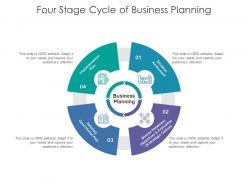
Four stage cycle of business planning





Try Before you Buy Download Free Sample Product
 Impress Your
 Audience
 100%
100% Editable
 Save Hours
 of Time


Our Four Stage Cycle Of Business Planning are topically designed to provide an attractive backdrop to any subject. Use them to look like a presentation pro.
People who downloaded this PowerPoint presentation also viewed the following :
Four stage cycle of business planning with all 2 slides:
Use our Four Stage Cycle Of Business Planning to effectively help you save your valuable time. They are readymade to fit into any presentation structure.
FAQs for Four stage cycle
So basically you've got four main stages: planning, doing the work, keeping tabs on progress, and then looking back at how it went. Start by figuring out your goals and how you'll hit them. Then just execute - but here's where it gets tricky. Most of us (myself included) totally drop the ball on monitoring, which is honestly where you catch problems before they blow up. After that, review everything to see what actually worked. The whole thing loops back around - your review becomes the foundation for planning round two. Oh, and definitely do quarterly check-ins or you'll just drift off course.
Honestly, I'd start with the easy wins first - industry reports and checking out what your competitors are doing. Survey your current customers online too. Social media listening tools are amazing for this stuff, way better than I expected when I first tried them. Focus groups work great but they'll eat up your time if you're not organized about it. Government databases have solid info, and don't sleep on trade publications. Just set your budget and timeline upfront or you'll be researching forever. Mix primary research with secondary - that combo gives you the full story.
SWOT analysis is like doing a gut check before you make any big moves. Map out your strengths, weaknesses, opportunities, and threats - gives you the real picture of where you stand internally and what's happening around you. Most people totally skip this step or half-ass it, which is dumb because it literally shapes your entire strategy. You'll know what you're good at, what needs work, where to jump on opportunities, and what might blindside you. Oh, and don't just do this once a year - I'd say quarterly makes way more sense since everything changes so fast now.
At minimum, do it yearly. But quarterly makes way more sense honestly - things move too fast now to wait a whole year. I'd do one big deep dive annually where you question everything, then lighter quarterly updates for tactics and numbers. Monthly works too if you're in startup mode or your industry's crazy volatile. My old boss used to say the trick is finding your rhythm and not flip-flopping every five seconds. Pick what works for your company size and actually stick to it, you know?
Okay so SMART goals are actually legit - Specific, Measurable, Achievable, Relevant, Time-bound. I used to think it was corporate BS but it works. Instead of "grow the business," say "increase revenue by 15%." Way better for tracking. Your targets should be realistic based on what's actually happened before, not some pipe dream. Everything needs to connect back to your main strategy too. Oh and definitely do quarterly check-ins - honestly that's probably the most crucial part because you'll need to adjust things. Most people set goals then forget about them completely.
So here's the thing - your financial forecasts need to come FROM your business plan, not the other way around. Take each big initiative you've mapped out and figure out exactly how it'll hit your revenue and costs. Timeline matters too. I've watched so many people just randomly plug numbers into Excel without thinking about what's actually driving them... total mess. Check both docs monthly and update them together when stuff changes. Every projected dollar should connect back to something real you're planning to do. Otherwise you're just making up numbers, honestly.
Honestly? Start basic. Gantt charts are clutch for timelines, and flowcharts help you map everything out step by step. SWOT analysis is solid for the strategic stuff too. Don't overthink the software - I've watched teams spend weeks picking the "perfect" tool when a spreadsheet would've worked fine. Kanban boards are cool if your team's into that visual thing. Miro and Lucidchart are decent, but PowerPoint works too (weird flex, but whatever). Just use what everyone already knows. You can always get fancy later once you figure out what actually works for your process.
Yeah, economic stuff totally messes with your planning cycle. When things get sketchy, you're basically doing quarterly check-ins instead of just annual plans. Honestly, it's pretty draining but you don't have much choice. Interest rates shift, people stop spending, and suddenly you're scrambling to rebuild your whole strategy. I've seen companies go from super confident five-year plans to "let's just figure out the next six months" mode real quick. The trick is watching those signals early - like way before you're panicking. Build contingency plans when times are good, not when everything's already falling apart.
Honestly, you're gonna run into three main headaches. Budget always gets blown - like, every single time. Key people disappear right when you need them because other projects steal them away. And departments stop talking to each other, which creates this whole mess of wrong assumptions. Oh, and markets love to change halfway through your project because why not? Super fun timing, right? Build in extra time and money from day one - trust me on this. Weekly check-ins are clutch for catching problems before they snowball into disasters. Sounds boring but it actually saves your sanity later.
Honestly, tech can be a game-changer for planning stuff. Automated data collection saves you from drowning in spreadsheets - and trust me, nobody has time for that nightmare anymore. Real-time dashboards are clutch because your whole team can jump in and update things at once. AI tools actually spot patterns you'd probably miss on your own. Financial modeling becomes way less painful too. Oh, and cloud platforms mean everyone stays in sync instead of working off different versions (been there, it's messy). Just make sure whatever you pick plays nice with your current setup. Otherwise you're just adding another headache to deal with.
You'll want to watch your revenue, profit margins, and cash flow first - those are make-or-break numbers. Customer stuff matters too: how much it costs to get them, how long they stick around, that lifetime value thing. Oh and operational metrics like productivity and market share. Honestly? Most people go overboard tracking every damn thing and then can't see the forest for the trees. I'd pick maybe 5-7 metrics that actually connect to your main goals. Check them monthly. That way you're not drowning in data but you still know what's happening. Way better than having 20 dashboards you never look at.
Don't wait until the end to ask for feedback - that's where most plans die. Figure out who matters early on (customers, employees, whoever) and when you actually need their input. Like, get customer thoughts before you finalize features, not after you've built everything. Set up regular check-ins throughout the process - surveys work, but honestly one-on-ones usually get better stuff. The thing people forget? You've gotta close the loop. Tell them what you did with their feedback, even if you ignored half of it. Otherwise they'll stop caring next time.
Think of risk assessment as your heads-up before stuff hits the fan. What could mess up your plans? Cash problems, competitors doing something crazy, market changes - you know the drill. I learned this the hard way watching good ideas crash because no one thought ahead. Don't go full doom-and-gloom, but definitely ask "what if this goes sideways?" Write down your biggest 3-5 worries and figure out plan B for each. Honestly beats scrambling later when everything's on fire.
Break your big goals into 90-day chunks - way less overwhelming that way. I always start with my annual revenue target, then work backwards to see what I actually need each quarter. New customers, product drops, whatever's gonna move things forward. Here's the thing though: most people (myself included, honestly) set these goals and then completely forget to check in. Don't do that! Pick 2-3 metrics you'll actually track. Review every quarter and change course if something's tanking. That review phase is where you'll find the good stuff - the real insights about what's working. Seriously, put your next review date in your calendar right now.
Think of strategic plans as your 3-5 year vision - where you want the company to go. Operational plans are more like your next 12-18 months of actual work to get there. Strategic stuff covers the big picture: growth targets, new markets, major goals. Pretty high-level thinking. Operational gets way more specific - budgets, deadlines, who's doing what tasks. Honestly, you can't really do one without the other. Start with strategy first, then break it down into operational steps. Otherwise you're just busy without direction, which I've definitely seen happen before. Both matter, but operational is where you'll spend most of your day-to-day energy.
-
Very unique and reliable designs.
-
Great quality slides in rapid time.
-
Unique design & color.
-
Designs have enough space to add content.
-
Best Representation of topics, really appreciable.
-
Easy to edit slides with easy to understand instructions.
-
Designs have enough space to add content.