


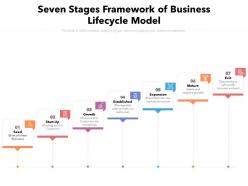
Seven stages framework of business lifecycle model





Try Before you Buy Download Free Sample Product
 Impress Your
 Audience
 100%
100% Editable
 Save Hours
 of Time


Our Seven Stages Framework Of Business Lifecycle Model are topically designed to provide an attractive backdrop to any subject. Use them to look like a presentation pro.
People who downloaded this PowerPoint presentation also viewed the following :
Seven stages framework of business lifecycle model with all 2 slides:
Use our Seven Stages Framework Of Business Lifecycle Model to effectively help you save your valuable time. They are readymade to fit into any presentation structure.
FAQs for Seven stages framework of
Okay so there are four main stages - startup, growth, maturity, and decline/renewal. Each one totally shifts your strategy. Startup's all about finding product-market fit and not dying. Growth means you're scaling fast and grabbing market share. Maturity? You're optimizing everything and protecting what you've built. Then decline hits and you either innovate hard or pivot completely. The thing is, most companies act like their current phase will last forever - huge mistake. Your priorities, how you spend money, and risk tolerance should change dramatically between stages. Figure out where you are right now and plan from there.
Honestly, just look at your numbers and daily headaches - they'll tell you everything. Still figuring out if people actually want your product while cash disappears? Classic startup phase. Once you've got steady revenue coming in and you're scaling up (though it still feels like controlled chaos half the time), that's growth stage. Maturity hits when your growth starts flattening out and you're tweaking processes instead of building new stuff. Check your burn rate and how you're getting customers. Are you solving fresh problems or just making current solutions better? That usually makes it pretty obvious which stage you're in.
Hey! So this totally depends on what stage you're at. Just starting out? Watch your customer acquisition costs and how fast you're growing users - retention rates tell you if people actually want what you're building. Once you hit growth mode, revenue growth and market share become way more important. Mature companies should focus on profit margins and customer lifetime value, though honestly most get sloppy here and stop paying attention. If things are declining, cash flow is everything. Pick like 3-5 metrics max and actually look at them monthly - don't get overwhelmed with tracking everything under the sun.
Market conditions are like hitting the gas or slamming the brakes on your business timeline. When things are hot, you'll blast through intro and growth phases because everyone's buying and investors are throwing money around. But during downturns? You might sit in maturity forever or even backslide into decline. I've seen companies pivot their entire model just to survive a bad economy - it's like hitting the reset button. Your timeline isn't fixed though. You've got to read the room and adjust your growth plans and cash flow based on what's actually happening out there.
Honestly, innovation is what keeps businesses from dying at each stage. Early on, you're scrambling for product innovation to find your market fit. Growth phase means focusing on processes so you can scale without everything falling apart (spoiler: stuff will still break). Maturity is where it gets interesting though - that's when you're most vulnerable to disruption. You've got to reinvent before someone else eats your lunch. The trick is knowing which type of innovation fits where you are now. Oh, and always be thinking about what's coming next, even when things are going well.
Honestly, start forecasting 3 months ahead and update it weekly - sounds tedious but it'll save your ass. Get invoices out immediately, then follow up like your life depends on it. Early payment discounts work surprisingly well for speeding up collections. With new customers, tighten those payment terms from day one. Also negotiate longer payment windows with your suppliers while you can - creates some breathing room. Banks are weird - they'll throw money at you when you don't need it, so grab a credit line while your books look decent. Oh, and resist blowing every dollar during growth spurts. That's the hardest part.
So there's actually a bunch of ways you can shake things up. Product innovation is probably your best bet - tweak what you've got or create something totally new for a different crowd. Geographic expansion works great too, or just dive into markets that are kinda related to yours. Oh, and don't ignore the boring stuff like making your operations smoother. That frees up cash for the fun projects. Aggressive pricing can steal market share fast. Sometimes though? A simple rebrand does way more heavy lifting than you'd think. Just pick one or two things max - I've seen too many businesses try everything at once and fail miserably.
Look, customer feedback is everything when you're starting out - you're literally building whatever early users say they need. Once you get bigger, it helps you figure out which features to prioritize and avoid costly mistakes down the road. Growth stage? That's when feedback shows you new markets to explore. Set up those feedback systems early though - surveys, interviews, support tickets, whatever works. I learned this the hard way, but you really want to hear what customers actually want, not what sounds good in your head. Sometimes you'll get flooded with input and feel totally overwhelmed, but that beats guessing.
Most companies either stick their heads in the sand or totally freak out and start slashing prices everywhere - which honestly just makes things worse. They'll cling to strategies that stopped working years ago. It's pretty painful to watch. Accept what's happening early, that's crucial. Double down on whatever's still making you money and cut costs smartly, not just randomly. Maybe the whole business model needs a complete overhaul? Either way, have an exit plan ready before you absolutely need it. Don't wait until you're backed into a corner.
Your tech needs totally shift as you grow. Start with cheap, flexible stuff - cloud CRM, basic project tools. They'll grow with you without breaking the bank. Once you're scaling up, that's when automation makes sense. Get those repetitive tasks off your plate and invest in better analytics to actually understand what customers want. I swear, so many companies go overboard too early and waste money. Later on? AI and fancy data platforms become worth it. Pro tip - check your tools every few months. Ask yourself "do we even use this anymore?" You'd be shocked how much random software just... accumulates.
Honestly, start way earlier than you think - like 2-3 years out. Get your books audited and clean up any messy legal stuff first. Build solid relationships with customers and suppliers because buyers hate inheriting drama. Document everything so the business doesn't crater when you leave (I've seen this happen too many times). If you're thinking family or employees might take over, start grooming them now. The worst thing? Waiting until you're completely burned out to figure this out. Your systems need to run without you, period. Oh, and succession planning isn't just about picking someone - they need actual training time.
Look, leadership can totally make or break how well you handle these business phases. Each stage needs different skills - startups need big vision and risk-taking, growth phase is all about nailing operations, maturity requires laser focus on efficiency. Then if you hit decline, you better have someone who can transform things fast. I've watched way too many solid companies crash because their leaders couldn't switch gears when needed. The tricky part? Figuring out when your current approach isn't working anymore. You've got to be brutally honest about whether your team has the right skills for what's coming next, not just what got you here.
Honestly, the economy can totally wreck your business no matter what stage you're in. When you're starting out, good luck getting loans if credit's tight. But even boom times aren't perfect - yeah there's more opportunity, but everyone else sees it too. Growth phase during a recession? Brutal. Your customers stop spending right when you desperately need that revenue coming in. I used to think established companies were bulletproof until 2008 happened. Build some wiggle room into how you operate. Keep way more cash on hand than feels comfortable - trust me on this one.
So here's what works - pick 3-4 "what if" scenarios for each stage of your business. Economic crash, supply chain mess, competitor swooping in, demand going crazy. Then figure out the warning signs and prep responses ahead of time. Cash cushions, backup suppliers, that kind of stuff. Most people think this is overkill (I used to), but man does it pay off when things go sideways. Just start with whatever scenario scares you most and build one decent backup plan. Way better than scrambling later.
Okay so basically B2B takes forever compared to B2C - we're talking months or years vs days/weeks. With B2B you've got like 5 different people who need to sign off on everything, which honestly drives me crazy sometimes. Plus there's all this relationship building you can't skip. B2C customers? They see something, want it, buy it. Done. Way more straightforward. The growth phases drag on longer too since you're nurturing these partnerships instead of just closing quick deals. My advice - if you're doing B2B stuff, just accept that everything will take twice as long as you think and focus hard on those relationships.
-
Excellent Designs.
-
Awesome use of colors and designs in product templates.
-
Designs have enough space to add content.
-
Designs have enough space to add content.