


Stages in channel partner lifecycle management




Try Before you Buy Download Free Sample Product
 Impress Your
 Audience
 100%
100% Editable
 Save Hours
 of Time


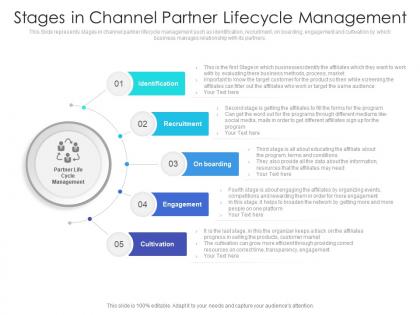
This Slide represents stages in channel partner lifecycle management such as identification, recruitment, on boarding, engagement and cultivation by which business manages relationship with its partners.
People who downloaded this PowerPoint presentation also viewed the following :
Stages in channel partner lifecycle management with all 2 slides:
Use our Stages In Channel Partner Lifecycle Management to effectively help you save your valuable time. They are readymade to fit into any presentation structure.
FAQs for Stages in channel
The key stages in the channel partner lifecycle include recruitment, onboarding, enablement, performance management, growth optimization, and renewal or transition. These stages streamline partnership development by establishing clear expectations, providing comprehensive training, and implementing continuous support systems, with many organizations finding that structured lifecycle management ultimately delivers stronger partner relationships, improved market reach, and enhanced revenue performance across diverse sales channels.
Organizations effectively onboard new channel partners through comprehensive training programs, clear communication of brand standards and expectations, dedicated partner support teams, and structured certification processes. This strategic approach enables partners to understand product portfolios, sales methodologies, and go-to-market strategies more quickly, while streamlining partner integration and accelerating time-to-productivity, ultimately delivering stronger channel relationships and enhanced revenue growth.
Key metrics include revenue generated, sales growth rates, customer acquisition numbers, deal closure times, market penetration levels, and partner satisfaction scores. These performance indicators enable organizations to assess partner effectiveness across different territories and product lines, while identifying high-performing partners for expanded partnerships and those requiring additional support, ultimately optimizing channel strategy and maximizing mutual profitability.
Ensuring alignment requires establishing clear mutual objectives, implementing regular performance reviews, creating shared incentive structures, and maintaining open communication channels throughout the partnership lifecycle. Through structured quarterly business reviews and collaborative planning sessions, organizations can synchronize partner strategies with their own growth targets, ultimately delivering enhanced market reach and revenue optimization for both parties.
Training and support serve as critical enablers throughout partner lifecycle management, encompassing onboarding programs, product education, sales enablement, technical certifications, and ongoing performance coaching. These initiatives accelerate partner time-to-market, enhance selling capabilities, and strengthen relationship retention, with many organizations finding that comprehensive support programs directly correlate with increased partner revenue contributions and long-term strategic alignment.
Technology facilitates better communication with channel partners through integrated CRM systems, automated messaging platforms, real-time collaboration tools, mobile applications, and centralized partner portals. These solutions streamline information sharing, enable instant updates on inventory and pricing, and provide seamless access to marketing resources, ultimately enhancing partnership efficiency and accelerating joint sales processes across diverse markets.
Retaining top-performing channel partners requires implementing exclusive incentive programs, providing priority technical support, offering enhanced marketing co-op funds, creating strategic business reviews, and establishing dedicated account management. These retention strategies enhance partner loyalty by delivering competitive advantages, streamlined operational support, and accelerated market access, with many organizations finding that personalized partnership approaches significantly increase long-term revenue growth.
Partner segmentation significantly impacts lifecycle management by enabling tailored approaches based on partner capabilities, market reach, performance levels, and strategic value to the organization. Through strategic segmentation, companies can allocate resources more effectively, customize onboarding processes, and implement differentiated support strategies, with many organizations finding that segmented approaches deliver higher partner engagement, improved performance outcomes, and stronger competitive positioning across diverse market segments.
Common partner renewal challenges include performance evaluation disputes, contract negotiation complexities, changing market conditions, renewal timeline management, and evolving partnership expectations. These obstacles can strain relationships through misaligned metrics, pricing disagreements, and strategic shifts, with many organizations finding that proactive communication, transparent performance tracking, and flexible renewal frameworks ultimately deliver stronger partnerships and improved retention rates.
Organizations leverage data analytics for improving partner performance by tracking sales metrics, engagement levels, training completion rates, customer satisfaction scores, and revenue contributions across different channels. Through predictive analytics and performance dashboards, businesses can identify underperforming partners, optimize resource allocation, and provide targeted support, with many companies finding that data-driven insights ultimately enhance partner productivity and strengthen channel relationships.
Relationship management serves as the foundation for successful partner lifecycle outcomes, directly influencing partner retention, performance optimization, and mutual revenue growth through consistent communication, strategic alignment, and trust-building initiatives. Strong relationship management enables organizations to maximize partner potential, reduce churn, and create collaborative environments where both parties achieve sustained competitive advantage and long-term business success.
Changing market dynamics significantly influence channel partner management by requiring more agile partnership strategies, enhanced digital collaboration tools, and flexible performance metrics that adapt to evolving customer expectations. Organizations increasingly find that successful channel management involves real-time market intelligence sharing, dynamic territory adjustments, and streamlined communication systems, ultimately delivering competitive responsiveness and sustained partner loyalty in volatile business environments.
**INPUT**: What are some best practices for conducting partner performance reviews? **OUTPUT**: Best practices for partner performance reviews include establishing clear KPIs upfront, conducting regular quarterly assessments, using data-driven scorecards, providing actionable feedback, and creating collaborative improvement plans. These structured approaches enable organizations to strengthen relationships, identify growth opportunities, and optimize resource allocation, with many companies finding that consistent review processes ultimately deliver improved partner satisfaction, enhanced performance alignment, and stronger competitive positioning. [Word count: 60]
Effective feedback loops can be established through regular partner surveys, performance review meetings, dedicated communication channels, joint business planning sessions, and structured escalation processes. These mechanisms enable organizations to identify partnership challenges early, optimize collaboration strategies, and enhance mutual value creation, with many companies finding that consistent feedback cycles strengthen partner relationships while driving improved business outcomes and competitive advantage.
Incentives drive channel partner engagement by aligning rewards with performance milestones, sales targets, and strategic objectives throughout onboarding, growth, and retention phases. These structured programs enhance partner loyalty, accelerate market penetration, and increase revenue generation, with many organizations finding that tiered incentive structures ultimately deliver stronger partnerships and competitive advantage.
-
Content of slide is easy to understand and edit.
-
Qualitative and comprehensive slides.
-
Best way of representation of the topic.
-
Great experience, I would definitely use your services further.