

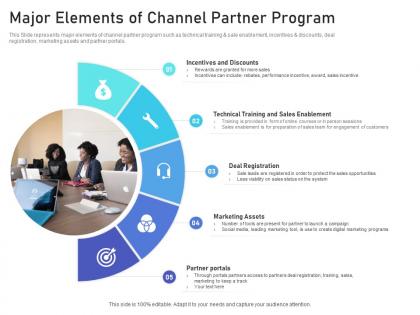
Major elements of channel partner program




Try Before you Buy Download Free Sample Product
 Impress Your
 Audience
 100%
100% Editable
 Save Hours
 of Time


This Slide represents major elements of channel partner program such as technical training and sale enablement, incentives and discounts, deal registration, marketing assets and partner portals.
People who downloaded this PowerPoint presentation also viewed the following :
Major elements of channel partner program with all 2 slides:
Use our Major Elements Of Channel Partner Program to effectively help you save your valuable time. They are readymade to fit into any presentation structure.
FAQs for Major elements of
Channel partner programs deliver expanded market reach, reduced sales costs, accelerated revenue growth, enhanced customer service capabilities, and improved competitive positioning. Through strategic partnerships, businesses access new geographic markets and customer segments while leveraging partners' established relationships and local expertise, ultimately achieving faster growth with lower operational overhead than direct sales approaches.
Identifying the right channel partners involves evaluating market reach, technical capabilities, customer relationships, financial stability, and strategic alignment with your business goals. Successful companies assess potential partners' existing client bases, sales expertise, and geographic coverage, while ensuring cultural fit and commitment levels match program requirements, ultimately selecting partners who can deliver scalable growth and enhanced market penetration.
Partner agreements should include clear performance metrics, territory definitions, pricing structures, marketing support commitments, training requirements, and dispute resolution processes. These elements enable partners to understand expectations while providing necessary resources, with many organizations finding that comprehensive agreements with defined revenue targets, co-marketing guidelines, and regular review schedules ultimately deliver stronger partnerships and sustained growth.
Effective channel partner training structures include comprehensive product knowledge sessions, sales methodology workshops, technical certification programs, ongoing skill development modules, and performance assessment frameworks. These programs streamline partner readiness through standardized curricula, hands-on practice opportunities, and milestone-based progression tracking, with many organizations finding that structured onboarding accelerates time-to-productivity while ensuring consistent brand representation across channels.
Channel partner programs should track revenue growth, partner acquisition rates, training completion percentages, market penetration levels, and customer satisfaction scores. These metrics enable organizations by measuring financial performance, operational efficiency, and strategic alignment, with many companies finding that combining quantitative sales data with qualitative partnership health indicators ultimately delivers comprehensive program optimization and sustained competitive advantage.
Marketing resources can be tailored through customizable templates, co-branded materials, localized content libraries, partner-specific messaging frameworks, and flexible campaign toolkits that accommodate different market segments and partner capabilities. These resources enable partners across retail, technology, and professional services sectors to maintain brand consistency while addressing their unique customer bases, ultimately delivering enhanced market penetration and stronger partner relationships.
Communication serves as the foundation for channel partner relationships, enabling transparent expectations, regular performance feedback, strategic alignment, and collaborative problem-solving. Through consistent updates, shared resources, and open dialogue channels, organizations build trust, resolve conflicts efficiently, and ensure partners remain engaged and motivated, ultimately delivering stronger market presence and mutual growth opportunities.
Technology enhances channel partner collaboration through unified communication platforms, shared CRM systems, real-time data analytics, automated workflow management, and integrated training portals. These digital solutions streamline information sharing, accelerate joint decision-making, and improve partner onboarding processes, with many organizations finding that strategic technology integration ultimately delivers faster market responses and stronger revenue growth.
Effective incentive strategies include tiered commission structures, performance bonuses, marketing development funds, exclusive territory rights, and recognition programs. These approaches enhance partner engagement by rewarding top performers, providing co-branded promotional support, and offering competitive advantages, with many organizations finding that combining financial incentives with strategic business support ultimately delivers stronger channel relationships and accelerated revenue growth.
Partner feedback can be integrated through regular surveys, quarterly business reviews, partner advisory councils, and dedicated feedback portals that capture real-time insights. Many successful programs establish formal feedback loops where partners collaborate on program design, policy updates, and resource development, ultimately creating more relevant support structures and stronger partner satisfaction that drives mutual growth.
**INPUT**: What are the common challenges faced when launching a channel partner program? **OUTPUT**: Common challenges include partner recruitment difficulties, inconsistent brand messaging, inadequate training resources, complex commission structures, and limited communication channels. These obstacles can significantly impact program effectiveness, with many organizations finding that insufficient onboarding processes and unclear performance metrics ultimately hinder partner engagement and revenue growth, requiring strategic planning and dedicated resources. **Word count: 54 words**
Companies should handle channel partner conflicts through clear escalation procedures, transparent communication protocols, and established mediation processes that prioritize mutual business interests over individual grievances. Successful resolution involves neutral facilitation, documented agreements on territory boundaries or pricing structures, and regular partner forums where issues can be addressed proactively, ultimately strengthening partnerships while maintaining channel stability.
Co-branding best practices include establishing clear brand guidelines, defining usage rights and restrictions, creating joint marketing materials, maintaining consistent messaging across channels, and implementing approval processes for partner communications. These practices streamline brand consistency by protecting brand equity, enhancing partner credibility, and ensuring unified customer experiences, with many organizations finding that strategic co-branding ultimately delivers stronger market presence and increased sales performance.
Social media enhances channel partner programs by enabling co-marketing campaigns, facilitating real-time communication between partners, and amplifying brand messaging across multiple networks simultaneously. Through platforms like LinkedIn and Twitter, organizations streamline partner onboarding, share product updates, and coordinate joint promotional activities, ultimately delivering broader market penetration and stronger partner relationships.
Clear goals and objectives provide strategic direction for channel partners, ensuring alignment with business priorities, performance expectations, and revenue targets. They enable partners to focus resources effectively, measure success consistently, and optimize their sales strategies, while helping organizations track ROI, identify top performers, and scale partnerships efficiently across diverse markets and customer segments.
-
Graphics are very appealing to eyes.