

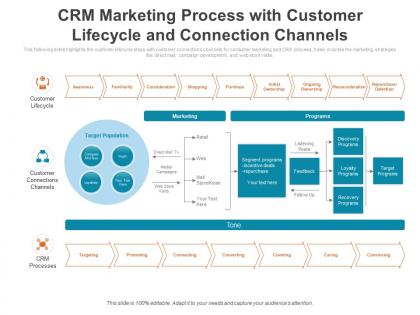
Crm marketing process with customer lifecycle and connection channels




Try Before you Buy Download Free Sample Product
 Impress Your
 Audience
 100%
100% Editable
 Save Hours
 of Time


Our CRM Marketing Process With Customer Lifecycle And Connection Channels are topically designed to provide an attractive backdrop to any subject. Use them to look like a presentation pro.
People who downloaded this PowerPoint presentation also viewed the following :
Crm marketing process with customer lifecycle and connection channels with all 2 slides:
Use our CRM Marketing Process With Customer Lifecycle And Connection Channels to effectively help you save your valuable time. They are readymade to fit into any presentation structure.
FAQs for Crm marketing process with customer lifecycle
So basically you'll want to start with data collection - grab info from all your customer touchpoints first. Then segment people by behavior, demographics, whatever makes sense for your business. Campaign creation comes next, and honestly this is where most people either crush it or totally mess up. After that you execute across your channels and track everything. The analysis part is where it gets interesting though - you figure out what actually worked and use those insights for your next round. Oh and don't try to do everything at once, start small with good data collection because that's your foundation for everything else.
So basically, your CRM shows you everything about each customer - what they've bought, what they like, how they interact with your stuff. Use that info to actually personalize your emails instead of sending the same boring message to everyone. Winter gear shoppers don't want summer sale emails, you know? Segment people based on their behavior and send them stuff they'll actually care about. You can customize subject lines, product suggestions, even the timing of when you send things. Honestly, most companies are terrible at this. The whole point is making your emails feel like you're talking to them specifically, not just mass marketing.
Honestly, data analytics is what makes CRM marketing actually worth doing. You'll see which customers matter most and what campaigns bring in real money. Instead of sending the same boring email to everyone (guilty!), you can target way better. The cool part? It finds patterns you'd never catch - like exactly when someone's ready to buy or where they bail out. I'd start simple though. Track open rates, conversions, and how much customers are worth over time. Once you get the hang of those three, you can dive deeper.
Honestly, just start with the basics - look at how recently people bought stuff, how often they buy, and how much they spend (that's called RFM analysis, sounds fancy but it's not). Your CRM probably has segmentation tools already built in, which is way better than trying to mess around in Excel like I did at first. Also check out demographics, where people live, and how they like to be contacted. Don't overcomplicate it though - maybe 3-4 groups to start. Pick one segment this week and send them something targeted. You'll be surprised how much better it works than blasting everyone with the same message.
Honestly, your biggest pain points will be messy data and team politics. Sales data is usually scattered everywhere - different systems, incomplete records, the works. Cleaning that up is brutal at first. Getting marketing and sales to actually work together instead of doing their own thing? Good luck with that one. Staff will push back on new processes too, which I get - nobody likes change. Oh, and integrating with whatever tools you're already using can be a total headache. My advice? Pick one simple thing to fix first, show some results, then build from there. Don't try to overhaul everything at once.
Honestly, CRM integration is a game changer - it connects all your tools so you're not constantly juggling tabs. Link it to your email platform, social media, analytics, whatever you use most. You'll finally see the full customer picture instead of piecing together fragments from different dashboards. The best part? Marketing and sales actually stay on the same page for once. Personalized campaigns become way easier when you can see real behavior patterns. I'd start with email and analytics first since those are probably your bread and butter anyway.
Honestly, start with conversion rates - that's the big one. How many of your leads actually become paying customers? Then look at customer acquisition cost and email performance (opens, clicks, the usual). Customer lifetime value matters too, but don't stress about stuff like total email volume - nobody cares how many emails you sent if they're not working. Lead scoring is clutch for seeing if you're going after the right people. Oh, and track how long your sales cycles are taking. That tells you if things are actually speeding up. Pick maybe 3-4 metrics that match what you're trying to accomplish first.
Dude, automation is seriously worth it - it handles all the boring repetitive stuff while you focus on actual strategy and building relationships. You can set up email sequences that trigger based on what customers do, score leads automatically, send personalized messages when they hit certain points. Honestly took me way too long to finally try it but now I'm kicking myself for waiting. The best part? Leads don't get forgotten when you're crazy busy since the system keeps working. My advice is start simple though - just pick one customer journey and automate that first before you go nuts with everything else.
First thing - get clear consent before grabbing any data. Your opt-ins need to spell out exactly what you're doing with their info. Set up role-based access so only the right people see sensitive stuff. Oh, and automate your data retention policies now - I learned this the hard way doing manual cleanups later. Check which regulations hit you (GDPR, CCPA, whatever). Start with auditing what data you've got sitting around. You'd be shocked what random stuff accumulates in systems over time. Regular access audits help too.
Dude, just grab HubSpot's free version or maybe Zoho's basic plan to start. Don't overthink it. Those handle like 90% of what small businesses actually need anyway. I'd focus on the stuff that wastes your time - automated follow-ups, email sequences, that kind of thing. Most expensive CRMs are honestly just paying for features you'll never touch. Here's the thing though - whatever you pick, you gotta actually use it consistently. Set up some basic workflows and force yourself to log every single interaction for at least a month. Otherwise it's just expensive digital clutter. You can always upgrade once you're making money from it.
So basically, CRM lead scoring ranks your prospects automatically based on what they do and who they are. No more chasing people who aren't interested! It tracks email opens, website clicks, downloads - all that stuff - then gives points to show you the hottest leads. The cool part is setting up email sequences that change based on someone's score. Like, someone downloading your pricing gets way different follow-ups than a casual blog reader. Honestly, it's pretty brilliant how it runs itself while you focus on closing deals. Just start with simple scoring rules first though.
Honestly, customer feedback is like having a cheat sheet for your CRM strategy. You're getting actual intel straight from people's mouths instead of making stuff up. Set up those automated surveys after purchases or support calls - then use what you learn to group customers by their real problems, not just demographics. Your campaigns will actually hit different when they're based on what people told you they want. Plus you'll spot which parts of your customer journey are totally broken (there's always at least one). Way better than throwing spaghetti at the wall and hoping something sticks.
Honestly, CRM is a game-changer for loyalty because you get the full picture of each customer - their buying history, what they love, how they behave. You can actually personalize stuff instead of sending those annoying mass emails everyone deletes immediately. Everything's stored in one spot, so you'll solve problems way faster. The segmentation tools help you create campaigns that actually hit different - way more effective. Oh, and automated follow-ups are clutch for loyalty programs. Start simple though: set up birthday emails or anniversary messages when someone made their first purchase. Those little touches make people feel special without you having to track everything manually.
Your CRM's got crazy good analytics now - honestly didn't expect how smart they've gotten. Start with your top 20% customers since they usually show where everything's headed. Look for the obvious stuff first: buying patterns, seasonal spikes, what products people grab together. Set up those automated alerts for when behavior shifts. Your system tracks email opens, site visits, all that good data. You can actually predict churn pretty well if you watch for customers following similar paths as previous buyers. Oh and purchase timing - that's huge for knowing when someone's ready to buy again. Makes targeting way less of a guessing game.
Honestly, AI is completely changing the CRM game right now. Predictive analytics can tell you which leads are actually worth chasing (game changer). Chatbots don't totally suck anymore, and you've got dynamic content that shifts based on what people do on your site. Voice assistants are creating weird new touchpoints too - still getting used to that idea myself. The whole thing's moving away from boring data entry toward smarter customer experiences. I'd start small though. Even basic automation in whatever platform you're using will save you hours each week.
-
Visually stunning presentation, love the content.
-
Appreciate the research and its presentable format.
-
Topic best represented with attractive design.