B2b customer journey mapping process

Rating:
87%
B2b customer journey mapping process
Slide 1 of 2
Favourites Favourites

Try Before you Buy Download Free Sample Product

Audience Impress Your
Audience
Editable 100%
Editable
Time Save Hours
of Time
The Biggest Sale is ending soon in
0
0
:
0
0
:
0
0
Rating:
87%
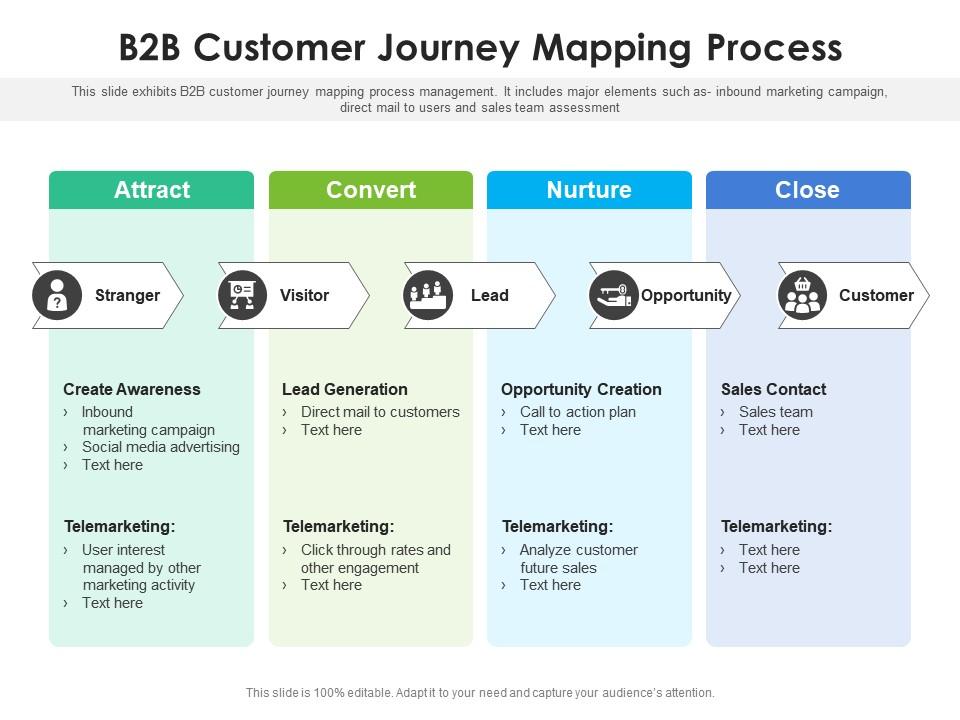
This slide exhibits B2B customer journey mapping process management. It includes major elements such as inbound marketing campaign, direct mail to users and sales team assessment. Introducing our B2B Customer Journey Mapping Process set of slides. The topics discussed in these slides are Stranger, Lead Generation, Opportunity, Customer, Visitor. This is an immediately available PowerPoint presentation that can be conveniently customized. Download it and convince your audience.

People who downloaded this PowerPoint presentation also viewed the following :

Content of this Powerpoint Presentation

Description:

The image is a PowerPoint slide titled "B2B Customer Journey Mapping Process," which outlines the stages a business customer goes through from being a stranger to becoming a customer. It is structured into four main columns: Attract, Convert, Nurture, and Close, each representing a phase in the marketing and sales process.

For the "Attract" stage:

"Stranger" and "Visitor" are labeled, with activities like inbound marketing campaigns and social media advertising suggested for creating awareness.
Telemarketing is also mentioned, with a focus on managing user interest through other marketing activities.

The "Convert" stage:

Moves from "Visitor" to "Lead," emphasizing lead generation through direct mail to customers.
Telemarketing here involves tracking click-through rates and other engagement metrics.

In the "Nurture" phase:

The focus is on "Lead" to "Opportunity," with strategies like a call to action plan.
Telemarketing activities include analyzing customer data for future sales.

Finally, the "Close" stage:

Describes the transition from "Opportunity" to "Customer," involving the sales team.
Additional telemarketing strategies can be inserted where it says "Text here."

Each section contains placeholders for further customization, as indicated by "Text here," allowing the slide to be tailored to specific business processes. The note "This slide is 100% editable. Adapt it to your needs and capture your audience's attention." repeats across all sections.

Use Cases:

This slide can be used across various industries for strategic customer relationship management:

1. Software and Technology:

Use: Mapping customer acquisition for SaaS products.

Presenter: Marketing Director

Audience: Sales and marketing teams

2. Healthcare Supplies:

Use: Streamlining the process from medical product awareness to purchase.

Presenter: Sales Manager

Audience: Distributors, sales reps

3. Manufacturing Equipment:

Use: Tracking client engagement from initial contact to closing machinery sales.

Presenter: Business Development Manager

Audience: Dealers, sales force

4. Wholesale Distribution:

Use: Developing strategies for converting leads into retail partners.

Presenter: Account Executive

Audience: Potential partners, internal sales teams

5. Professional Services:

Use: Demonstrating client progression for consultancy services.

Presenter: Senior Consultant

Audience: Consulting staff, business development teams

6. Financial Services:

Use: Describing the client engagement process for financial products.

Presenter: Financial Advisor

Audience: Prospective clients, relationship managers

7. Real Estate Commercial:

Use: Outlining tenant or buyer journey from property discovery to lease or purchase.

Presenter: Real Estate Broker

Audience: Property investors, sales agents


FAQs for B2b customer

Look, B2B journeys break down into five stages: Awareness (they know something's broken), Consideration (hunting for fixes), Decision (comparing vendors while getting everyone to agree), Purchase (the actual contract dance), and Post-Purchase (making it work + renewals). Here's the thing though - B2C is straightforward, but B2B is absolute chaos. Multiple people hop in randomly, timelines drag for months, and there's endless back-and-forth. Consideration stage? Prepare for demos, RFPs, and committee meetings that go nowhere. You'll want to figure out who's calling shots at each stage and what info they actually need to say yes.

Honestly, buyer personas are everything when it comes to mapping your B2B customer journey. Without them you're basically shooting in the dark. Different personas take completely different paths through your funnel - an IT director's gonna dig deep into all the technical specs while a CEO might just want the high-level benefits, you know? I always tell people to focus on their top 2-3 personas first (don't go crazy with like 10 different ones). Then create separate journey maps for each since their timelines and touchpoints are so different. The content they want varies a ton too.

Miro and Mural are my top picks - super easy for teams to collaborate and edit stuff together. Lucidchart's solid too if you want more structure and templates. Honestly though? Some of the best journey maps I've seen were made in Figma or even PowerPoint (I know, I know). There are fancy specialized tools like Smaply but they're probably overkill unless you're mapping journeys 24/7. Just start with whatever your team already knows how to use. The actual insights you get matter way more than which shiny tool you picked.

Honestly, analytics is a game-changer for figuring out where people actually bail vs where you think they do. Track conversion rates at each step and use heatmaps to spot the friction points. You'll see which channels bring in decent leads instead of just traffic. The segmentation stuff is where it gets interesting though - break it down by company size or role and patterns just jump out at you. Oh, and don't go crazy trying to track everything right away. Pick your main touchpoints first or you'll end up with way too much noise.

Honestly, the hardest part is just getting everyone on the same page. Different departments all think they own the customer relationship, but none of them actually see what's happening end-to-end. Your data's gonna be messy too – B2B buyers lurk around researching for months before they even ping sales. It's not like B2C where you can track everything cleanly. Multiple people are involved in every decision, sales cycles drag on forever, and touchpoints are everywhere. Super frustrating. I'd pick one persona or product first and get those teams actually talking to each other. Way easier than trying to boil the ocean from day one.

Honestly, the best way is grabbing feedback through surveys, interviews, and digging through support tickets. Map out where customers actually touch your business first. Then ask them what sucks and what doesn't at each step - their real words, not what you think they feel. I've seen companies get this totally wrong by just guessing. Use their exact quotes on your map so you can spot the frustrating parts versus the smooth ones. Oh, and set up some kind of regular check-in system. Customer feelings change faster than you'd think, so your map needs to stay fresh.

Think of content marketing like breadcrumbs leading people to your door. Early on, you're writing helpful blog posts and research stuff to catch their attention. Once they're interested, hit them with comparison guides and case studies. When they're ready to buy? That's when you pull out demos and ROI calculators. Honestly, the best content marketers feel more like that friend who actually knows what they're talking about than some sleazy car salesman. Map your content to where people get confused or stuck in their buying process. Oh, and definitely audit what you've already got before creating new stuff - you might be surprised what's just sitting there unused.

Look, when your sales and marketing teams actually talk to each other, leads stop feeling like they're playing telephone between departments. The messaging stays consistent - no more confusing prospects with different pitches at every step. Both teams can finally see what's happening across the whole customer journey instead of being blind to half of it. Marketing figures out which leads actually convert (spoiler: probably not the ones they think), and sales learns what content prospects care about. Honestly, just get both teams in a room to map out the process together. Find where things get weird in the handoffs - that's where you start fixing stuff.

Track your conversion rates between each stage and see where people are dropping off - that's huge. Time spent in each phase matters too. Customer acquisition cost vs lifetime value is make-or-break stuff, seriously. If those numbers are off, you're in trouble. Email opens, content downloads, meeting acceptance rates - all good engagement signals. Lead quality scores tell you if you're even targeting the right folks. Oh, and make dashboards your team will actually check daily, not some fancy thing that sits there collecting dust.

Honestly, B2B is such a pain because you're dealing with entire committees instead of just one person. B2C customers see an ad, maybe read a review, boom - they buy. But B2B? You've got the end user, their boss, procurement, IT, probably someone's uncle who has "concerns." Takes forever too - we're talking months for big purchases, not impulse clicks. They don't really care about your Instagram ads either. These buyers are digging through trade publications and wanting demos. Start by figuring out who's actually involved in making the call - it's never just one person.

Ask open-ended stuff first - like "walk me through how you usually handle this" instead of leading them toward answers. The real gold? When they get frustrated or confused, that's when you dig deeper. I always record these (with permission obvs) because you miss so much trying to take notes. Talk to different people too - various roles, company sizes, whatever. Oh and honestly, the surface workflow stuff is boring anyway. You want their actual emotions and pain points. Listen way more than you talk. Once you really get their world, then you can start mapping things out.

So journey mapping basically lets you see where customers get stuck or annoyed. Map out every step from when they first hear about you through buying and beyond. The visual makes problems jump out - like that awkward silence after demos when prospects just vanish (seriously, why does that always happen?). You'll catch things like missing follow-ups, teams not talking to each other, or customers needing help at weird times. Pretty eye-opening stuff. Focus on the worst problems first since you can't fix everything at once.

Okay so first thing - segment your customers by industry, company size, where they are in the buying process. That's your base. Then set up dynamic content on your site and emails that actually speaks to their specific problems. Account-based marketing is honestly pretty clutch for this stuff. Build out different content hubs for each buyer persona, and use your CRM to trigger the right messages at the right time. The whole point is creating separate paths for different customer types instead of that generic spray-and-pray approach everyone does. Oh, and definitely start with just one segment first - don't try to boil the ocean.

Digital transformation basically turns customer journey mapping into chaos - but good chaos, if that makes sense? People bounce between your app, website, social media, then maybe call you or walk into a store. Those neat linear maps we used to make? Totally useless now. The upside is you get actual data on what customers do instead of just guessing (which honestly makes my data-loving heart happy). Start by mapping all your digital stuff first - Instagram, email, website, whatever. Then add the offline touchpoints. It gets messy but you'll see patterns.

Look, getting everyone involved in mapping your customer journey is a game changer. Sales sees handoffs differently than customers do - and that gap is huge. Marketing finds out where their leads actually get stuck (spoiler: it's usually not where they think). The best part? When people help build the map, they actually care about fixing what's broken instead of just sitting through another pointless meeting. Your customer success team finally gets to see what wild promises sales is making. Meanwhile, product discovers how confusing your demo process really is. Honestly, just grab one person from each team that talks to customers and you're golden.

Ratings and Reviews

87% of 100
Review Form
Write a review
Most Relevant Reviews
  1. 100%

    by Kyle Anderson

    Great quality slides in rapid time.
  2. 80%

    by Williams Nelson

    Perfect template with attractive color combination.
  3. 80%

    by Damien Murray

    Use of icon with content is very relateable, informative and appealing.

3 Item(s)

per page: