


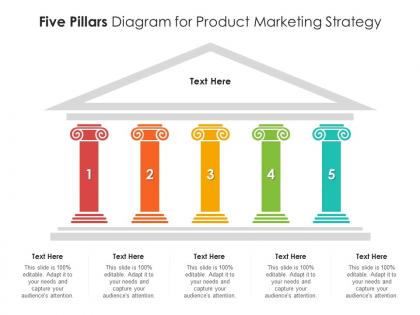
Five pillars diagram for product marketing strategy infographic template




Try Before you Buy Download Free Sample Product
 Impress Your
 Audience
 100%
100% Editable
 Save Hours
 of Time


This Five Pillars Diagram For Product Marketing Strategy Infographic Template is a professionally drafted slide that can be deployed by managers, executives, owners, consultants, and other individuals to make their presentation more visually appealing. This layout helps the viewers gain quality information in less amount of time, thus conveying your message in the best possible manner. It reinforces the topics presented and makes their explanation more simplified, which is why this infographic template will suit any professional domain. Its vivid colors, graphics, design, etc., not only increases the aesthetics of the slideshows but also initiates immediate action. One of the advantages of downloading this PowerPoint design is that it can be reproduced as PNGs, JPGs, and PDFs that can be stored for further application. Hence, without indulging in a vigorous brainstorming session, download this layout now.
People who downloaded this PowerPoint presentation also viewed the following :
Five pillars diagram for product marketing strategy infographic template with all 2 slides:
Use our Five Pillars Diagram For Product Marketing Strategy Infographic Template to effectively help you save your valuable time. They are readymade to fit into any presentation structure.
FAQs for Five pillars diagram for product marketing
Okay so you'll need five main things: market research to actually understand your customers, competitive analysis to see what you're dealing with, positioning that sets you apart, messaging that clicks with people, and a solid go-to-market plan. Most teams totally skip the research though and jump right into messaging - which is honestly backwards. Figure out your target customer personas first, then build around them. Your positioning should answer why they'd pick you over everyone else. Oh and make sure your messaging sounds like how they actually talk, not corporate speak.
Honestly, market research is everything. It shows you who's actually buying your stuff and what keeps them up at night. Otherwise you're just throwing darts blindfolded - not fun when it's your budget on the line. You'll figure out how to talk to different customer groups, which channels actually work, and where you stack up against competitors. Plus you might discover opportunities you totally missed before. Oh, and do customer interviews first! Don't write any marketing copy until you've talked to real people. Trust me on this one.
Honestly, customer segmentation is everything for product marketing. You're basically grouping people by demographics, behaviors, whatever makes sense - then crafting messages that actually hit different for each group. Without it? You're just throwing stuff at the wall. Different segments have totally different pain points and buying triggers. Some prefer email, others live on social. I'd start with maybe 2-3 main segments (don't overcomplicate it at first), then build specific value props for each. Oh and different pricing strategies too - that's huge. Each group needs its own approach basically.
Honestly, competitive analysis is a game changer for finding your spot in the market. Map out what competitors do well vs where they suck - their messaging, pricing, features, who they target. Then use their weak spots as your advantage. I'm lowkey obsessed with checking competitor sites (probably too much lol) but you'll find angles they're missing. Track their campaigns and customer reviews too. Oh, and set up Google Alerts so you don't have to manually stalk them all the time. It's sneaky but super effective for positioning yourself better.
Dude, stop listing features like everyone else does - that's why you're invisible. You need to find what competitors suck at and become the obvious fix for that problem. Seriously, most businesses just throw features at the wall and hope something sticks. Come up with a solid "we're the only ones who..." statement that actually hits people in the feels. What outcome are you giving them? How do you make them feel? Talk to real customers constantly - honestly, their words should become your marketing copy. Oh, and test this stuff early before you waste months going down the wrong path.
Dude, storytelling is everything in product marketing. Don't just dump features on people - show them how your product actually fixes their problems. I've watched so many campaigns bomb because they got obsessed with specs instead of, you know, connecting with humans. Figure out what your customers are struggling with first. Then craft stories where they're the hero and your product helps them win. Customer testimonials work great for this. Oh, and test different story angles - what clicks with one group might totally flop with another. Make it emotional, not technical.
Track brand awareness surveys, website traffic, and social engagement first. Then look at conversion stuff - lead quality, trial-to-paid rates, customer acquisition costs. Sales velocity matters too since it shows if your messaging actually speeds up deals. Retention is honestly where the real magic happens though - NPS scores and churn rates tell you everything about whether you're finding the right people. Don't go crazy with like 20 different dashboards. Pick maybe 4-5 metrics that match your goals and check monthly. Way better than drowning yourself in spreadsheets every week.
Honestly, digital marketing has been a total game-changer for product launches. You can actually target the exact people who'd buy your stuff instead of just throwing money at random ads and hoping something sticks. Social media, email, content marketing - there's so much data now that you'll know pretty quickly if your messaging is hitting or missing the mark. Here's what I'd do: find 2-3 places where your customers actually spend time online. Test different ways of talking about your product. Then just double down on whatever's actually converting. Way better than the old "spray and pray" approach we used to do.
Honestly, start with SWOT analysis - it's boring but works for figuring out where you stand. Then hit the 4Ps (Product, Price, Place, Promotion) to cover your marketing basics. Jobs-to-be-Done is clutch for actually understanding what customers want instead of guessing. Positioning canvases are solid too, plus competitive battle cards if you're into that. For tools, Aha! and ProductPlan are pretty decent for visual mapping. Though tbh, sometimes I just use Google Sheets because I'm lazy. Don't go overboard - pick like 2-3 things that match where your product is right now.
Honestly, good collaboration between product and marketing is a game-changer. It kills that whole "build it and they'll come" fantasy we've all seen crash and burn. Marketing gets early access to roadmaps so they can actually prep campaigns that make sense. Product gets real customer feedback instead of just guessing what people want. Weekly cross-team standups work well - keeps everyone talking instead of working in silos. Oh, and shared dashboards are clutch so you're not arguing over different numbers later. Sounds basic but you'd be surprised how many teams skip this stuff.
Dude, community-driven stuff is everywhere right now. Tech companies are building these crazy engaged user bases before they even finish their products. Partnership marketing is huge too - you literally can't do this alone when you're introducing something brand new. Educational content works because people don't know these problems exist yet, so you gotta teach them. Oh, and the whole "build in public" thing? It's changed the game completely. Focus on the "why now" story instead of just listing features. Find your early evangelists first and give them actual reasons to spread the word about you.
UGC is honestly a game-changer for marketing. People trust real customers way more than fancy ads anyway. Get your customers posting photos and reviews with branded hashtags or contests - whatever gets them sharing. Then actually use that content! Put it on your website, social, everywhere. I've seen conversion rates jump 30%+ just from swapping out stock photos for real customer pics. The trick is making sharing super simple for people. Oh and customer spotlights work great too - everyone loves feeling featured.
Honestly, just don't be sketchy with people's data. Get clear permission upfront - none of that fine print nonsense buried in Terms of Service that everyone ignores. Collect what you actually need, not everything you can get your hands on. Store it properly and make it easy for people to bail out or delete their stuff. Also, quit the predatory targeting - don't go after people who are clearly struggling or use those annoying dark patterns. I hate when companies do that. Treat people how you'd want brands treating you. Do a quick audit of what you're doing now and clean up the obvious problems first.
Honestly, start with getting your core messaging down on paper - value props, tone, all that stuff - where everyone can actually find it. The tricky part is making sure people use it (good luck with that lol). Each platform needs its own spin though. Your TikTok voice won't match LinkedIn, but the main message should thread through both. I'd audit what you have now first - you'll probably find some cringey inconsistencies. Regular check-ins between teams help too. Oh, and create those channel-specific guides I mentioned, otherwise people just wing it and you're back to square one.
Honestly? Most people launch without knowing who they're actually talking to. Big mistake. You'll end up with boring, generic messaging that nobody cares about - trust me, I've watched it happen so many times. Skip the competitive research and you're flying blind. Also, marketing and sales need to be on the same page about positioning, otherwise it's a mess. Oh, and don't launch too early just because you're excited. Product-market fit first, then spend money. Start with figuring out exactly who your audience is. Everything else flows from there.
-
Awesomely designed templates, Easy to understand.
-
Best Representation of topics, really appreciable.