


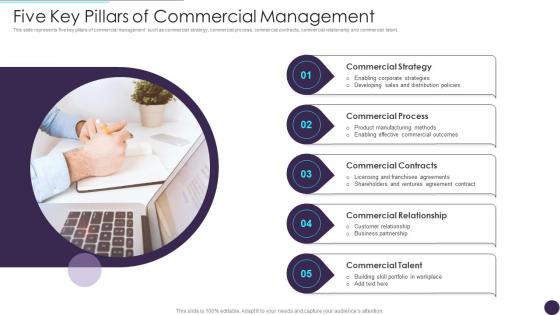
Five Key Pillars Of Commercial Management




Try Before you Buy Download Free Sample Product
 Impress Your
 Audience
 100%
100% Editable
 Save Hours
 of Time


This slide represents five key pillars of commercial management such as commercial strategy, commercial process, commercial contracts, commercial relationship and commercial talent.
People who downloaded this PowerPoint presentation also viewed the following :
Five Key Pillars Of Commercial Management with all 6 slides:
Use our Five Key Pillars Of Commercial Management to effectively help you save your valuable time. They are readymade to fit into any presentation structure.





FAQs for Five Key Pillars
Effective commercial management includes strategic pricing optimization, comprehensive contract management, robust financial planning and forecasting, market analysis and competitive intelligence, and stakeholder relationship management. These components work together by streamlining revenue generation, minimizing operational risks, and enhancing decision-making processes, with many organizations finding that this integrated approach ultimately delivers sustainable competitive advantage and improved profitability.
Data analytics improves commercial management decision-making by providing real-time insights into customer behavior, market trends, pricing optimization, and operational efficiency. Through predictive modeling and performance dashboards, organizations can identify revenue opportunities, minimize risks, and streamline resource allocation, with many retail and manufacturing companies finding that data-driven strategies ultimately deliver faster responses to market changes and enhanced competitive advantage.
Stakeholder engagement ensures alignment between commercial objectives and stakeholder expectations through regular communication, transparent reporting, collaborative decision-making, and proactive issue resolution. This strategic approach enables organizations to build stronger partnerships, reduce project risks, and accelerate deal closures, with many companies finding that engaged stakeholders ultimately deliver better outcomes and sustained competitive advantage.
Risk management strategies significantly enhance commercial performance by minimizing financial losses, improving decision-making accuracy, and strengthening stakeholder confidence through proactive threat identification and mitigation. These approaches enable organizations to optimize resource allocation, reduce insurance costs, and maintain operational continuity, with many companies finding that robust risk frameworks ultimately deliver sustainable revenue growth and competitive market positioning.
Best practices for negotiating contracts include thorough preparation and market research, establishing clear objectives and deal-breakers, building collaborative relationships with counterparts, leveraging data-driven arguments, and ensuring comprehensive risk assessment. These approaches streamline negotiations by reducing miscommunication, accelerating decision-making timelines, and creating mutually beneficial agreements, with many organizations finding that strategic preparation ultimately delivers stronger partnerships and enhanced competitive advantage.
Technology streamlines commercial management processes by automating contract workflows, centralizing vendor data, and enabling real-time financial tracking across multiple projects and partnerships. Through cloud-based platforms and AI-powered analytics, organizations enhance procurement efficiency, accelerate approval cycles, and improve compliance monitoring, ultimately delivering significant cost savings and operational transparency.
Organizations should track revenue growth, profit margins, customer acquisition cost, customer lifetime value, market share, and sales conversion rates. These metrics enable businesses to assess performance across sales, marketing, and customer retention functions, with many companies finding that combining financial indicators with operational efficiency measures ultimately delivers comprehensive insights for strategic decision-making and competitive advantage.
Market analysis influences commercial strategy development by providing critical insights into customer behavior, competitive positioning, pricing opportunities, and market trends that inform strategic decision-making. Through comprehensive market research, organizations can identify emerging opportunities, assess competitive threats, and optimize resource allocation, ultimately enabling more targeted approaches that enhance market penetration and deliver sustainable competitive advantage.
Commercial management challenges include contract complexity, vendor relationship management, cost control, compliance requirements, and performance monitoring across multiple stakeholders. These obstacles can be mitigated through automated contract management systems, strategic vendor partnerships, and integrated dashboards that streamline processes, enhance visibility, and deliver improved cost efficiency while reducing operational risks.
Effective pricing strategies enhance revenue by leveraging market research, competitive analysis, dynamic pricing models, and value-based approaches that align with customer willingness to pay. Through strategic pricing optimization, organizations streamline revenue generation, maximize profit margins, and strengthen market positioning, with many retail and manufacturing companies finding that data-driven pricing delivers sustained competitive advantage.
Cross-departmental collaboration in commercial management ensures alignment between sales, marketing, finance, and operations teams, creating unified strategies that maximize revenue opportunities and minimize operational inefficiencies. This strategic coordination enables organizations to respond faster to market changes, deliver consistent customer experiences, and optimize resource allocation, with many companies finding that integrated approaches significantly enhance competitive positioning and profitability.
International regulations significantly impact commercial management strategies by requiring compliance adaptations, market entry modifications, and operational restructuring across different jurisdictions. Companies must navigate varying tax codes, labor laws, environmental standards, and trade restrictions, with many multinational organizations finding that proactive regulatory alignment streamlines global expansion while delivering competitive advantages through enhanced market access and operational efficiency.
Commercial management adapts to evolving consumer trends through data analytics, flexible pricing strategies, agile supply chain management, digital channel integration, and personalized customer experiences. These approaches enable organizations to respond quickly to market shifts, anticipate demand patterns, and optimize resource allocation, with many retail and financial services companies finding that adaptive strategies deliver enhanced customer satisfaction and sustained competitive advantage.
Essential commercial management skills include financial analysis, contract negotiation, risk assessment, stakeholder communication, and strategic planning. These competencies enable professionals to optimize pricing strategies, manage vendor relationships, and drive revenue growth, with many organizations finding that strong commercial managers deliver measurable cost savings and competitive positioning advantages.
Businesses can leverage partnerships to enhance commercial management by accessing complementary expertise, sharing operational costs, expanding market reach, and accelerating innovation cycles. Strategic alliances enable companies to streamline resource allocation, minimize financial risks, and deliver comprehensive customer solutions, with many organizations finding that collaborative approaches ultimately provide competitive advantages they couldn't achieve independently.
-
No second thoughts when I’m looking for excellent templates. SlideTeam is definitely my go-to website for well-designed slides.
-
Great designs, really helpful.