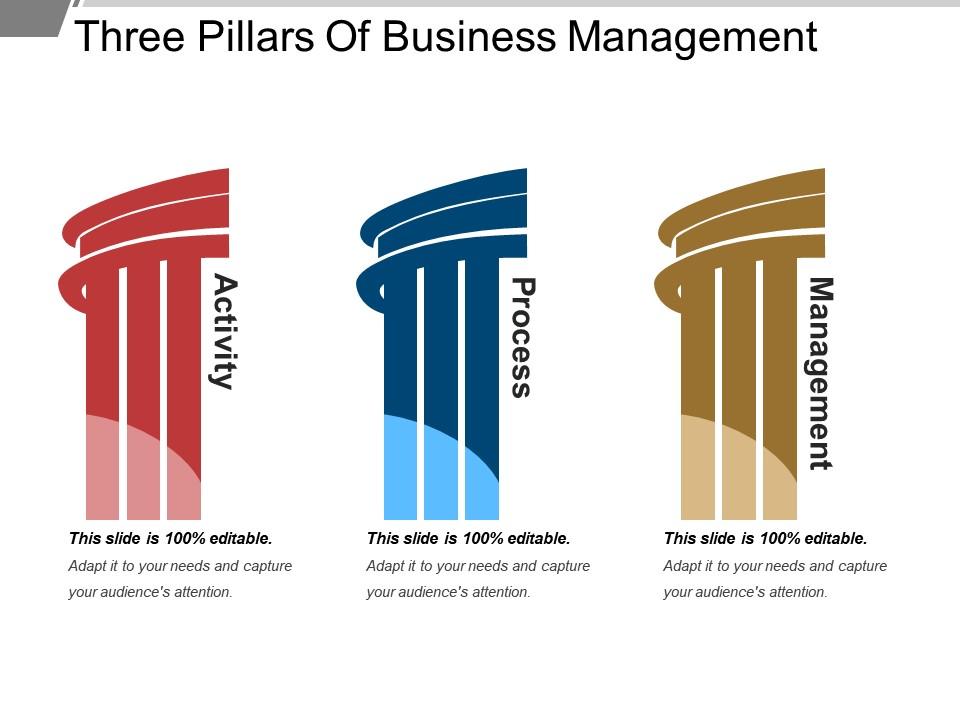
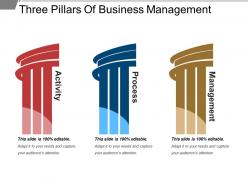
Three pillars of business management powerpoint layout
Try Before you Buy Download Free Sample Product
Audience
Editable
of Time
Attain the objective of your business using Three Pillars Of Business Management PowerPoint Layout. Take the assistance of this PPT template and strategize your priorities and preferences to meet your current and future needs. You can emphasize on the three major pillars such as activity, process, and management using our PowerPoint presentation template. If you want to explain the importance of enterprise planning systems, then use this PPT slide. There are different categories like design, modeling, monitoring, execution, and optimization, which you highlight using our PowerPoint presentation template. Generate a report on the overall sales and revenue of the project with the help of our PPT template. The PowerPoint presentation template contains high-grade icons with which you can make your presentation even more reliable and engaging. Outline the numerous tools and methodologies that help to upgrade your business skills using the PowerPoint presentation template. So, download this ready-to-use PPT slide to run your organization efficiently.
People who downloaded this PowerPoint presentation also viewed the following :
Three pillars of business management powerpoint layout with all 5 slides:
Investigate every clue with our Three Pillars Of Business Management Powerpoint Layout. Establish the interplay of events.
FAQs for Three pillars of business
So you're gonna need solid goal-setting and financial planning - that's like your foundation. Team management is huge too, plus you gotta keep tracking how things are going. Market changes will totally blindside you if you're not ready (learned that the hard way lol). Communication systems are a must so nobody's confused about what's happening. Resource allocation is tricky but prevents you from blowing your whole budget early. Honestly? Don't try fixing everything at once - pick your weakest area first. Way less overwhelming that way.
Honestly? Your leadership style makes or breaks how your team actually functions together. I've watched autocratic managers get stuff done fast but then wonder why everyone quits. Democratic approaches work way better for creativity - people actually care when they feel heard. Though laissez-faire can be amazing with seasoned pros, it leaves newbies totally lost (learned that one the hard way). Really comes down to reading your team and the situation. Take a hard look at how you currently lead, then try switching things up based on what each person needs.
Honestly, data analytics is a total game-changer for making business decisions. No more shooting in the dark hoping you're right about what customers want. You can actually see patterns, predict what people will buy next, and fix issues before they become disasters. My friend's retail store started tracking customer purchases and realized their bestselling items were completely different than what they thought lol. Analytics helps with everything - inventory, pricing, where to spend marketing dollars. Just don't go crazy at first. Pick one thing you've got good data on and start there. Building it up gradually works way better than trying to analyze everything at once.
Honestly, you've gotta bake change right into how your company operates instead of scrambling every time something hits. Cross-functional teams are your best friend here - they can actually move fast when the market shifts. Communication though? That's where most places screw up. Don't just tell people what's changing, explain the why behind it. I've watched so many leaders shoot themselves in the foot by keeping everyone in the dark. Train your team regularly so they're not freaking out over every little pivot. Monthly market reviews help too - keeps you ahead of the curve instead of always playing catch-up.
One-on-ones are huge - but actually listen, don't just go through the motions. Give real recognition for specific stuff they did well. Let them weigh in on decisions that impact their day-to-day work. Flexible schedules are honestly a game-changer. People want some control over their time. Also throw in training or challenging projects that help them grow. I know it sounds obvious, but treating them like actual humans instead of robots makes all the difference. Start by asking what drives each person individually. You'll probably be surprised by their answers, and it gives you a clear direction.
Look, your company culture is basically running the show behind the scenes. Risk-averse places? You'll see tons of meetings and approval chains before anything happens. But entrepreneurial spots let people make quick calls and try stuff out. Culture dictates whether your managers are collaborative or just bark orders from the top. It also shapes how conflict gets handled and what behaviors actually get rewarded (versus what the mission statement claims). Honestly, trying to separate culture from management is pointless - they're feeding off each other constantly. Figure out what your workplace truly rewards first.
Look, managing your money properly is literally what separates businesses that make it from ones that don't. I've watched so many good companies tank just because they couldn't handle cash flow during growth spurts - it's brutal. You gotta track your numbers weekly and actually know where your money's going. Smart budgeting lets you decide when to hire or expand based on real data instead of gut feelings. Oh, and cash flow forecasting? Super boring but totally necessary if you don't want to go broke right when things get exciting. Create realistic growth budgets and stick to them.
First thing - get all your department heads together for a proper risk assessment. They know where stuff actually breaks down. Cover financial, operational, legal, reputation risks, the whole deal. After that, rank everything by how likely it is vs how badly it'd mess you up. Then figure out what you're gonna do about each one. Honestly, doing this quarterly instead of once a year makes way more sense. Oh, and make sure someone's actually responsible for watching each risk - otherwise it just becomes this document that sits in a drawer somewhere. The whole thing needs to stay alive, you know?
Honestly, just make people feel safe to throw out crazy ideas without getting shut down. Mix up your teams - I've seen marketing and engineering come up with brilliant stuff when they actually talk to each other. Give everyone some time each week to mess around with new concepts, even if it's just a couple hours. Here's the thing though - you can't just say you celebrate failures, you actually have to do it when someone's experiment flops. Ask "what if" questions yourself and be genuinely curious. Try this: pick one meeting this week and straight-up ask for weird solutions. You'll be surprised what people come up with.
Honestly, digital tools are game-changers for running a business. They handle all the boring repetitive stuff automatically and give you data in real-time. Plus your team can work together even when they're scattered everywhere. You're probably already using some - cloud storage, project apps, that kind of thing. AI analytics are pretty solid too for making quicker decisions. But here's the thing: don't just grab every shiny new tool you see. Figure out what's actually driving you crazy first. Maybe it's scheduling or tracking expenses? Then find something that fixes that exact problem. Way more effective than trying random software.
So stakeholder management is just figuring out how to keep all the important people in your business loop happy - customers, employees, investors, suppliers, you name it. These folks can literally make or break you, so it's worth the effort. Regular check-ins help you catch problems early and build actual trust. You'll get better feedback too, which honestly saves you from making dumb mistakes later. Coffee meetings work great for this, nothing fancy needed. Start by listing your key people and just... talk to them more. Sounds simple but most people skip this step entirely.
Good communication just makes everything click better. Your team knows what's expected, decisions happen faster, and you catch problems before they explode. Being upfront about goals means people actually understand what they're working toward - honestly, too many places just leave everyone guessing. It builds real trust with your team and clients, which totally affects how productive everyone is and whether they stick around. Oh, and pick the right way to communicate - nobody wants a three-paragraph Slack message when you could just call them, you know?
Dude, this stuff matters way more than people think. Bad conflict handling will literally destroy a team - I've watched it happen firsthand and it's messy. The trick is jumping on problems early instead of letting them snowball. Listen to everyone's side first (even when you already know who's being ridiculous). Focus on fixing things rather than pointing fingers. Trust me, once you start actually hearing people out during disagreements, everything changes. Teams that figure this out end up way stronger, while the ones that don't... well, they turn into those nightmare workplaces nobody wants to stick around for.
Honestly, mix the hard numbers with gut feelings. Financial performance and turnover rates are obvious ones to track. Customer satisfaction scores too. But here's the thing - sometimes just walking around tells you more than spreadsheets do. Are people actually engaged or just going through motions? Employee surveys help, though half the time people don't answer honestly anyway. 360 feedback works better for real insights. Pick maybe 4-5 metrics that match what you're trying to achieve. Check them quarterly so you're not obsessing daily but still catching problems early.
Ugh honestly business ethics gets messy fast. You've gotta think about everyone affected - employees, customers, community, not just profits. Transparency matters too. Are you being straight with people? Short-term gains can bite you later if you're cutting corners ethically. I'd make some quick mental checklist... am I being fair? Respecting rights? What about environmental stuff? Sounds preachy but when you're stressed about hitting numbers, it's easy to rationalize sketchy choices. Maybe jot down a few basic principles beforehand so you're not making it up as you go.
-
Awesome use of colors and designs in product templates.
-
Great product with highly impressive and engaging designs.