


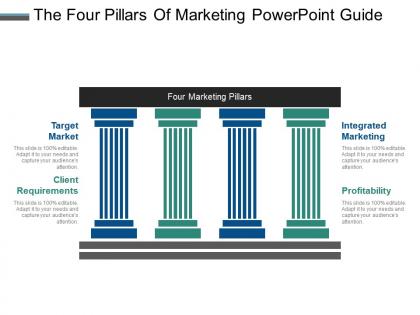
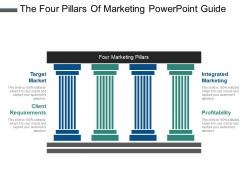
The four pillars of marketing powerpoint guide




Try Before you Buy Download Free Sample Product
 Impress Your
 Audience
 100%
100% Editable
 Save Hours
 of Time


Foster customer relations with our The Four Pillars Of Marketing Powerpoint Guide. Give them all due care and attention.
People who downloaded this PowerPoint presentation also viewed the following :
The four pillars of marketing powerpoint guide with all 5 slides:
Our The Four Pillars Of Marketing Powerpoint Guide allow you to deliver a few jokes. It will inject a bit of humor.


FAQs for The four pillars of
Key elements of a successful marketing strategy include clear target audience identification, compelling value propositions, integrated multi-channel approaches, consistent brand messaging, and data-driven performance metrics. These components work together by aligning customer insights with business objectives, optimizing resource allocation across touchpoints, and enabling continuous campaign refinement, ultimately delivering enhanced customer engagement and measurable ROI growth.
Businesses can effectively leverage social media for brand promotion through strategic content creation, targeted advertising, community engagement, influencer partnerships, and consistent brand messaging across platforms. Companies in retail, hospitality, and tech increasingly find success by combining authentic storytelling with data-driven campaigns, ultimately delivering enhanced customer relationships, broader market reach, and measurable ROI that strengthens competitive positioning.
Content marketing enhances customer engagement by delivering valuable, relevant information that educates, entertains, and addresses audience needs throughout their buyer journey. Through strategic blog posts, videos, and interactive content, businesses build trust, foster community connections, and drive meaningful conversations, with many organizations finding that consistent, quality content ultimately increases brand loyalty and conversion rates.
Data analytics improves marketing decision-making by providing customer behavior insights, campaign performance metrics, audience segmentation capabilities, and predictive trend analysis. Through advanced analytics tools, marketing teams can optimize budget allocation, personalize customer experiences, and measure ROI more accurately, with many organizations finding that data-driven strategies deliver significantly higher conversion rates and competitive advantage.
Influencer marketing delivers enhanced brand credibility, targeted audience reach, authentic content creation, improved engagement rates, and cost-effective advertising compared to traditional channels. Through strategic partnerships with relevant influencers, brands achieve higher conversion rates, expanded market penetration, and stronger customer trust, with many companies finding that influencer collaborations generate significantly better ROI than conventional marketing approaches.
Companies measure marketing campaign ROI through conversion tracking, customer acquisition costs, lifetime value analysis, attribution modeling, and revenue attribution across touchpoints. These metrics enable organizations to optimize budget allocation, identify high-performing channels, and demonstrate marketing's direct impact on business growth, with many enterprises finding that comprehensive measurement strategies ultimately deliver 20-30% improved campaign effectiveness.
Understanding your target audience enables more effective messaging, better resource allocation, and higher conversion rates by tailoring campaigns to specific demographics, preferences, and behaviors. This strategic approach helps businesses minimize marketing waste, enhance customer experiences, and deliver more personalized content, with many organizations finding that audience-focused strategies significantly improve ROI and competitive positioning.
SEO significantly enhances online marketing efforts by improving search visibility, driving organic traffic, and reducing customer acquisition costs through sustainable rankings. This strategic approach enables businesses to capture high-intent audiences, complement paid advertising campaigns, and build long-term digital authority, with many organizations finding that strong SEO foundations amplify their overall marketing ROI.
Innovative marketing trends include AI-powered personalization, interactive content experiences, voice search optimization, sustainable brand positioning, and omnichannel customer journey mapping. These technologies streamline targeting precision, enhance engagement rates, and deliver measurable ROI improvements, with many retail and financial services organizations finding that strategic integration ultimately drives competitive advantage in increasingly crowded markets.
Storytelling enhances brand identity by creating emotional resonance, establishing authentic values, communicating purpose clearly, and differentiating from competitors through unique narratives. Through compelling brand stories, companies across retail, hospitality, and consumer goods build deeper customer relationships, increase loyalty, and drive engagement, with many organizations finding that narrative-driven marketing delivers significantly higher conversion rates and lasting competitive advantage.
Ethical considerations in digital marketing include data privacy protection, transparent advertising practices, honest customer communications, responsible targeting methods, and consent-based data collection. These practices build consumer trust by ensuring clear disclosure of sponsored content, respecting user preferences, and maintaining authentic brand messaging, with many organizations finding that ethical approaches ultimately deliver stronger customer loyalty and sustainable competitive advantage.
Small businesses can compete by leveraging personalized customer service, local community engagement, targeted social media marketing, authentic storytelling, and agile campaign adaptation. These strategies enable smaller companies to build deeper customer relationships, respond faster to market changes, and create authentic brand connections, with many local businesses finding that personalized approaches ultimately deliver higher customer loyalty than larger competitors.
Successful email marketing strategies include audience segmentation, personalized content creation, compelling subject lines, mobile optimization, and automated drip campaigns. These approaches enhance engagement by delivering targeted messaging, improving open rates, and nurturing leads through strategic touchpoints, with many retailers and service providers finding that personalized campaigns deliver significantly higher conversion rates and customer retention.
Businesses can utilize marketing automation tools effectively by segmenting audiences, personalizing customer journeys, automating email campaigns, tracking behavioral triggers, and integrating CRM systems. These platforms streamline lead nurturing, enhance customer engagement, and deliver targeted messaging across multiple channels, with many companies finding that automation reduces manual workload while increasing conversion rates and revenue growth.
B2B marketing faces longer sales cycles, multiple decision-makers, and complex product explanations, while B2C marketing contends with shorter attention spans, emotional triggers, and mass market competition. These distinct challenges require different approaches, with B2B companies focusing on relationship building and educational content, while B2C brands emphasize brand awareness and immediate conversion optimization.
-
Thanks for all your great templates they have saved me lots of time and accelerate my presentations. Great product, keep them up!
-
Use of different colors is good. It's simple and attractive.