


7p marketing mix ppt design 4





Try Before you Buy Download Free Sample Product
 Impress Your
 Audience
 100%
100% Editable
 Save Hours
 of Time


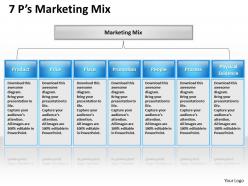
Running late for work? Looking for easy to go, unique, color and editable 7P Marketing Mix PowerPoint slide with diagrams. Don't worry, we offer alternatives to 4 P's, 5P's and 6 P's marketing mix for business, research work, startups and entrepreneurs. Marketing Mix being the foundational model has evolved significantly with its many other type and this PowerPoint show provides good amount of space to effectively put forward the ideas. Our team of professionals offer easy tips to work on pre-designed PPT diagrams which are compatible with 2010 and 2013 versions plus fully editable and compatible with word, doc, excel. The presentation icons provide space for every single topic like- Product, price, place, promotion, people, process and physical evidence. The colored features help to bifurcate and absorb the important facts quickly. 7P Marketing Mix PowerPoint presentation helps you achieve any mode of distribution –may it be intensive distribution, exclusive distribution, selective distribution or Franchising. Get a profitable ending with our 7P Marketing Mix ppt design 4. Keep the cash registers ringing till the end.
People who downloaded this PowerPoint presentation also viewed the following :
7p marketing mix ppt design 4 with all 5 slides:
You have repeatedly displayed your professional acumen. Now put a stamp of authority with our 7P Marketing Mix ppt design 4.
FAQs for 7p marketing mix
The seven elements of the 7P marketing mix include Product, Price, Place, Promotion, People, Process, and Physical Evidence. These components work together by addressing traditional marketing fundamentals alongside service-specific factors, enabling businesses to create comprehensive marketing strategies that enhance customer experiences, streamline service delivery, and ultimately deliver competitive advantage in increasingly service-oriented markets.
Service-based businesses emphasize People, Process, and Physical Evidence more heavily, as they rely on staff expertise, streamlined service delivery, and tangible credibility markers to build trust. While product businesses focus primarily on Product, Price, Place, and Promotion, service companies must carefully manage customer interactions, service consistency, and environmental cues, with many finding that these additional elements directly impact customer satisfaction and retention rates.
The 'People' element directly influences customer satisfaction through employee expertise, communication skills, responsiveness, and service attitude, as these human interactions shape every customer touchpoint. Well-trained staff in sectors like hospitality, retail, and financial services create positive experiences, build trust, and resolve issues effectively, ultimately delivering enhanced customer loyalty and competitive advantage.
Businesses can effectively leverage 'Process' by streamlining customer touchpoints, automating routine interactions, and standardizing service delivery across all channels. Through optimized workflows and digital integration, companies in retail, banking, and hospitality significantly reduce wait times, minimize errors, and deliver consistent experiences, ultimately enhancing customer satisfaction and building competitive advantage.
Physical evidence establishes brand credibility by creating tangible touchpoints that customers can see, feel, and experience, including store layouts, packaging design, website interfaces, employee uniforms, and facility cleanliness. These elements build trust and reinforce brand promises, with many retail and service organizations finding that consistent physical evidence significantly enhances customer confidence and loyalty.
Successful promotion strategies within the 7P framework include Nike's "Just Do It" emotional branding, Coca-Cola's integrated digital and traditional campaigns, Amazon's personalized email marketing, and Starbucks' social media engagement initiatives. These approaches streamline brand messaging, enhance customer touchpoints, and deliver measurable ROI, with many companies finding that strategic promotion integration across multiple channels ultimately drives both brand awareness and competitive advantage.
Pricing strategy significantly influences consumer psychology by shaping perceived value, quality expectations, and purchase urgency through psychological anchors, price-quality associations, and scarcity perceptions. Strategic pricing approaches like premium positioning or limited-time offers trigger emotional responses that drive buying decisions, with many retailers and service providers finding that carefully calibrated pricing enhances brand perception while optimizing conversion rates.
Online retailers can improve 'Place' through multi-channel distribution strategies, marketplace expansion, strategic partnerships with third-party logistics providers, mobile-optimized platforms, and localized fulfillment centers. These approaches streamline delivery times, enhance customer accessibility, and reduce shipping costs, with many e-commerce businesses finding that diversified distribution channels ultimately deliver competitive advantage and improved customer experiences.
Changing consumer behaviors significantly reshape the 'Product' component by driving demand for personalization, sustainability, digital integration, and flexible service offerings. Companies increasingly adapt their product strategies through enhanced customization options, eco-friendly materials, smart technology integration, and hybrid physical-digital experiences, with many organizations finding that responsive product evolution delivers stronger customer loyalty and competitive advantage in today's dynamic marketplace.
Integrating the 7Ps creates a comprehensive marketing framework that ensures all elements—product, price, place, promotion, people, process, and physical evidence—work synergistically to deliver consistent customer experiences. This strategic combination enables organizations to optimize resource allocation, enhance brand positioning, and streamline customer touchpoints across multiple channels, ultimately delivering competitive advantage and measurable business growth.
Businesses measure 7P effectiveness through specific KPIs for each element: product performance metrics, pricing elasticity analysis, distribution channel efficiency, promotional ROI, customer service satisfaction scores, process optimization data, and physical evidence impact assessments. Through integrated analytics platforms, organizations track conversion rates, customer retention, and revenue attribution across touchpoints, ultimately delivering comprehensive insights that enable strategic adjustments and competitive advantage.
Innovative practices include AI-powered customer sentiment analysis training, cross-functional role rotations, real-time feedback systems, empathy-building workshops, and digital collaboration platforms. These approaches enhance employee-customer interactions by developing emotional intelligence, improving communication skills, and enabling personalized service delivery, with many organizations finding that empowered, well-trained staff ultimately drive higher customer satisfaction and competitive advantage.
Seasonal trends significantly influence promotional strategies by dictating timing, messaging, and channel selection, with businesses adjusting advertising campaigns, sales promotions, and content themes to align with consumer behavior patterns. Retail companies leverage holiday seasons for discount campaigns, while travel agencies promote summer packages during winter months, ultimately maximizing engagement and revenue through strategically timed promotional activities.
Businesses face significant challenges adapting the 7P framework across cultures, including varying consumer behaviors, communication preferences, pricing sensitivities, distribution expectations, and service standards that differ dramatically between markets. While global companies like McDonald's and Coca-Cola successfully localize their marketing mix strategies, organizations must invest considerable resources in cultural research and local partnerships, ultimately delivering more authentic customer experiences and stronger competitive positioning in diverse international markets.
Digital transformation has enhanced the 7Ps' relevance by enabling personalized products, dynamic pricing strategies, omnichannel distribution, targeted digital promotions, streamlined processes, and data-driven people management. Through AI, automation, and analytics, businesses can optimize each element in real-time, with retail, financial services, and healthcare organizations finding that integrated digital approaches ultimately deliver superior customer experiences and competitive advantage.
-
Thanks for all your great templates they have saved me lots of time and accelerate my presentations. Great product, keep them up!
-
Much better than the original! Thanks for the quick turnaround.