

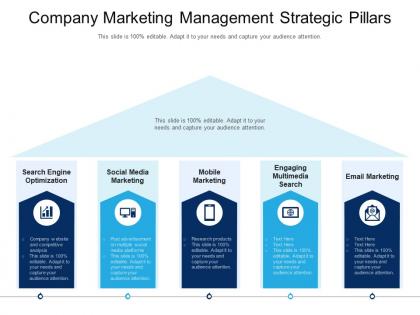
Company marketing management strategic pillars




Try Before you Buy Download Free Sample Product
 Impress Your
 Audience
 100%
100% Editable
 Save Hours
 of Time


Our Company Marketing Management Strategic Pillars are topically designed to provide an attractive backdrop to any subject. Use them to look like a presentation pro.
People who downloaded this PowerPoint presentation also viewed the following :
Company marketing management strategic pillars with all 2 slides:
Use our Company Marketing Management Strategic Pillars to effectively help you save your valuable time. They are readymade to fit into any presentation structure.
FAQs for Company marketing
So first thing - figure out who you're actually talking to, then build everything around that. You'll need the basics like positioning and your 4 Ps (product, price, place, promotion). Set some real goals you can measure, not just fuzzy stuff. Budget matters too - I mean, obviously money's gonna dictate what you can do. Keep your messaging consistent everywhere, which is harder than it sounds. Oh, and definitely scope out your competition because you don't want any surprises. The trick is making sure none of this operates in isolation - it all has to connect somehow.
Track the basics first - ROI, conversion rates, website traffic, lead gen. Social media engagement and email opens are pretty telling too. But honestly? Customer surveys can be way more valuable than raw numbers since they tell you *why* things are working or not. Don't go crazy tracking everything though - pick 3-4 metrics that actually matter for your goals. I'd set up a simple dashboard (nothing fancy) and check it monthly. That way if something's tanking, you can switch gears fast instead of waiting around.
Dude, you've gotta know who you're talking to before you do anything else. Otherwise you're just shouting into the void hoping someone cares. I made that mistake early on - total waste of money. Look at your current customers first, then dig into your analytics to figure out what makes them tick. Their problems, where they hang out online, what actually gets them to buy stuff. Build those buyer personas (sounds fancy but it's just detailed profiles) and use them for everything. Trust me, your ads will perform way better when you're speaking directly to real people instead of everyone and no one.
Don't overthink this - most companies do and it's painful to watch. Find what you're genuinely better at that customers actually care about. Pick one or two things, not everything. Your customer service? Some niche expertise? Problems you solve that others skip over? Here's the thing - your best customers probably already tell you what makes you different. Listen to what they say about you vs competitors. That's your answer right there. Once you figure it out, make sure your messaging and how you operate actually backs it up. Start by asking current customers what they'd tell their friends about working with you.
Honestly, short-form video is where it's at right now. TikTok and Reels are still getting crazy engagement numbers. Also, AI personalization tools are pretty solid for customizing your messaging based on what users actually do on your site. People are obsessed with interactive stuff too - polls, quizzes, whatever lets them share their hot takes. Oh, and voice search is picking up steam with all the smart speakers everywhere. But seriously, don't go nuts trying every trend. Pick like 2-3 that actually fit your audience and what you can afford, then nail those instead of half-assing everything.
Honestly, storytelling beats boring feature lists every time. Instead of pushing what your product does, focus on why people actually need it. Look at Nike - their ads aren't really selling shoes, they're selling the idea that you can push your limits and become better. That's way more powerful than talking about cushioning technology or whatever. You can weave stories into pretty much everything - social posts, emails, even your about page. Start with one main story about why your business exists and what problem you're solving. People remember stories, not specs. Make them feel something and they'll remember you.
Honestly, social media has totally flipped marketing on its head. It's not just another marketing channel anymore - it's basically the whole foundation now. You've gotta think mobile-first and create stuff people actually want to share, not just boring branded content. The algorithms can be a real pain, but when you get it right? The organic reach is amazing. Everything moves so much faster now. Trends change overnight and customers give feedback instantly, so your strategy needs to be super flexible. Oh, and don't try to be everywhere at once - pick 2 or 3 platforms where your people actually spend time and focus on building real relationships there first.
Honestly, it comes down to speed and data. Digital lets you change course fast based on real numbers, but traditional stuff like TV or print? You're locked in for months. Traditional has better reach and makes you look legit, though the targeting is basically throwing darts blindfolded. I can test a Facebook ad in hours, but that billboard isn't going anywhere. Smart approach is mixing both - traditional builds brand recognition, digital tracks what actually converts. Oh, and map where your customers really hang out, not where you assume they do.
Honestly, the worst thing you can do is try targeting everyone - you'll just end up reaching nobody. Pick one specific audience first. Also, don't guess what customers want when you have actual data sitting right there. I see people do this all the time and it's so frustrating! Skip the competitor research and you're basically flying blind. Oh, and don't spread your budget across every single platform either. Better to absolutely crush it on 2-3 channels than suck everywhere. Set one clear goal upfront that you can actually measure, then build everything around that. Way easier than trying to do ten things at once.
Honestly, you've gotta bake flexibility into everything from day one. Check your market data quarterly - bare minimum. I can't tell you how many businesses I've watched get completely wrecked because they ignored obvious warning signs. Keep your campaigns bite-sized so pivoting doesn't feel like moving mountains. Always have a Plan B (and C, if we're being real). Test stuff small first - seems obvious but you'd be surprised. Oh, and make sure your team actually tells you when things are going sideways. That heads-up can save your ass way more than any fancy analytics dashboard.
Honestly, just focus on the big three: CAC, LTV, and ROAS. Those'll tell you if your marketing actually works or if you're just burning cash. I used to obsess over impressions and stuff - total waste of time. Track your conversion rates too, plus attribution data so you know which channels are actually bringing in customers. The LTV to CAC ratio is everything - shoot for 3:1 minimum. Set up tracking for these first, then worry about the fancy campaign metrics later. Oh, and don't get distracted by all the shiny dashboard numbers that don't matter.
Honestly, your brand is like the foundation for everything else you'll do marketing-wise. It tells you who to target, what tone to use, where to advertise - all that stuff. Like, you wouldn't see Rolex plastering discount codes everywhere, you know? That'd be weird and totally off-brand for them. Your brand values help you figure out which partnerships actually make sense too. I'd say nail down your positioning first - what you stand for, who you're talking to. Then just let that guide your decisions. Way easier than trying to wing it without a clear direction.
Honestly, I'd start with content marketing and social media - you'll get the most out of your limited budget that way. Write blog posts or make videos that actually solve problems for people. Don't spread yourself thin on every platform though, just pick where your customers are actually scrolling around. Email's kind of old school but it works crazy well if you're not boring about it. Oh, and team up with other small businesses for cross-promotion stuff. My cousin did that with her bakery and it was huge. Just master one thing first before jumping into everything else.
Honestly, just start collecting feedback everywhere - surveys, reviews, social media, wherever people are talking. Then actually look for patterns in what they're saying. Like if everyone keeps saying they had no clue about some feature you're pushing hard, that's a massive red flag about your messaging. Take those insights and tweak your strategy - maybe your targeting's off or you need different positioning. Oh, and test changes with small groups first before going all-in. The biggest mistake I see is companies collecting tons of feedback but never doing anything with it. Set up regular team meetings to review what you're hearing and actually make changes based on it.
Look, don't bullshit people about what your product actually does - they'll figure it out and you're screwed. Be upfront about data collection too, nobody likes feeling spied on. Avoid targeting kids with sketchy stuff or making people feel like crap about themselves just to sell more. I get it, hitting those conversion numbers feels urgent, but honestly? The sleazy tactics always backfire eventually. Quick test: would you feel weird explaining your strategy to customers in person? If yes, probably time to rethink it. Privacy laws exist for a reason anyway.
-
Informative presentations that are easily editable.
-
Great product with highly impressive and engaging designs.
-
Awesome presentation, really professional and easy to edit.
-
Top Quality presentations that are easily editable.
-
Appreciate the research and its presentable format.