


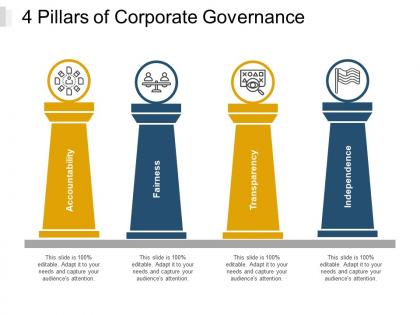
4 pillars of corporate governance




Try Before you Buy Download Free Sample Product
 Impress Your
 Audience
 100%
100% Editable
 Save Hours
 of Time


Absorb the jolt with our 4 Pillars Of Corporate Governance. Handle conditions that can cause alarm.
People who downloaded this PowerPoint presentation also viewed the following :
4 pillars of corporate governance with all 5 slides:
Instill a greater degree of efficiency with our 4 Pillars Of Corporate Governance. Be able to do the job faster.




FAQs for 4 pillars
Honestly, start with the basics - accountability, transparency, fairness, and responsibility. Your executives need to actually own their decisions instead of giving vague PR responses when stuff hits the fan. Be upfront with shareholders about what's really happening, the risks you're facing, all of it. Don't play favorites - treat all shareholders the same way, not just the ones writing big checks. Oh, and obviously make ethical calls while keeping everyone's interests in mind. I'd audit where you stand on these four areas first. That'll show you what needs the most work right away.
Honestly, good governance is like a trust signal to investors. They see proper board oversight and clean financials, and suddenly they're way more comfortable throwing money at you. Makes sense - nobody wants to back a sketchy operation where leadership might disappear with their cash. Clear processes mean lower borrowing costs too. Stock prices? They tend to reflect that confidence. If you're thinking about raising capital, get your audit stuff and board structure sorted first. It's boring work but pays off big time when investors actually trust what you're telling them.
Your board's basically the watchdog keeping management in check. They set big picture strategy, approve major decisions, and make sure nobody's breaking rules or going off the rails. Plus they handle CEO stuff like succession planning and how much to pay executives. Risk management falls under them too. Honestly, they're like the referee between shareholders and the people actually running things day-to-day. Pro tip though - if you've got any governance drama brewing, give your board liaison a heads up early. Trust me, they'll help you sort it out way better than if you spring surprises on them later.
Honestly, you're looking at three big things: disclosure, oversight, and getting stakeholders involved. Your board needs independent directors who'll actually push back on management - not just yes-men. Publish detailed financials regularly and be transparent about exec pay and conflicts of interest. I know the audit committee stuff sounds boring as hell, but investors care about that credibility. Set up ways for shareholders and employees to speak up without getting burned for it. Start by auditing what you're already disclosing. Where are the gaps? What decisions are you making behind closed doors that people should know about?
Basically, public companies get hammered with way more regulations - SEC filings, quarterly calls, all that compliance stuff. Private ones? They can pretty much structure their boards however they want since they don't answer to public shareholders. Independence requirements are huge for public companies too. Honestly, private companies move so much faster because there's less red tape and fewer people to please. Oh, and if you're trying to figure out what framework to use - just check if you need public company standards first. That decision alone will shape everything else you do.
So regulatory rules are like the minimum bar companies have to hit, but they're all over the place depending where you are. US companies deal with way stricter board independence stuff after Sarbanes-Oxley, while some European markets are more chill about it. Here's the kicker though - most big companies just follow whatever the toughest rules are across all their markets. Makes sense, right? Why juggle different standards when you can pick one and stick with it. Even if your local regs are pretty loose, you might still need NYSE-level compliance if you're listed there. My advice? Figure out which jurisdiction has the harshest requirements first.
Honestly? The regulatory juggling act is brutal - every country has different rulebooks you're trying to follow simultaneously. Cultural stuff makes it worse since what flies in one place totally clashes elsewhere. Board composition gets messy fast when you need local expertise but also global oversight. Oh, and don't get me started on varying disclosure standards... compliance costs add up ridiculously quick (learned that the hard way). Best approach I've seen is setting core global principles but leaving room for local tweaks. Way better than forcing some cookie-cutter approach that'll backfire.
Track the obvious stuff first - meeting attendance, diversity numbers, audit results, compliance mess-ups. Those are your baseline metrics. But honestly? The soft metrics tell you way more about what's actually happening. Survey your board and execs about how decisions get made and if info flows properly. Response time to governance issues is huge too - like, are you catching risk management problems before they explode or just scrambling after? Oh, and definitely benchmark against other companies in your space. Regular assessments help, but the survey feedback usually reveals the real gaps.
Honestly, ethics is what keeps companies from imploding spectacularly. Trust me, you don't want to be the next headline about corporate scandals. Start with a clear code of conduct that people actually understand - not some 50-page legal document nobody reads. Regular training helps too, though make it engaging or people zone out. Whistleblower programs work, but only if employees believe they won't get fired for speaking up. Here's the thing though - if your leadership team acts shady, forget it. Everyone takes their cues from the top. Also, update your policies regularly because business moves fast and yesterday's ethics might not cover today's dilemmas.
Look, corporate governance is basically what sets up how your company finds and deals with risks. The board decides what risks they're cool with taking and builds the whole framework around that. Good governance means clear lines - who's responsible for what, who makes the big decisions. Risk reports go straight to the board so they catch problems before they blow up. Think of it like guardrails on a winding road, honestly. Here's the thing though - and this drives me nuts - your risk processes need to match what leadership actually wants, not just what they say in meetings. Otherwise you're flying blind.
Honestly, just get a basic board going even if it's you plus one advisor at first. Document every meeting and major decision - seriously, the paper trail will save your ass later. Cap table needs to be clean from day one because untangling that mess down the road is pure hell. Set clear roles for everyone and put some basic financial controls in place. Oh, and figure out what compliance stuff applies to your industry early on. The whole point is building these habits while you're still small so they don't feel impossible when you're bigger. Way easier than trying to retrofit everything later.
Honestly, start with digital board portals - they'll make document sharing so much easier. Automated reporting cuts down on those annoying manual errors (and saves you hours). Real-time dashboards are great for tracking compliance stuff at a glance. AI can actually spot risks early, which is pretty neat. Your analytics will get way more accurate too. Here's the thing though - don't just throw random tools at it. Pick stuff that works with what you already have. I'd focus on nailing one thing first, maybe board meetings, then build from there. Makes way more sense than trying to overhaul everything at once.
So basically, shareholders get to vote on stuff like who's on the board, CEO pay, big mergers - you know, the important decisions. Individual investors like us? Pretty powerless unless we team up. But the big players - pension funds, hedge funds - they actually have clout. Shareholder activism is everywhere now, pushing companies on climate stuff, diversity, whatever. Oh and here's the thing - if you want to know where your company's headed, watch what the biggest shareholders are doing. They file proposals, make demands, and management actually listens to them. That's usually where change starts, not from some random person with 100 shares complaining.
Look, when you've got different people from various backgrounds on your board, they're gonna catch stuff that a bunch of similar folks would totally miss. Some will push back on bad ideas. Others bring fresh angles to problems - honestly, it's like having backup brains to double-check your thinking. The tougher questions they ask also keep management on their toes, which is huge for accountability. Studies show these diverse boards actually perform better on governance too. I'd start by figuring out what voices you're currently missing, then go from there.
Dude, ESG stuff is becoming mandatory now - not just nice-to-have anymore. Boards are freaking out about cybersecurity too, demanding way more oversight. Oh and stakeholder capitalism means you can't just focus on shareholders anymore - employees, communities, environment all matter now. AI governance is insane right now. Like, I swear every board I know is totally lost trying to figure it out. Remote meetings aren't going anywhere either, so you better make sure your processes actually work online. Honestly? Audit your gaps now, especially data privacy and ESG reporting. Regulators are moving stupid fast on this stuff and you don't want to get caught behind.
No Reviews