

Corporate governance structure good ppt example




Try Before you Buy Download Free Sample Product
 Impress Your
 Audience
 100%
100% Editable
 Save Hours
 of Time


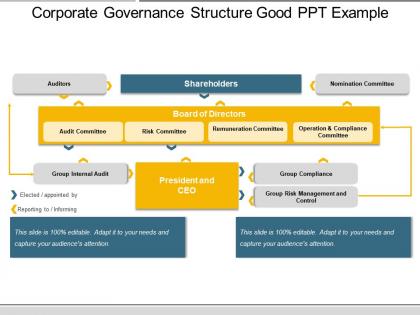
Do you want to create PPT on corporate governance in India? If yes, then we are providing our pre designed corporate governance structure good PPT example presentation template to display the theories of corporate governance.This PPT design can be used as the application of best management practices, compliance of law to ethical standards for effective management and distribution of wealth for sustainable development of all stakeholders. Design template is mainly used by top management, entrepreneurs, managing directors and business professionals to highlight governance and management structure in front of clients, stakeholder and organizational internal team members. You can also use this PPT design to display pillars of corporate governance, policies, and rules of corporate governance that everyone has to follow while working in the organization. So, without giving a second thought, just download this wonderful PPT template and display principles of corporate governance to your audience. Feel cosy and comfortable with our Corporate Governance Structure Good Ppt Example. They are like a fitting fur coat.
People who downloaded this PowerPoint presentation also viewed the following :
Corporate governance structure good ppt example with all 5 slides:
If your presentation needs to be the best use the best tools to make it. Thousands of Corporate Governance Structure Good Ppt Example are on hand to make sure your presentations are always looking great.





FAQs for Corporate governance structure
Key components of an effective corporate governance structure include independent board oversight, transparent financial reporting, robust internal controls, clear executive accountability frameworks, and comprehensive stakeholder engagement mechanisms. These elements work together by ensuring strategic decision-making transparency, minimizing operational risks, and maintaining regulatory compliance, with many organizations finding that strong governance structures ultimately deliver enhanced investor confidence and sustainable competitive advantage.
Different governance structures impact organizational performance by influencing decision-making speed, accountability mechanisms, and strategic oversight effectiveness. While centralized structures enable faster decisions and clearer accountability, decentralized models enhance innovation and responsiveness, with many organizations finding that hybrid approaches combining board oversight with operational autonomy deliver optimal performance and competitive advantage.
The board of directors provides strategic oversight, risk management, executive supervision, stakeholder representation, and regulatory compliance within corporate governance frameworks. Through these responsibilities, boards ensure organizational accountability, approve major strategic decisions, and monitor executive performance, while balancing shareholder interests with broader stakeholder needs, ultimately delivering enhanced transparency and long-term value creation.
Companies ensure accountability within governance frameworks by implementing independent board oversight, establishing clear reporting mechanisms, conducting regular performance evaluations, and maintaining transparent stakeholder communication. These practices enhance organizational integrity by separating oversight from management, creating audit trails for decision-making, and enabling swift corrective actions, ultimately delivering improved investor confidence and regulatory compliance.
Corporate governance and risk management work symbiotically, with governance frameworks establishing oversight mechanisms, accountability structures, and risk appetite definitions that guide strategic decision-making. Through board committees, internal controls, and compliance protocols, organizations can identify potential threats, mitigate operational vulnerabilities, and ensure regulatory adherence, ultimately delivering enhanced stakeholder confidence and sustainable business performance.
Transparency influences stakeholder trust by providing clear visibility into decision-making processes, financial performance, executive compensation, and strategic initiatives through regular reporting and open communication channels. When companies consistently share accurate information about operations, risks, and governance practices, investors, employees, and customers develop greater confidence in leadership integrity, ultimately strengthening long-term relationships and market credibility.
Best practices for board composition include diverse skill sets, independent directors, varied industry expertise, gender and demographic diversity, and complementary professional backgrounds. These practices enhance decision-making through multiple perspectives, strengthen risk oversight and strategic planning, while improving stakeholder confidence and regulatory compliance, with many organizations finding that diverse boards ultimately deliver superior financial performance and governance outcomes.
Technology enhances corporate governance practices by automating compliance monitoring, enabling real-time risk assessment, and facilitating transparent board communications through digital platforms and data analytics. These solutions streamline regulatory reporting, enhance decision-making with comprehensive dashboards, and improve stakeholder transparency, with many organizations finding that automated governance systems significantly reduce compliance costs while strengthening oversight capabilities.
Companies face implementation challenges including resistance to cultural change, compliance costs, stakeholder alignment difficulties, and balancing transparency with competitive confidentiality. These reforms often require extensive training, updated systems, and restructured processes, with many organizations finding that phased implementation approaches help minimize disruption while ultimately delivering enhanced accountability, improved investor confidence, and stronger regulatory compliance across all operational levels.
Regulatory frameworks vary significantly across countries, with some emphasizing shareholder primacy like the US, while others prioritize stakeholder governance like Germany's co-determination model. These differences reflect cultural values and economic philosophies, with many multinational corporations finding that understanding diverse regulatory landscapes enables better compliance, strategic market entry, and ultimately delivers competitive advantage in global operations.
Shareholder engagement ensures accountability, transparency, and alignment between management decisions and investor interests within governance structures. Through voting rights, board communications, and strategic input, engaged shareholders drive better corporate performance, risk management, and long-term value creation, with many publicly traded companies finding that active shareholder participation ultimately enhances decision-making quality and competitive positioning.
Corporate governance mitigates conflicts of interest through independent board oversight, transparent disclosure requirements, audit committees, executive compensation controls, and robust internal controls. These mechanisms enhance accountability by separating oversight from management, ensuring arms-length transactions, and maintaining fiduciary responsibilities, with many organizations finding that strong governance frameworks ultimately deliver improved stakeholder trust and long-term value creation.
Cultural factors significantly influence corporate governance through varying stakeholder priorities, regulatory frameworks, transparency expectations, and decision-making processes across regions. Anglo-American systems emphasize shareholder primacy and individual accountability, while European models prioritize stakeholder capitalism, and Asian approaches often reflect hierarchical structures and long-term relationship building, ultimately shaping how organizations balance oversight, risk management, and strategic direction.
Ethics serves as the foundational framework for corporate governance, establishing transparent decision-making processes, accountability mechanisms, stakeholder protection protocols, and regulatory compliance standards. These ethical principles streamline board oversight, enhance investor confidence, and minimize reputational risks, with many organizations finding that strong ethical governance ultimately delivers competitive advantage and sustainable growth.
Smaller companies can implement effective governance by establishing clear board roles, creating standardized policies, leveraging technology for compliance tracking, and forming advisory committees with external expertise. While budget constraints present challenges, many startups and growing businesses find that streamlined governance frameworks, regular stakeholder communication, and strategic use of governance software ultimately deliver enhanced credibility and operational efficiency.
-
Enough space for editing and adding your own content.
-
Wonderful templates design to use in business meetings.