


Corporate security management powerpoint presentation slides




Try Before you Buy Download Free Sample Product
 Impress Your
 Audience
 100%
100% Editable
 Save Hours
 of Time


Corporate security requires planning and due importance in businesses today to keep vital information confidential with integrity, availability and assurance. Check out our efficiently designed Corporate Security Management template that will reduce the risk of crisis in your company and the effects of that crisis occurring outside. This template aims to identify high safety risks, enable management for corporate security to protect the company from fears, and set up safety plans to reduce such risks. One can display their current security plans critical success factors and significant reasons for poor security to know the companys challenges. Security management tasks require organizations to show the operations elements and overcome them by setting an advanced safety plan for IT. Businesses evaluate information processing assets for analyzing the risk and clearly define the corporate security management system through adopting high-tech assessment controls for themselves. Customize this 100 percent editable template through assistance from our skilled research team. Get access now.
People who downloaded this PowerPoint presentation also viewed the following :
Content of this Powerpoint Presentation
Slide 1: This slide introduces Corporate Security Management. State Your Company Name and begin.
Slide 2: This is an Agenda slide. State your agendas here.
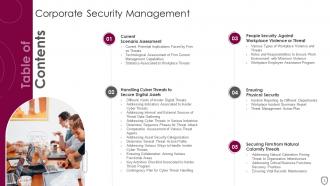
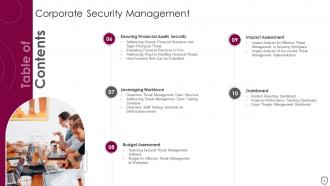
Slide 3: This slide presents Table of Content for the presentation.
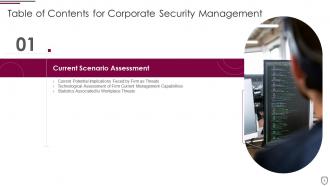
Slide 4: This is another slide continuing Table of Content for the presentation.
Slide 5: This slide depicts title for 'Current scenraio assessment'.
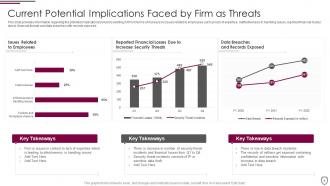
Slide 6: This slide provides information regarding the potential implications/concerns existing in firm.
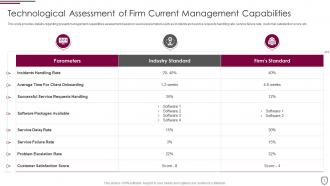
Slide 7: This slide provides details regarding present management capabilities assessment.
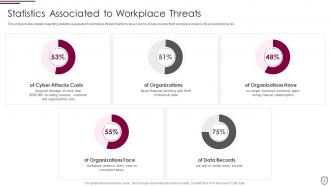
Slide 8: This slide provides details regarding statistics associated to workplace threats.
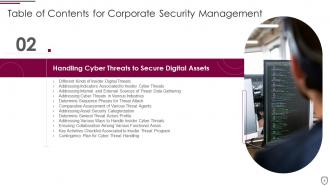
Slide 9: This slide displays title for 'Handling cyber threats to secure digital assets'.
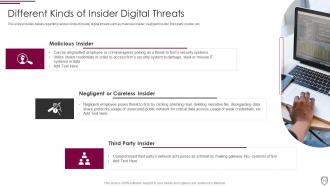
Slide 10: This slide provides details regarding various kinds of insider digital threats.
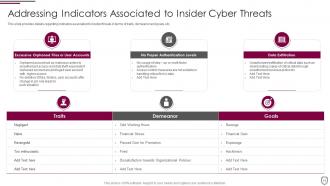
Slide 11: This slide provides details regarding indicators associated to insider threats.
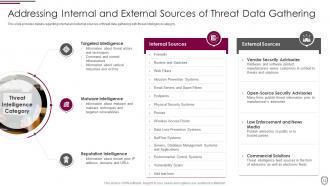
Slide 12: This slide provides details regarding internal and external sources of threat data.
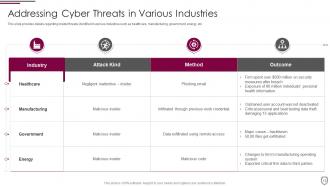
Slide 13: This slide provides details regarding insider threats identified in various industries.
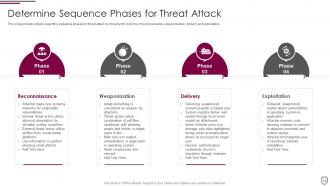
Slide 14: This slide provides details regarding sequence phases for threat attack by threat actor.
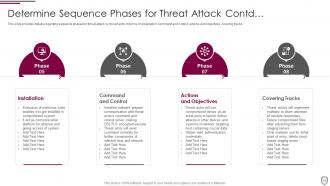
Slide 15: This slide presents continued content.
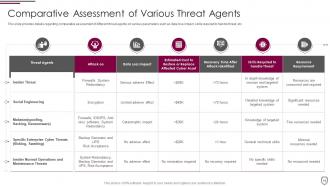
Slide 16: This slide provides details regarding comparative assessment of different threat agents on various parameters.
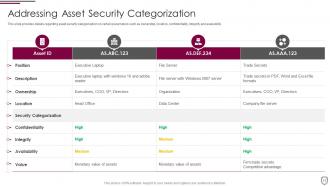
Slide 17: This slide provides details regarding asset security categorization on certain parameters.
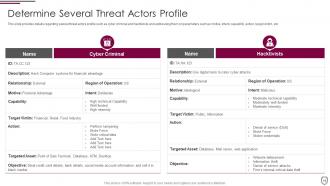
Slide 18: This slide provides details regarding several threat actors profile.
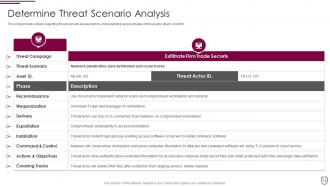
Slide 19: This slide provides details regarding threat scenario assessment by understanding various phases of threat actor attack on victim.
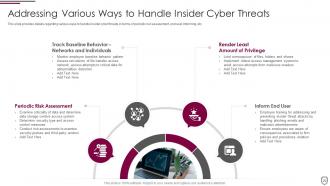
Slide 20: This slide provides details regarding various ways to handle insider cyber threats.
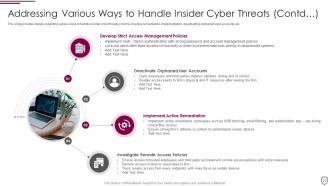
Slide 21: This slide exhibits continued content.
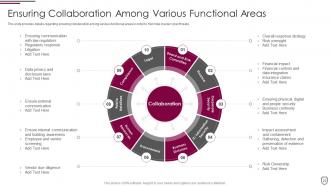
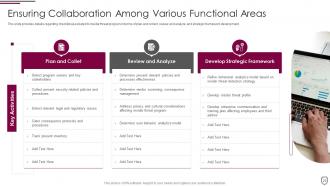
Slide 22: This slide provides details regarding ensuring collaboration among various functional areas.
Slide 23: This slide provides details regarding checklist associated to insider threat program.
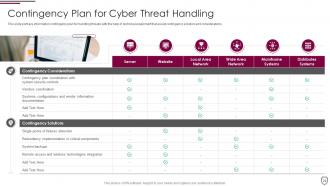
Slide 24: This slide portrays information contingency plan for handling threats with the help of technical equipment.
Slide 25: This slide shows title for 'People security against workplace violence or threat'.
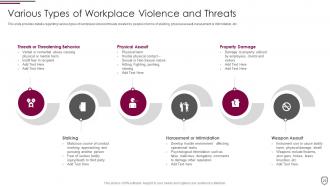
Slide 26: This slide provides details regarding various types of workplace violence threats created by people.
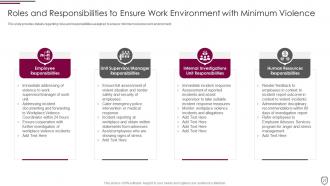
Slide 27: This slide provides details regarding roles and responsibilities assigned to ensure minimum violence work environment.
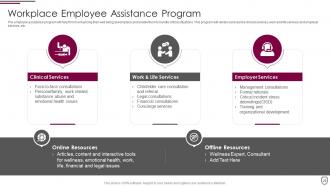
Slide 28: This slide depicts Workplace Employee Assistance Program.
Slide 29: This slide displays title for 'Ensuring physical security'.
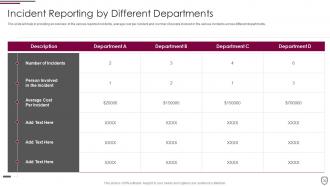
Slide 30: This slide provides overview of the various reported incidents.
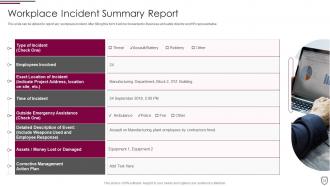
Slide 31: This slide can be utilized to report any workplace incident.
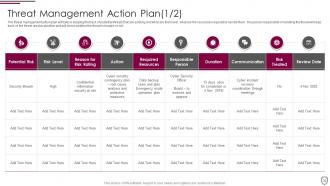
Slide 32: This slide presents Threat Management Action Plan.
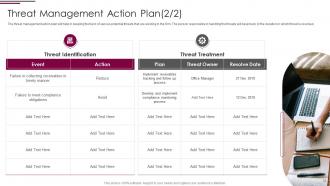
Slide 33: This slide exhibits continued content.
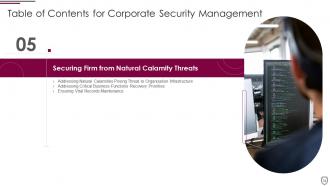
Slide 34: This slide shows title for 'Securing firm from natural calamity threats'.
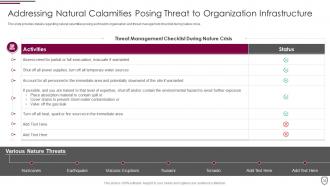
Slide 35: This slide provides details regarding natural calamities posing as threat.
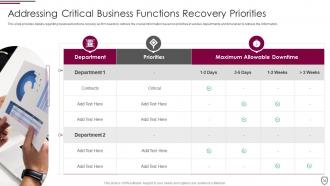
Slide 36: This slide provides details regarding business functions recovery as firm needs to retrieve the crucial information.
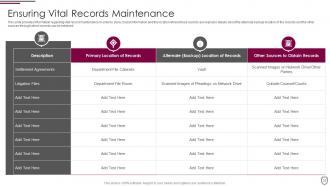
Slide 37: This slide provides information regarding vital record maintenance in order to store crucial information.
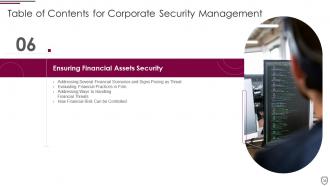
Slide 38: This slide displays title for 'Ensuring financial assets security'.
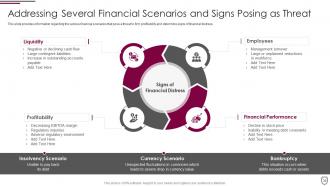
Slide 39: This slide provides information regarding the various financial scenarios that pose a threat to firm.
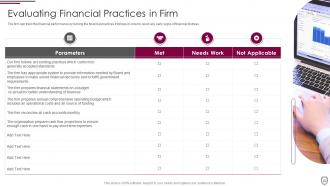
Slide 40: This slide presents Evaluating Financial Practices in Firm.
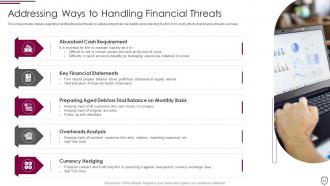
Slide 41: This slide provides details regarding handling financial threats by safeguarding financial stability.
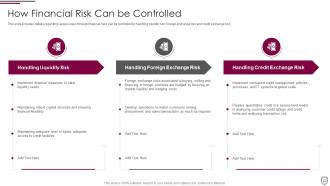
Slide 42: This slide provides details regarding various ways through financial risks can be controlled.
Slide 43: This slide presents title for 'Leveraging workforce'.
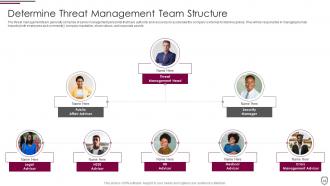
Slide 44: This slide exhibits 'Determine Threat Management Team Structure'.
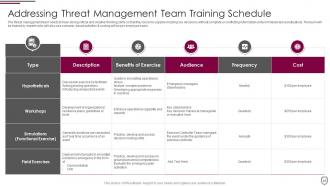
Slide 45: This slide addresses Threat Management Team Training Schedule.
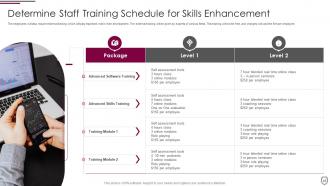
Slide 46: This slide shows 'Determine Staff Training Schedule for Skills Enhancement'.
Slide 47: This slide depicts title for 'Budget assessment'.
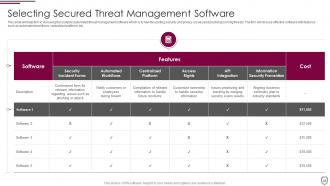
Slide 48: This slide highlights 'Selecting Secured Threat Management Software'.
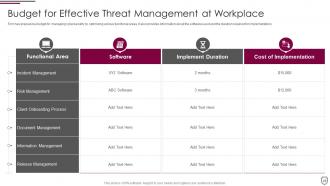
Slide 49: This slide illustrates Budget for Effective Threat Management at Workplace.
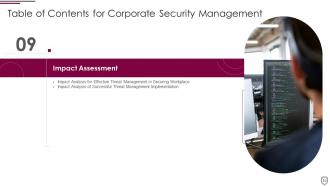
Slide 50: This slide presents title for 'Impact assessment'.
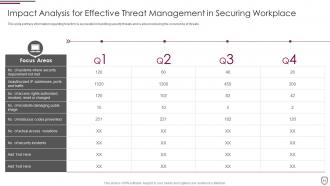
Slide 51: This slide portrays information regarding how firm is successful in handling security threats.
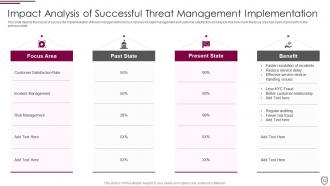
Slide 52: This slide depicts the impact of successful implementation of threat management.
Slide 53: This slide exhibits title for 'Dashboard'.
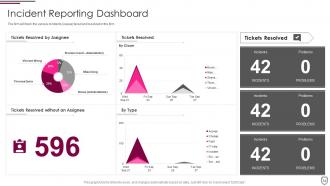
Slide 54: This slide shows Incident Reporting Dashboard.
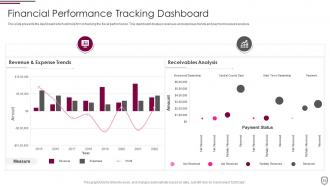
Slide 55: This slide presents the dashboard which will help firm in tracking the fiscal performance.
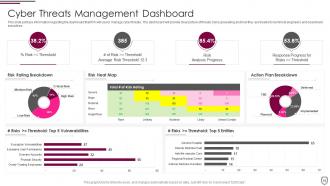
Slide 56: This slide portrays information regarding the dashboard that firm will use to manage cyber threats.
Slide 57: This slide displays Icons for Corporate Security Management.
Slide 58: This slide is titled as Additional Slides for moving forward.
Slide 59: This slide provides 30 60 90 Days Plan with text boxes.
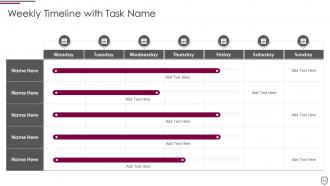
Slide 60: This slide represents Weekly Timeline with Task Name.
Slide 61: This slide showcases Roadmap For Process Flow.
Slide 62: This slide shows Post It Notes. Post your important notes here.
Slide 63: This is a Timeline slide. Show data related to time intervals here.
Slide 64: This slide depicts Venn diagram with text boxes.
Slide 65: This slide contains Puzzle with related icons and text.
Slide 66: This is Our Target slide. State your targets here.
Slide 67: This slide shows Circular Diagram with additional textboxes.
Slide 68: This is a Thank You slide with address, contact numbers and email address.
Corporate security management powerpoint presentation slides with all 73 slides:
Use our Corporate Security Management Powerpoint Presentation Slides to effectively help you save your valuable time. They are readymade to fit into any presentation structure.







FAQs for Corporate security management
So basically you need to cover four main things: physical security like access controls and cameras, cybersecurity with firewalls and data protection, personnel stuff like background checks and training, plus risk assessment. Most companies screw this up because they treat each area separately instead of connecting them - which is honestly pretty dumb. Oh, and don't forget incident response planning and regular audits. Here's the thing though: everyone needs to own security now, not just the IT guys. I'd start with a full risk assessment of what you've got, then tackle your biggest weak spots first.
Look, risk assessment is basically your security foundation - can't protect stuff you don't even know is vulnerable. Start by mapping out your assets, threats, and weak spots, then figure out which combos could actually mess up your business. It's like getting a physical but for your company's security health, I guess? This whole process drives where you put your money, what controls you build, and which risks get priority. Honestly, without it you're just guessing and hoping for the best. Don't forget to update it regularly since new threats pop up all the time.
Honestly, AI and machine learning are crushing it right now - they can spot threats and even predict attacks before they happen. Cloud security platforms are pretty sweet too since you can manage everything from one place (super helpful if your team's scattered everywhere). Biometric access is getting crazy sophisticated - those old keycards were a joke anyway. You'll also want IoT security tools as more random devices connect to your network. Zero-trust architecture is flipping how we think about perimeter security on its head. I'd probably start by looking at what gaps you have now, then tackle whichever of these fixes your biggest headaches first.
Don't try to slap data protection stuff onto your security policies after the fact - build it in from day one. Figure out what regulations actually hit your company (GDPR, CCPA, whatever) and write policies your team can understand, not some lawyer-speak nightmare. Honestly, I've watched so many places just throw in "follow all laws" and call it done. That's useless. You'll want data classification rules, who can access what, how to handle breaches, retention timelines - the works. Oh and definitely audit quarterly. Catching problems yourself beats having regulators find them first.
Honestly, start with phishing training for your team - that's where most breaches begin. Weak passwords are still killing companies in 2024, which is wild. Get multi-factor authentication set up ASAP. Social engineering attacks are getting scary good, and your people will always be the biggest risk factor. Keep software patched, watch out for disgruntled employees, and don't forget basic stuff like locking server rooms. Third-party vendors can be backdoors too. Remote access points need serious attention since everyone's still working from home. Those two things I mentioned first though? They'll stop like 80% of common attacks.
Look, most security breaches happen because someone messed up, not because of some elite hacker. Training your team is honestly the best investment you can make. Teach them to spot sketchy emails, use decent passwords, handle data properly - that kind of stuff. Your fancy security software won't help if someone clicks a bad link or walks away from an unlocked computer. I'd say start with quarterly sessions covering basics, then throw in some realistic scenarios. Makes people actually think about it instead of just zoning out. Security training sounds boring but it really does work.
Look, you really need an incident response plan because when shit hits the fan, people panic. I've seen teams waste precious hours just figuring out who's supposed to do what. Your plan keeps everyone focused so you can actually contain the damage instead of making it worse. It also helps you bounce back faster and keep customers from losing faith in you. Most compliance stuff requires documentation anyway, so you're killing two birds with one stone. Just don't let it collect dust - run practice drills so people remember their roles when it matters.
Dude, you can have crazy good firewalls and encryption, but what's the point if someone walks in and plugs a USB into your computer? Physical security fills those gaps that digital stuff misses. Like, access controls and cameras stop people from even reaching your systems. Locked server rooms are huge too. Also - and this happens more than you'd think - tons of social engineering relies on someone actually showing up pretending to be delivery or maintenance. You've gotta match your physical security to your digital level, otherwise attackers will just take the easier route.
Dude, leadership makes or breaks this whole thing. If your C-suite isn't actually doing the security stuff they preach, forget it - nobody else will care either. The best companies I've worked with treat security like it's just part of the job, not some annoying extra task. They celebrate when someone catches a sketchy email. Failures get discussed openly instead of swept under the rug. Honestly, it's wild how different the vibe feels between places that do security as teamwork vs. places where it feels like you're getting scolded. Get your executives modeling the right behavior first - everything else flows from there.
You need both types of metrics - the predictive stuff and the aftermath data. Track things like training completion rates, vuln scan results, and how your team handles drills. Then measure actual incidents, what breaches cost you, and audit outcomes. Most places just count the bad things after they happen because it's simpler, but that's kinda backwards if you think about it. The real value comes from seeing whether you're preventing problems or just cleaning up messes. Pick maybe 3-5 metrics that match your biggest headaches and check them monthly. Don't go overboard with tracking everything.
So first off, dig deep into any vendor before you bring them on - security questionnaires, check their certs, do risk assessments based on what data they'll touch. Get your contracts tight with security requirements and audit rights built in. Here's the thing though - most companies totally drop the ball after onboarding. You can't just sign them and forget about them! Keep monitoring their security situation regularly. Oh, and maintain a current list of all your vendors with risk levels noted. Trust me, you'll need it. Have termination procedures ready too because breaches happen and you don't want to scramble.
Dude, cybersecurity is literally the backbone of everything now. Your cameras, door locks, visitor systems - they're all networked, which means hackers can mess with your physical security too. Pretty crazy when you think about it. Can't separate digital and physical anymore, they're basically one thing. My old boss learned this the hard way when someone got into our building through a compromised camera system. Work with your IT people to check all your connected devices. Also make sure that stuff runs on its own network segment, not mixed in with everything else.
Honestly, the whole remote work thing completely destroyed traditional security approaches. Now everyone's moving to zero-trust - basically don't trust anyone or anything by default. AI threat detection is getting really sophisticated too. Supply chain attacks are happening constantly (feels like every other week), so you better start auditing your vendors now. Insider threats are becoming a massive focus since people realize employees can be the biggest risk. Physical and cyber security teams are finally talking to each other, which is about time. Oh, and companies are throwing money at security training because, let's face it, humans mess up constantly.
Honestly, just be upfront about what you're tracking and why. Companies that secretly monitor everything create this super weird vibe - I've watched it kill morale. Spell out your policies clearly: what data, how it's used, all that stuff. Give people a say through feedback sessions or whatever works. Focus on real business risks instead of watching literally everything employees do. Use anonymous data when you can. Oh, and actually ask your team what bothers them privacy-wise. You'd be shocked what comes up. Start there and work backwards.
Honestly, crisis communication is where most companies totally drop the ball. Build your incident response teams and communication plans before you need them - figuring out who talks to reporters mid-breach is a nightmare. Set up clear escalation procedures and pick your spokespeople ahead of time. Your crisis plans need employee alerts, stakeholder message templates, and recovery timelines that match your security response. But here's the thing - you've gotta run tabletop exercises regularly or people freeze up when it actually hits the fan.
-
Innovative and attractive designs.
-
The content is very helpful from business point of view.