

Corporate Restructuring Powerpoint Presentation Slides





Try Before you Buy Download Free Sample Product
 Impress Your
 Audience
 100%
100% Editable
 Save Hours
 of Time


Restructuring of corporate models simplifies management reorders and removes barriers to output. Charts are prepared to improve decision-making, organize present needs, and make the model more profitable. Grab our competently designed Corporate Restructuring template to enhance communication and decision-making. It also gives a brief idea about simplifying management, reordering the companys organizational hierarchy, and removing barriers to productivity. This PPT presentation can be helpful for change management officers in corporate restructuring. The outline of this template covers the organizations current situation analysis, including current business processes, roles and responsibilities, and change readiness assessment. Further, this proposal includes Business Restructuring Approaches, a Strategic organizational chart, a restructuring readiness checklist, restructuring strategies, and associated risks. This template also covers organization risk identification, opportunities in restructuring the company workflow, mitigation plans, and processes. Further, it involves employee training plans and new communication plans. This corporate restructuring deck includes post-implementation KPIs, surveys, timelines, and performance measurement reports. Customize this 100 percent editable template now.
People who downloaded this PowerPoint presentation also viewed the following :
Content of this Powerpoint Presentation
Slide 1: This slide displays title i.e. 'Corporate Restructuring' and your Company Name.
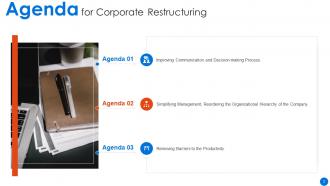
Slide 2: This slide presents agenda.
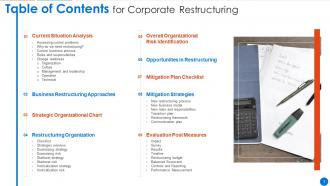
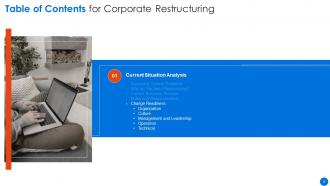
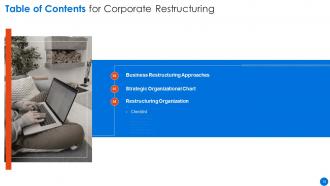
Slide 3: This slide exhibits table of contents.
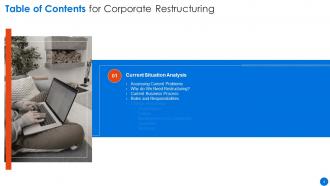
Slide 4: This slide depicts title for four topics that are to be covered next in the template.
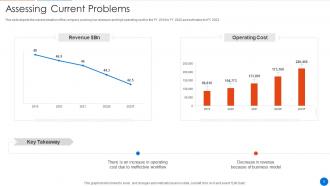
Slide 5: This slide depicts the current situation of the company covering low revenues and high operating cost for the FY 2016 to FY 2022 and estimates for FY 2023.
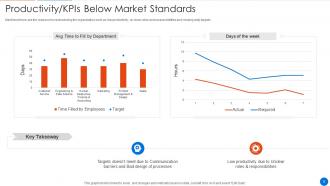
Slide 6: This slide shows the reasons for restructuring the organization such as low productivity, un clear roles and responsibilities and missing daily targets.
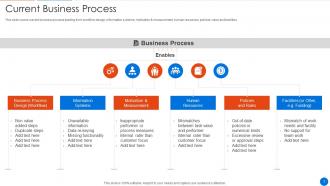
Slide 7: This slide covers current business process starting from workflow design, information systems, motivation & measurement, human resources, etc.
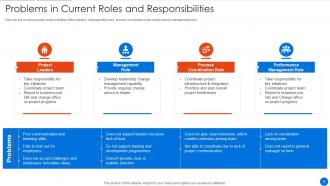
Slide 8: This slide covers current responsibilities of the leaders, management roles , process coordinator roles, performance management roles.
Slide 9: This slide depicts title for four topics that are to be covered next in the template.
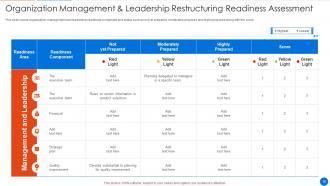
Slide 10: This slide covers organization management and leadership readiness component and status such as not yet prepared.
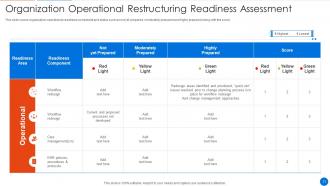
Slide 11: This slide covers organization operational readiness component and status such as not yet prepared.
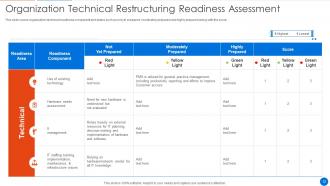
Slide 12: This slide covers organization technical readiness component and status such as not yet prepared.
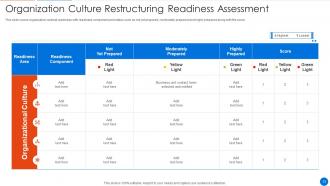
Slide 13: This slide covers organization cultural readiness with readiness component and status such as not yet prepared.
Slide 14: This slide depicts title for four topics that are to be covered next in the template.
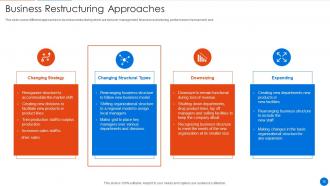
Slide 15: This slide covers different approaches to business restructuring which are turnover management, financial restructuring, etc.
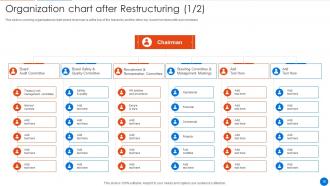
Slide 16: This slide is covering organizational chart where chairman is at the top of the hierarchy and the other key board members with sub members.
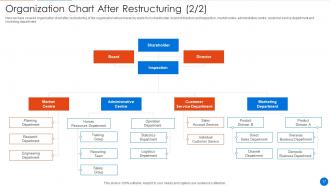
Slide 17: This slide shows organization chart after restructuring of the organization where hierarchy starts from shareholder, board of directors and inspection, etc.
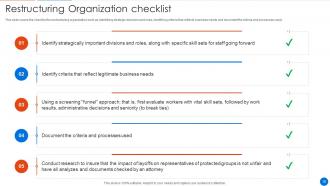
Slide 18: This slide covers the checklist for restructuring organization such as identifying strategic divisions and roles.
Slide 19: This slide depicts title for seven topics that are to be covered next in the template.
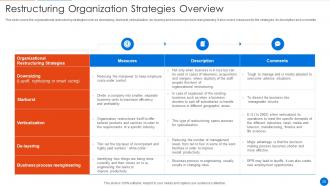
Slide 20: This slide covers the organizational restructuring strategies such as downsizing, starburst, verticalization, de-layering and business process reengineering.
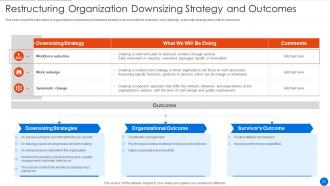
Slide 21: This slide covers the bifurcation of organizational restructuring downsizing strategy such as workforce reduction, work redesign, etc.
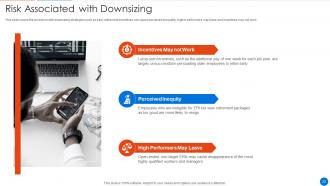
Slide 22: This slide covers the problems with downsizing strategies such as early retirement incentives can cause perceived inequality, etc.
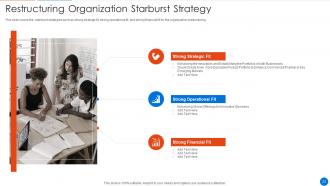
Slide 23: This slide covers the starburst strategies such as strong strategic fit, strong operational fit, and strong financial fit for the organization restructuring.
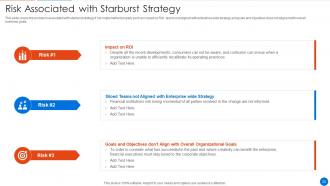
Slide 24: This slide covers the problems associated with starburst strategy if not implemented properly such as impact on ROI, etc.
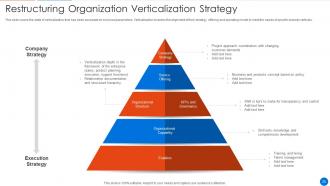
Slide 25: This slide covers the state of verticalization that has been assessed on six broad parameters. Verticalization includes the alignment of their strategy, etc.
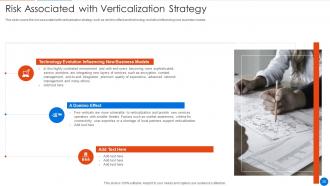
Slide 26: This slide covers the risk associated with verticalization strategy such as domino effect and technology evolution influencing new business models.
Slide 27: This slide depicts title for four topics that are to be covered next in the template.
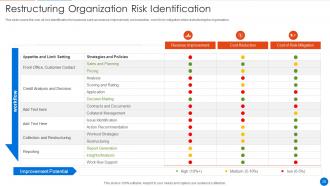
Slide 28: This slide covers the over all risk identification for business such as revenue improvement, cost reduction, etc.
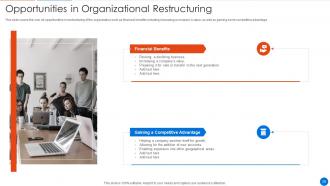
Slide 29: This slide covers the over all opportunities in restructuring of the organization such as financial benefits.
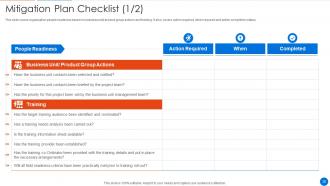
Slide 30: This slide covers organization people readiness based on business unit/ product group actions and training.
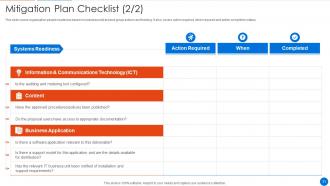
Slide 31: This slide covers organization people readiness based on business unit/ product group actions and training.
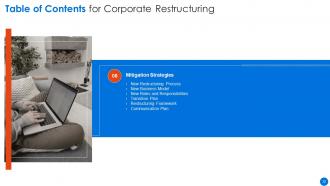
Slide 32: This slide depicts title for eleven topics that are to be covered next in the template.
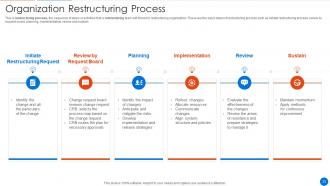
Slide 33: This slide displays restructuring process, the sequence of steps or activities that a restructuring team will follow for restructuring organization.
Slide 34: This slide describes the overall structure; it is necessary to determine the accountability and responsibilities of managers.
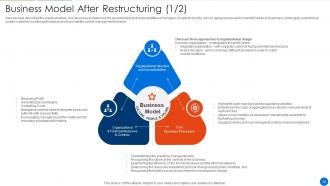
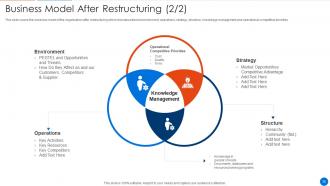
Slide 35: This slide covers the business model of the organization after restructuring which includes external environment, operations, strategy, etc.
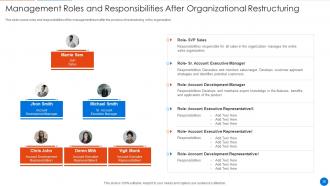
Slide 36: This slide covers roles and responsibilities of the management team after the process of restructuring in the organization .
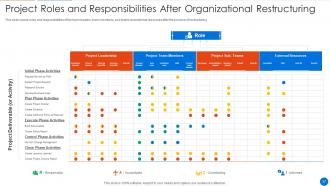
Slide 37: This slide covers roles and responsibilities of the team leaders, team members, sub-teams and external resources after the process of restructuring.
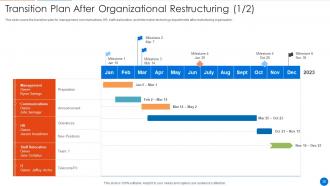
Slide 38: This slide covers the transition plan for management, communications, HR, staff reallocation, etc.
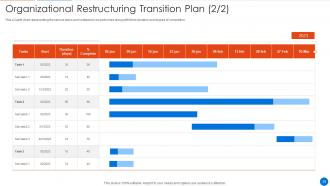
Slide 39: This slide exhibits Gantt chart representing the various tasks and subtasks to be performed along with there duration and degree of completion.
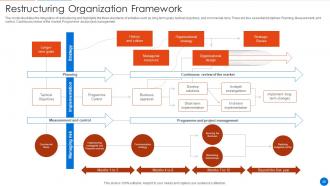
Slide 40: This slide illustrates the integration of restructuring and highlights the three standards of activities such as long-term goals, etc.
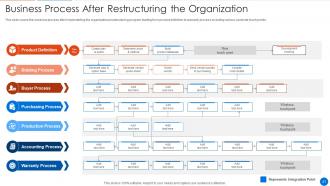
Slide 41: This slide covers the business process after implementing the organizational restructuring program starting from product definition to warranty process.
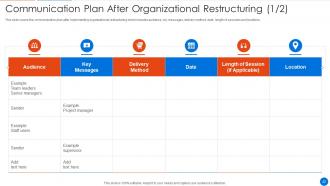
Slide 42: This slide covers the communication plan after implementing organizational restructuring which includes audience, key messages, delivery method, etc.
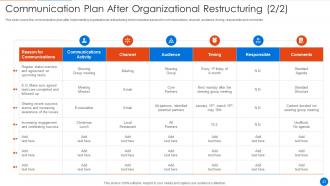
Slide 43: This slide covers the communication plan after implementing organizational restructuring which includes reasons for communications, channel, etc.
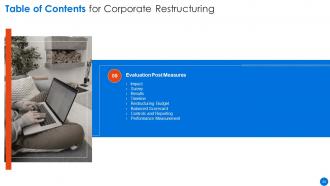
Slide 44: This slide depicts title for eight topics that are to be covered next in the template.
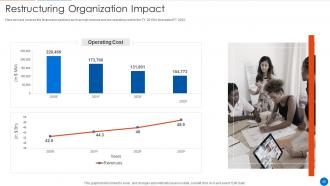
Slide 45: This slide displays the financial projections such as high revenue and low operating cost for the FY 2019 to forecasted FY 2022.
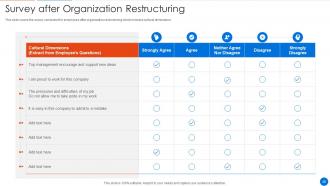
Slide 46: This slide covers the survey conducted for employees after organization restructuring which includes cultural dimensions.
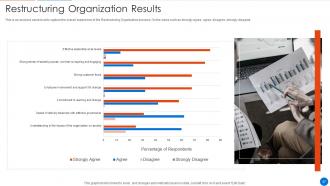
Slide 47: This slide capture the overall experience of the Restructuring Organization process. On the views such as strongly agree, agree, disagree, strongly disagree.
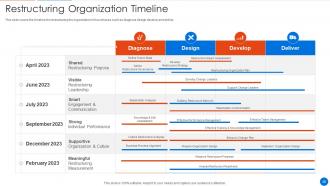
Slide 48: This slide covers the timeline for restructuring the organization in four phases such as diagnose design develop and deliver.
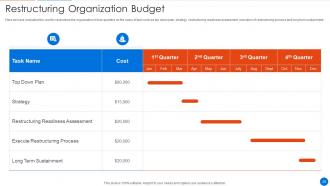
Slide 49: This slide exhibits the cost for restructure the organization in four quarters on the basis of task such as top down plan, strategy, etc.
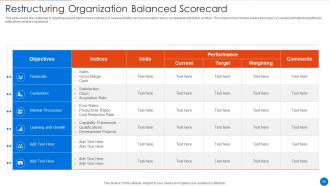
Slide 50: This slide covers the challenge in reporting several performance indices is to assess whether an improvement in one is comparable with that in another.
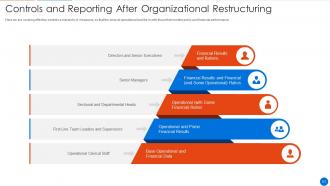
Slide 51: This slide covers effective controls a hierarchy of measures, so that the ones at operational level tie.
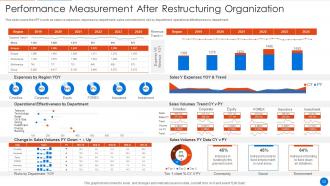
Slide 52: This slide covers the KPI’s such as sales vs expenses, expenses by department, sales volumes trend, risk by department, operational effectiveness by department.
Slide 53: This is the icons slide.
Slide 54: This slide presents title for additional slides.
Slide 55: This slide depicts 30-60-90 days plan for projects.
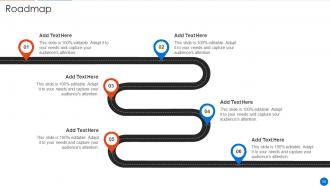
Slide 56: This slide shows roadmap of company.
Slide 57: This slide depicts posts for past experiences of clients.
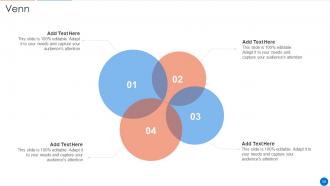
Slide 58: This slide displays Venn.
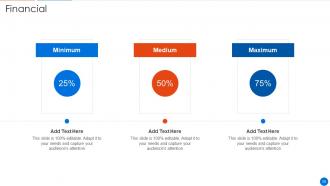
Slide 59: This slide showcases financials of company.
Slide 60: This slide shows puzzle for displaying elements of company.
Slide 61: This is thank you slide & contains contact details of company like office address, phone no., etc.
Corporate Restructuring Powerpoint Presentation Slides with all 66 slides:
Use our Corporate Restructuring Powerpoint Presentation Slides to effectively help you save your valuable time. They are readymade to fit into any presentation structure.









FAQs for Corporate Restructuring
Usually it comes down to money problems, the company running inefficiently, or they're trying to pivot strategy. Companies restructure when they're drowning in debt, bleeding market share, or scrambling to keep up with industry shifts. Sometimes they'll cut costs through layoffs or sell off parts - sucks but keeps them alive. Other times it's more forward-thinking, like spinning off divisions to focus on what they do best or setting up for new markets. Honestly, the key thing is figuring out if they're in crisis mode or actually planning ahead strategically.
Oh man, restructuring is rough - morale always drops hard at first. People freak out about losing their jobs or getting shuffled around randomly. Plus everyone starts questioning if the bosses even have a plan (honestly, half the time they don't). Your culture will take a beating while trust disappears and gossip spreads like wildfire. But here's the thing - transparency makes or breaks you here. Communicate why you're doing this and what people can expect. Over-communicate actually. If you leave people guessing? That's when your top performers start updating their resumes.
So basically mergers are when two companies join up as equals - though honestly that rarely happens since someone usually has more power. Acquisitions are different - that's when one company just buys another outright, like the classic big fish eating small fish thing. You get their customers, tech, whatever you're after. Divestitures flip it around completely - you're selling off pieces of your own business. Maybe it's not core to what you do anymore, or you need the cash. Really depends what you're trying to accomplish - growing bigger through deals or trimming down to focus.
Listen, you've gotta beat the rumor mill to the punch - employees absolutely lose their minds when they hear stuff secondhand. Be straight up about why this is happening and what it means for everyone. Hit multiple channels: town halls, emails, sit-downs with your key players. If you're public, loop in those investor calls too. Honestly, timing is everything here - make sure they're hearing it from you first. Oh, and get your leadership team on the same page beforehand because mixed messages will torpedo this whole thing. Transparency's your friend right now.
Look, financial analysis is basically your GPS when you're dealing with restructuring stuff. It tells you where the cash problems are hiding and which fixes might actually work. You're looking at debt loads, how money flows in and out, what assets are worth - the whole picture. Without it? You're just throwing darts blindfolded, honestly. The data helps you decide between debt restructuring, selling off assets, changing operations, or sometimes just cutting losses entirely. Oh and definitely run different scenarios because this stuff never goes according to plan. Trust me on that one.
Regulatory approvals are your biggest headache, plus you've got shareholder rights and creditor protections to navigate. Employment law kicks in if you're cutting staff or moving people around. Watch out for change-of-control clauses in existing contracts - they'll bite you. Securities law is honestly where most deals go sideways because the disclosure rules are insanely picky. Tax stuff can totally kill your deal, so get tax lawyers involved from day one. Oh, and map out all stakeholder agreements first, then figure out regulatory requirements. Work backwards from there and you'll save yourself a ton of pain.
Dude, tech seriously saves your butt during restructuring. Project management tools help track everything, and data analytics show you exactly what's broken. Communication software keeps people in the loop when everything's nuts. Without digital document management, you'd drown in paperwork - trust me on that one. Cloud tools are perfect since everyone ends up scattered everywhere anyway. Oh, and map out what tech you already have first. Don't wait until you're drowning to figure out what's missing. Analytics tools especially help pinpoint problem areas before they get worse.
Dude, you've got to overcommunicate like crazy - seriously, more than feels comfortable. Tell people what you know AND what you're still figuring out, because gossip spreads fast when there's silence. Get your key players involved in decisions that affect their teams. Radio silence kills these things - I've watched restructures completely bomb because leadership disappeared for weeks. Quick wins help a ton, so celebrate the small stuff. Also, don't pretend this isn't stressful for everyone. Regular team check-ins are your friend for catching issues early.
Honestly, restructuring can go either way for your brand. Customers might see it as smart growth if you frame it right. But layoffs? That screams "we're struggling" to most people. I'd focus your messaging on what customers actually get out of this - better products, faster service, whatever. Skip the boring efficiency talk. Nobody cares about your internal processes. The transparency thing is huge though. People can smell BS from a mile away, so just be upfront about why you're doing it and how it helps them specifically.
Track the obvious stuff first - revenue, costs, cash flow, ROI. But honestly? The operational metrics matter just as much. Employee retention, customer satisfaction, how fast you're getting products out the door. Market share too, obviously. I'd set up a simple dashboard with maybe 6-7 key things tops - any more and you'll drown in data. Check it monthly. The trick is making sure everything ties back to why you restructured in the first place. Otherwise you're just measuring random stuff that looks important.
Honestly, your biggest headache will be people freaking out and quitting. Key employees bail when there's uncertainty - it's just human nature. Cash gets weird too, especially if you're already dealing with debt stuff. Losing all that knowledge when people leave is brutal. Oh, and customers start questioning if you're stable, which... fair enough I guess? The regulatory paperwork becomes a total mess if you're switching up corporate structures. My take? Talk to your team way more than feels necessary and figure out how you're keeping your best people before word gets out.
Figure out what absolutely can't stop - critical stuff, key clients, systems that'd tank you. Talk to your teams constantly about what's changing. I've watched companies go silent for weeks and rumors just destroy everything. Get backup plans ready so when one department implodes, others can cover temporarily - even if it's messy. Honestly, the communication thing is probably your biggest risk here. Pick specific people to be your "keep the lights on" crew while leadership handles the big moves. Short updates beat perfect ones that never happen.
Here's what I've noticed from all the big corporate failures - companies get obsessed with slashing costs but totally forget what they're actually building toward. Cutting headcount feels productive, but then what? You need people to buy into the vision too, otherwise everyone just bails or phones it in. Look at Sears - complete disaster because they had no real plan beyond "spend less money." Honestly, the whole thing reminds me of people who crash diet without thinking about sustainable habits. Smart restructuring means you're moving toward something concrete, not just running away from your current mess.
Dude, transparency is everything here - start talking to your best people NOW before they hear rumors and panic. Figure out who you absolutely can't lose and have real conversations about what's coming. I learned this the hard way watching companies hemorrhage talent because they stayed quiet too long. Throw retention bonuses at key players if you have to. Give them bigger roles or clearer paths forward. Actually bring your top performers into the planning if possible - makes them feel important plus you get better ideas. Don't just assume they'll stay because you need them to.
Honestly, just tell people what's happening before they have to ask. Nobody likes surprises when it comes to changes that mess with their routine. Make sure your customer service folks actually know what's going on - there's nothing more annoying than calling for help and the rep sounds more confused than you are. Try to keep things running smoothly during the switch, even if you need some Band-Aid solutions temporarily. For your big clients, maybe assign someone to walk them through it personally? I'd rather over-explain than deal with angry customers later. Focus on what's actually better for them, not just the cool new features.
-
The content is very helpful from business point of view.
-
Easy to edit slides with easy to understand instructions.