


Corporate culture powerpoint presentation slides





Try Before you Buy Download Free Sample Product
 Impress Your
 Audience
 100%
100% Editable
 Save Hours
 of Time


Introduce better culture value beliefs, and behavior in the company by incorporating Corporate Culture PowerPoint Presentation Slides. This presentation contains various slides explaining the current situation analysis of the company, analyzing current flaws in the company’s culture, strategy, and approach, develop a culture change plan, etc. Take advantage of company culture PPT slideshow, and showcase the company’s productivity and revenue for four years. After that, describe the assimilation strategy and its features. Utilize our ready-to-use PowerPoint infographics, and discuss cultural issues in the company due to mergers and acquisitions. Analyze the current flaws in the company’s culture by taking the assistance of the organization culture PPT layouts. Provide information on integration strategies and the top-down approach of the company by using this visually-appealing PowerPoint slide deck. The presentation allows you to develop a culture change plan and roadmap for the cultural integration strategy. Showcase the impact of developing a new culture plan by downloading our visually-attention-grabbing working culture PPT presentation.
People who downloaded this PowerPoint presentation also viewed the following :
Content of this Powerpoint Presentation
Slide 1: This is a title slide that introduces Corporate Culture. Add the name of your company here.
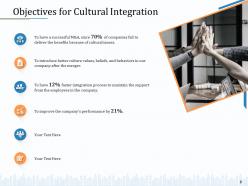
Slide 2: This slide provides the Objectives for Cultural Integration. This includes having a successful M & M&A (because 70% of companies fail to deliver benefits because of cultural issues), introducing better cultural values, beliefs, and behaviors after the merger, and improving the company's performance by 21% and more.
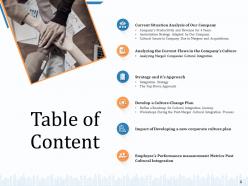
Slide 3: This slide contains the Table of Contents. The contents are Current Situation Analysis of Our Company, Analyzing the Current Flaws in the Company’s Culture, Strategy and its Approach, Develop a Culture-Change Plan, Impact of Developing a new corporate culture plan and Employee’s Performance measurement Metrics Post Cultural Integration.
Slide 4: This slide introduces the Current Situation Analysis of Our Company which includes the Company’s Productivity and Revenue for 4 Years, Assimilation Strategy Adapted by Our Company, and Cultural Issues in the Company Due to Mergers and Acquisitions.
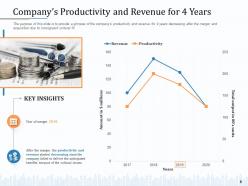
Slide 5: This slide provides the Company’s Productivity and Revenue for 4 Years which decreases after the merger due to incongruent cultural fit with key insights like a year of merger and the productivity trend.
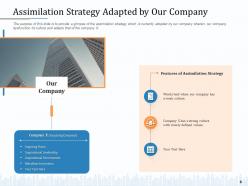
Slide 6: This slide provides information about the Assimilation Strategy Adapted by the Company to adapt to another company’s culture. It works best when our company has a weak culture, and Company X has a strong culture with clearly defined values.
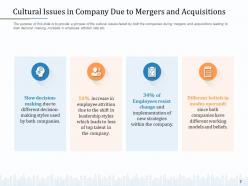
Slide 7: This slide talks about Cultural Issues in a Company Due to Mergers and Acquisitions such as Slow decision-making , a 16% increase in employee attrition, and 34% of Employees resisting change .
Slide 8: This slide introduces Analyzing Merged Companies Cultural Integration which involves Analyzing the Current Flaws in the Company’s Culture.
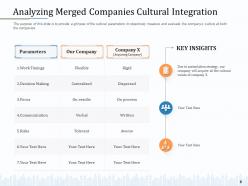
Slide 9: This slide talks about the cultural parameters to objectively measure and evaluate the company’s culture at both the companies. These parameters include work timings, decision making, focus, risks, and communication, and more.
Slide 10: This slide introduces Strategy and its Approach, which includes Integration Strategy and The Top-Down Approach.
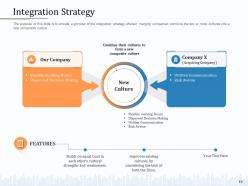
Slide 11: This slide shows us the integration strategy wherein merging companies combine the two or more cultures into a new composite culture. Its features include building on equal trust in each other’s cultural strengths and weaknesses and improving existing cultures by considering the best of both the firms etc.
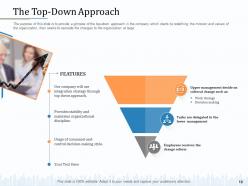
Slide 12: This slide showcases The Top-Down Approach in the company, which starts by redefining the organization's mission and values, then seeks to cascade the changes to the organization at large. It takes place in 3 general steps, which go as follows: Upper management decides on cultural change, tasks are delegated to the lower management, and employees receive the change reform.
Slide 13: This slide introduces Develop a Culture-Change Plan which includes Define a Roadmap for Cultural Integration Journey and Workshops During the Post-Merger Cultural Integration Process.
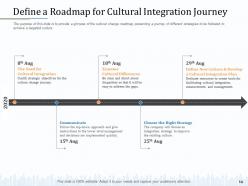
Slide 14: This slide show how to Define a Roadmap for Cultural Integration Journey of different strategies to be followed to achieve a targeted culture. These strategies could be: The need for cultural integration, communication, examine cultural differences, choose the right strategy and define new culture & develop a cultural integration plan.
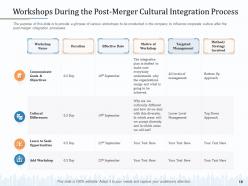
Slide 15: This slide contains tabulated details of Workshops During the Post-Merger Cultural Integration Process. The workshops, such as Communication Goals and Objectives, Cultural Differences, and Learn to Seek Opportunities, are to be conducted in the company to influence corporate culture after the post-merger integration processes.
Slide 16: This slide introduces Impact of Developing a new corporate culture plan.
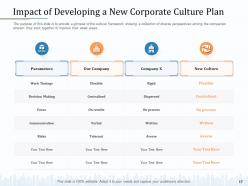
Slide 17: This slide makes Impact of Developing a New Corporate Culture Plan showing a collection of diverse perspectives among the companies wherein they work together to improve their weak areas. The variables for this are: Work timings, decision-making, focus, risk, and communication, among others.
Slide 18: The slide introduces Employee’s Performance measurement Metrics Post Cultural Integration.
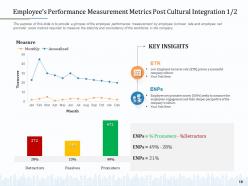
Slide 19: This slide is part 1 of 2 of Employee’s Performance Measurement Metrics Post Cultural Integration. Employee performance is measured by employee turnover rate and employee net promoter score metrics required to measure the stability and consistency of the workforce in the company.
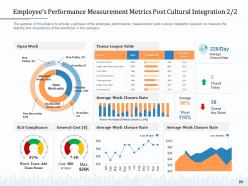
Slide 20: This slide is part 2 of 2 of Employee’s Performance Measurement Metrics Post Cultural Integration. The employee performance measurement post cultural integration is required to measure the stability and consistency of the workforce in the company.
Slide 21: This slide introduces Additional Slides.
Slide 22: This slide contains various Corporate Culture Icons Slide to choose from.
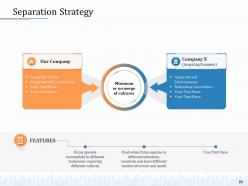
Slide 23: This slide represents the Separation Strategy. This is used when a firm operates successfully in different industries requiring needs, market strategies, countries, and different cultures.
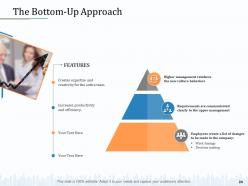
Slide 24: This slide represents The Bottom-Up Approach which starts from the employee stage of the company and ends at the higher management.
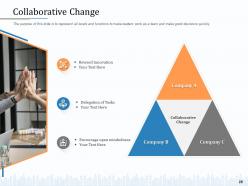
Slide 25: This slide represents Collaborative Change to display all levels and functions to make leaders work as a team and make good decisions quickly.
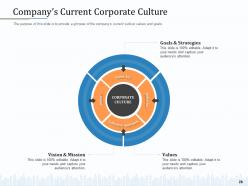
Slide 26: This is a slide that visually represents the Company’s Current Corporate Culture. This includes Goals and Strategies, the Vision and Mission, and the Values of the company.
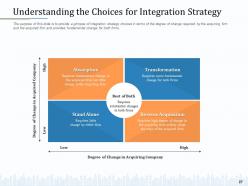
Slide 27: This slide provides information on Understanding the Choices for Integration Strategy regarding the degree of change required by the acquiring firm and the acquired firm and provides fundamental change for both firms.
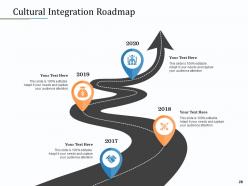
Slide 28: This slide shows the Cultural Integration Roadmap to present the steps to achieve better integration of various cultures.
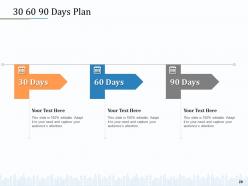
Slide 29: This is a slide with a 30 60 90 Days Plan to set goals for these important intervals.
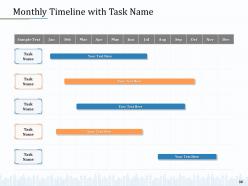
Slide 30: This slide shows a table for a Monthly Timeline with Task Name.
Slide 31: This is a Thank You slide where details such as the address, contact number, email address are added.
Corporate culture powerpoint presentation slides with all 31 slides:
Use our Corporate Culture Powerpoint Presentation Slides to effectively help you save your valuable time. They are readymade to fit into any presentation structure.



FAQs for Corporate culture
Honestly, it starts with leadership that actually walks the walk - not just fancy mission statements nobody believes. You need people to feel safe speaking up without getting burned for it. Trust goes both ways too, which sounds obvious but so many places mess this up. Fair pay and decent work-life balance aren't negotiable anymore. Recognition when someone does good work makes a huge difference. Psychological safety is clutch - like, mistakes happen and they should be learning moments, not witch hunts. But here's the thing - just ask your team what's broken. They'll tell you exactly what needs fixing if you actually listen.
Honestly, your company culture is huge for this stuff. People who feel valued and trusted? They'll bust their ass for you. But toxic workplaces just crush people's motivation - I've seen it happen so fast it's crazy. Good cultures boost everything: teamwork, communication, how long people actually stick around. The whole nine yards. You should probably take a hard look at where you're at right now. What's making people feel unsupported? Start there. Recognition and growth opportunities make a massive difference too. It's wild how much this impacts productivity once you really think about it.
Honestly, your leadership style basically becomes your company's personality. When you're open and collaborative, your team picks up on that energy and works better together. Micromanage people? You'll get fear and zero trust - which is awful for everyone. Here's the thing though - people pay way more attention to what you actually do than your fancy mission statements. How you communicate, deal with drama, handle mistakes... all of that trickles down whether you mean it to or not. I've seen it happen so many times. The behaviors you think nobody notices? Those are exactly what's shaping your culture every single day.
Honestly? Anonymous surveys are your best bet for getting real feedback - people actually tell the truth when they're not worried about backlash. I'd do pulse surveys regularly. But also watch how things actually work around there: meetings, decision-making, even random hallway conversations. Exit interviews are pure gold since those people have nothing to lose anymore. Oh, and maybe get an outside consultant for focus groups? Sometimes you're way too in it to see what's obvious to everyone else. Start with surveys though - you need that baseline data first.
Look, diverse teams just straight up make better decisions - that's not even debatable anymore. You get people from different backgrounds throwing around ideas, and suddenly you're solving problems in ways nobody thought of before. Way more fun than being stuck with a bunch of clones too, honestly. But here's where companies mess up: they'll hire diversely then wonder why people leave. It's because diversity without inclusion is basically useless. Those new voices need to actually feel safe speaking up and know their input matters. Otherwise you're just wasting everyone's time.
Yeah, remote work totally messes with company culture flow. Those random hallway chats? Gone. Water cooler gossip where you actually learn stuff? Nope. I swear I picked up more about office politics just by watching people interact than from any meeting. Now leadership has to work way harder to spell out values since you can't just absorb them by being around. The trick is creating fake "casual" moments - which sounds weird but works. Also being super clear about expectations because that cultural osmosis thing doesn't happen through a screen, unfortunately.
Honestly, the worst thing you can do is try changing everything at once. Culture takes forever - like years, not weeks. Leadership has to actually walk the walk too, because people can spot fake behavior instantly. Most places get obsessed with adding perks instead of fixing real problems like how decisions get made or communication breakdowns. Oh, and they totally forget to celebrate the small stuff, which just kills all momentum. My advice? Pick maybe 2-3 specific behaviors you want more of, then keep highlighting them when you see it happening. Stories work way better than policies.
Honestly, the trick is using real stories instead of those generic posters nobody reads. Like when Sarah from accounting helped marketing hit their crazy deadline - that's the stuff that actually matters. Tell those stories in meetings, newsletters, wherever. People remember stories way better than some mission statement they saw once. The whole point is showing what living your values looks like day-to-day, not just talking about them. Works way better than I expected when we started doing it.
Okay so first thing - you gotta actually define what those values look like day-to-day, not just have them on a poster somewhere. When you're hiring, focus on people who live those values, not just the ones with perfect resumes. Your leadership team needs to walk the walk because honestly, everyone's watching them more than listening to company emails. Survey your people regularly to see if they actually witness these values in action. Oh and here's the thing that trips up most companies - every single decision you make, from handling drama to celebrating wins, should scream your values. It's all about consistency.
Dude, onboarding is literally your first shot at showing new people what your company's actually like. Skip the boring paperwork marathon - I mean, you'll need some of that stuff, but don't make it the main event. Most places totally waste this moment. Share real stories instead. Connect them with people who actually embody your culture. Give them something meaningful to work on right away, not just training videos. You're basically creating their first impression of "how we roll here." Make it count, not just another admin checklist they have to survive.
Look, culture really does make or break your hiring game. Good people will literally hunt you down when you've got something authentic going on - they want to work somewhere that actually matches what they care about. Your best employees stay forever when they feel like they belong. But here's the thing - toxic workplaces? Total talent black holes. Nobody decent wants in, and your stars bolt the second they can. I've seen it happen so many times. Just be real about what your culture actually is instead of some fantasy version.
Start with making people feel safe to screw up - that's honestly the biggest thing. When your team isn't terrified of failing, they'll actually try stuff. Celebrate those "good failures" just like you do wins. Your managers need to show curiosity instead of just breathing down everyone's necks for results. Silos are innovation killers, so get different departments talking. Give people some dedicated time to mess around with ideas outside their normal work - even 10% helps. Make innovation everyone's thing, not just the R&D team's problem. Ask your people what's blocking them from trying new approaches. You'll probably learn something.
You'll spot it pretty quick - crazy high turnover, everyone's gossiping instead of actually talking, and managers breathing down people's necks constantly. People look miserable and checked out. Oh, and there's always someone getting blamed instead of fixing the actual problem. Favoritism runs wild too. Honestly? Start with real conversations about what sucks. Write stuff down so you have receipts later. Set boundaries and stick to them - this part's huge. If you're the boss, don't just promise changes, actually do them. I've seen too many places where leadership talks big but nothing shifts. Small consistent moves work way better than some dramatic overhaul nobody believes anyway.
Honestly, start with the basics - engagement surveys and retention rates tell you if people actually buy into your values. Internal promotion rates are huge too. I'd also track how fast new hires settle in and whether departments actually collaborate (not just say they do). Those culture surveys feel weird to roll out, but the data doesn't lie. Look at the small stuff - is anyone using that feedback tool you launched? Are managers doing their promised check-ins? Pick 3-4 metrics that match what you're trying to build. Check quarterly, not once a year.
Honestly, your company culture is huge for customer satisfaction. Employees who actually buy into your values? Customers pick up on that energy immediately. There's such an obvious difference between someone just doing their job versus someone who genuinely cares - and trust me, customers feel it every single time. Happy, engaged workers naturally give better service and become real advocates for your brand. Consistent experiences build trust, which keeps people coming back. I'd focus on hiring people who fit your culture first, then keep reinforcing those values regularly. You'll see it reflected in your customer feedback faster than you think.
-
Professional and unique presentations.
-
Design layout is very impressive.
-
Illustrative design with editable content. Exceptional value for money. Highly pleased with the product.
-
Very unique and reliable designs.
-
Good research work and creative work done on every template.
-
Great experience, I would definitely use your services further.
-
Informative presentations that are easily editable.
-
Good research work and creative work done on every template.
-
Nice and innovative design.
-
Excellent products for quick understanding.