


Building high performance company culture powerpoint presentation slides




Try Before you Buy Download Free Sample Product
 Impress Your
 Audience
 100%
100% Editable
 Save Hours
 of Time


Our Building High Performance Company Culture Powerpoint Presentation Slides are topically designed to provide an attractive backdrop to any subject. Use them to look like a presentation pro.
People who downloaded this PowerPoint presentation also viewed the following :
Content of this Powerpoint Presentation
Slide 1: This slide is titled “Building High-Performance Company Culture.” State your company name and get started.
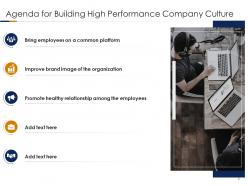
Slide 2: This slide is titled “Agenda for Building High-Performance Company Culture.” It shows Bring employees to a common platform, improve the brand image of the organization, Promote healthy relationships among the employees, etc.
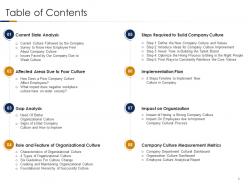
Slide 3: This slide is titled “Table of Contents.” It shows Current Culture Followed by the Company, Survey to Know How Employees Feel About Company Culture, Issues Faced by Our Company Due to Weak Culture, etc.
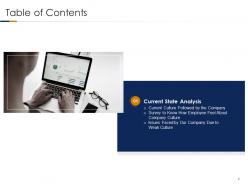
Slide 4: This slide is titled “Table of Contents.” It includes Current State Analysis, Current Culture Followed by the Company, Survey to Know How Employees Feel About Company Culture, and Issues Faced by Our Company Due to Weak Culture.
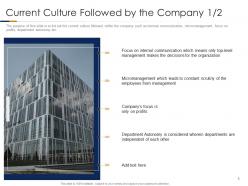
Slide 5: This slide is titled “Current Culture Followed by the Company 1/2.” It shows the purpose of this presentation is to list out the current culture followed within the company such as internal communication, micromanagement, focus on profits, department autonomy, etc.
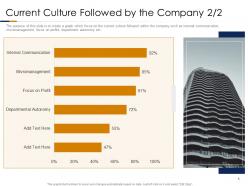
Slide 6: This slide is titled “Current Culture Followed by the Company 2/2.” The purpose of this presentation is to create a graph that focuses on the current culture followed within the company such as internal communication, micromanagement, focuses on profits, department autonomy, etc.
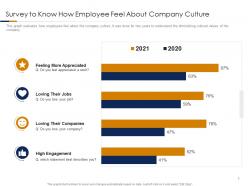
Slide 7: This slide is titled “Survey to Know How Employees Feel About Company Culture.” This graph evaluates how employees feel about the company culture.
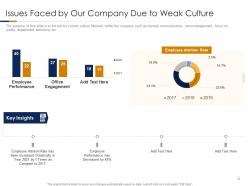
Slide 8: This slide is titled “Issues Faced by Our Company Due to Weak Culture.” The purpose of this presentation is to list out the current culture followed within the company such as internal communication, micromanagement, focus on profits, department autonomy, etc.
Slide 9: This slide is titled “Table of Contents.” It shows How Does a Poor Company Culture Affect Employees, what impact does negative workplace culture have on wider society, Affected Areas Due to Poor Culture, etc.
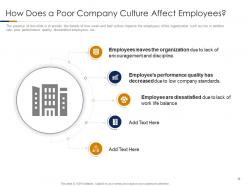
Slide 10: This slide is titled “How Does a Poor Company Culture Affect Employees?” The purpose of this presentation is to provide the details of how weak and bad culture impacts the employees of the organization such as rise in attrition rate, poor performance quality, dissatisfied employees, etc.
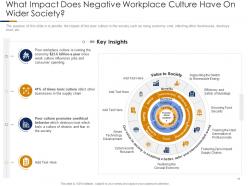
Slide 11: This slide is titled “What Impact Does Negative Workplace Culture Have On Wider Society?” The purpose of this presentation is to provide the impact of the poor culture in the society such as rising economic cost, infecting other businesses, destroying trust, etc.
Slide 12: This slide is titled “Table of Contents.” It shows the Need For Better Organizational Culture, Signs of a Bad Company Culture and How to Improve, and Gap Analysis.
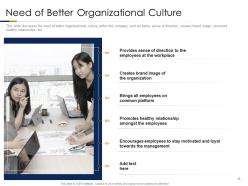
Slide 13: This slide is titled “Need of Better Organizational Culture.” It discusses the need for better organizational culture within the company such as a better sense of direction, creating a brand image, etc.
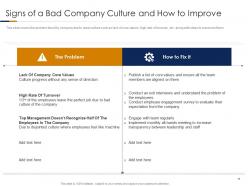
Slide 14: This slide is titled “Signs of a Bad Company Culture and How to Improve.” It covers the problem faced by the company due to weak culture such as lack of core values, high rate of turnover, etc.
Slide 15: This slide is titled “Table of Contents.” It includes Characteristics of Organizational Culture, 4 Types of Organizational Culture, Six Guidelines for Culture Change, Creating and Maintaining Organizational Culture, etc.
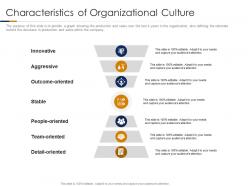
Slide 16: This slide is titled “Characteristics of Organizational Culture.” The purpose of this presentation is to provide a graph showing the production and sales over the last 4 years in the organization, also defining the rationale, etc.
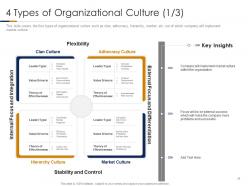
Slide 17: This slide is titled “4 Types of Organizational Culture (1/3).” It covers the four types of organizational culture such as clan, adhocracy, hierarchy, market, etc.
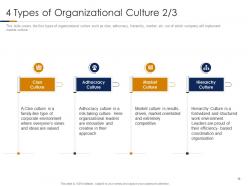
Slide 18: This slide is titled “4 Types of Organizational Culture (2/3).” It covers the four types of organizational culture such as clan, adhocracy, hierarchy, market, etc.
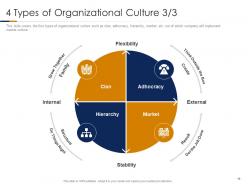
Slide 19: This slide is titled “4 Types of Organizational Culture (3/3).” It covers the four types of organizational culture such as clan, adhocracy, hierarchy, market, etc.
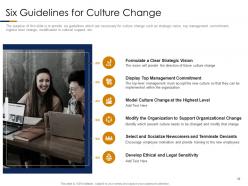
Slide 20: This slide is titled “Six Guidelines for Culture Change.” The purpose of this presentation is to provide six guidelines that are necessary for culture change such as strategic vision, top management commitment, highest level change, modification in cultural support, etc.
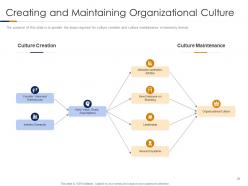
Slide 21: This slide is titled “Creating and Maintaining Organizational Culture.” The purpose of this presentation is to provide the steps required for culture creation and culture maintenance in a hierarchy format.
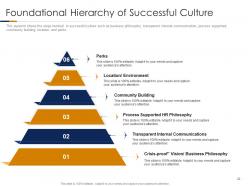
Slide 22: This slide is titled “Foundational Hierarchy of Successful Culture.” This pyramid shows the steps involved in successful culture such as business philosophy, transparent internal communication, process support, etc.
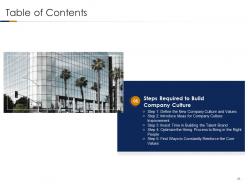
Slide 23: This slide is titled “Table of Contents.” It includes Step 1: Define the New Company Culture and Values, Step 2: Introduce Ideas for Company Culture Improvement, Step 3: Invest Time in Building the Talent Brand, etc.
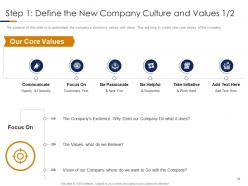
Slide 24: This slide is titled “Step 1: Define the New Company Culture and Values (1/2).” The purpose of this presentation is to understand the company’s existence, values, and vision. This will help to create new core values for the company.
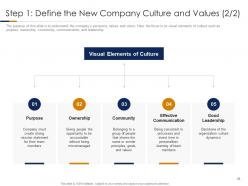
Slide 25: This slide is titled “Step 1: Define the New Company Culture and Values (2/2).” The purpose of this presentation is to understand the company’s existence, values, and vision. Here the focus is on visual elements of culture such as purpose, ownership, community, communication, and leadership.
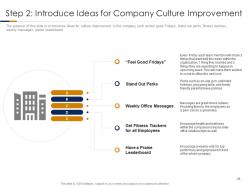
Slide 26: This slide is titled “Step 2: Introduce Ideas for Company Culture Improvement.” The purpose of this presentation is to introduce ideas for culture improvement in the company such as feel-good Fridays, stand-out perks, fitness trackers, weekly massages, and a praise leader board.
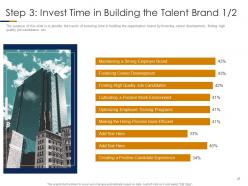
Slide 27: This slide is titled “Step 3: Invest Time in Building the Talent Brand (1/2).” The purpose of this presentation is to provide the trends of investing time in building the organization’s brand by fostering career development, finding high-quality job candidates, etc.
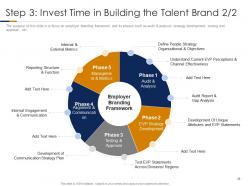
Slide 28: This slide is titled “Step 3: Invest Time in Building the Talent Brand (2/2).” The purpose of this presentation is to focus on the employer branding framework and its phases such as audit & analysis, strategy development, testing, and approval., etc.
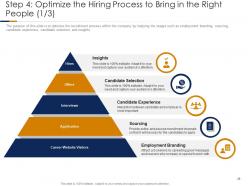
Slide 29: This slide is titled “Step 4: Optimize the Hiring Process to Bring in the Right People (1/3).” The purpose of this presentation is to optimize the recruitment process within the company by implying the stages such as employment branding, and insights.
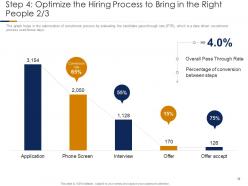
Slide 30: This slide is titled “Step 4: Optimize the Hiring Process to Bring in the Right People (2/3).” This graph helps in the optimization of the recruitment process by evaluating the candidate pass-through rate (PTR), which is a data-driven recruitment process used these days.
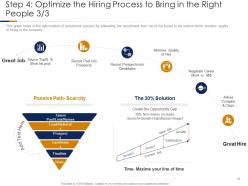
Slide 31: This slide is titled “Step 4: Optimize the Hiring Process to Bring in the Right People (3/3).” This graph helps in the optimization of the recruitment process by evaluating the recruitment from the top of the funnel to the bottom which provides quality of hiring in the company.
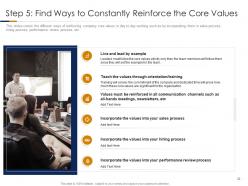
Slide 32: This slide is titled “Step 5: Find Ways to Constantly Reinforce the Core Values.” This slide covers the different ways of reinforcing company core values in day-to-day working such as by incorporating them in the sales process, hiring process, the performance review process, etc.
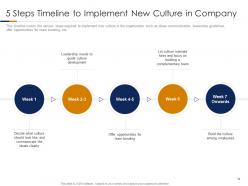
Slide 34: This slide is titled “5 Steps Timeline to Implement New Culture in Company.” This timeline covers the various steps required to implement new culture in the organization such as ideas communication, leadership guidelines, offering opportunities for team bonding, etc
Slide 35: This slide is titled “Table of Contents.” It shows the Impact of Having a Strong Company Culture, Impact on Employees due to Improved Company Cultural Process, and Impact on the Organization.
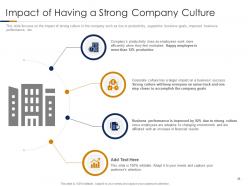
Slide 36: This slide is titled “Impact of Having a Strong Company Culture.” This slide focuses on the impact of a strong culture in the company such as a rise in productivity, supportive business goals, improved business performance, etc.
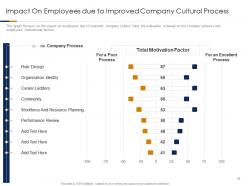
Slide 37: This slide is titled “Impact on Employees due to Improved Company Cultural Process.” This graph focuses on the impact on employees due to improved company culture. Here the evaluation is based on the company process and employees’ motivational factors.
Slide 38: This slide is titled “Table of Contents.” It shows Company Department Cultural Dashboard, Organization Culture Dashboard, Employee Culture Analytical Report, and Company Culture Measurement Metrics.
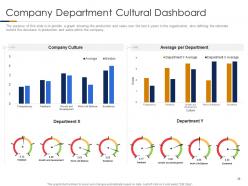
Slide 39: This slide is titled “Company Department Cultural Dashboard.” The purpose of this presentation is to provide a graph showing the production and sales over the last 4 years in the organization, also defining the rationale behind the decrease in production, and sales within the company.
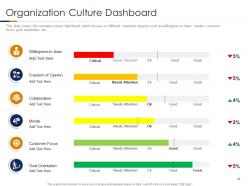
Slide 40: This slide is titled “Organization Culture Dashboard.” This slide covers the company culture dashboard which focuses on different important aspects such as willingness to learn, morale, etc.
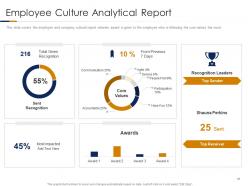
Slide 41: This slide is titled “Employee Culture Analytical Report.” This slide covers the employee and company cultural report wherein an award is given to the employee who is following the core values.
Slide 42: This slide is titled “Building High-Performance Company Culture Icons Slide.” This slide is 100% editable. Adapt it to your needs and capture your audience's attention.
Slide 43: This slide is titled “Additional Slides.”
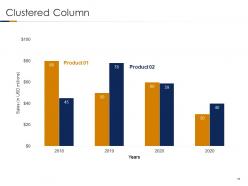
Slide 44: This slide is titled “Clustered Column.” It can be used to represent sales data for a calendar year.
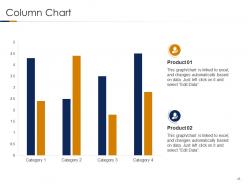
Slide 45: This slide is titled “Column Chart.” Evaluate your products on various parameters. This graph/chart is linked to excel and changes automatically based on data. Just left-click on it and select “Edit Data”.
Slide 46: This slide contains Post-It Notes that can be used to express any brief thoughts or ideas.
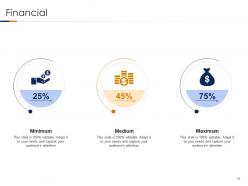
Slide 47: This slide presents the financial data with the data’s numbers at minimum, medium, and maximum percentages.
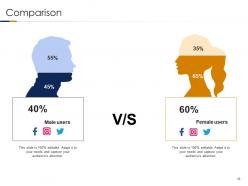
Slide 48: This slide presents the Comparison between the percentages of male and female Facebook users.
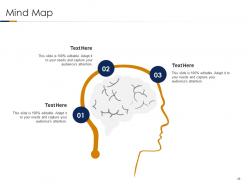
Slide 49: The slide is titled “Mind Map.” Use this creative template as per your need.
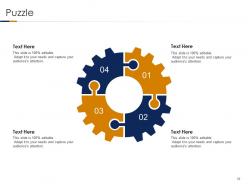
Slide 50: This slide is titled “Puzzle.” You can use this template to display your product or an idea implementation technique.
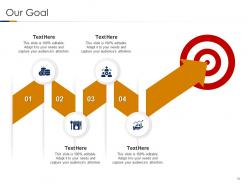
Slide 51: This slide is titled “Our Goal.” Add goals as per your long-term and short-term goals.
Slide 52: This is a Thank You slide where details such as the address, contact number, and email address are added.
Building high performance company culture powerpoint presentation slides with all 52 slides:
Use our Building High Performance Company Culture Powerpoint Presentation Slides to effectively help you save your valuable time. They are readymade to fit into any presentation structure.

FAQs for Building high performance company culture
Look, high-performing teams nail a few basics. Everyone's crystal clear on goals - not that vague corporate speak nonsense. People feel safe calling out problems without getting thrown under the bus. Learning happens constantly, not just during those painful annual trainings we all hate. Quick decisions matter too - nobody wants to sit in meeting hell forever. Trust between managers and teams? Non-negotiable. Oh, and recognition that actually means something, not generic "thanks for your hard work" garbage. I'd start by honestly looking at what you've got versus what's missing.
Start with psychological safety - your team won't take risks if they're scared of screwing up. Set clear goals but let them figure out the how. I'm big on regular check-ins too, not just those useless annual reviews. Actually celebrate the wins when they happen (seriously, why do so many managers skip this?). Ask what's blocking them first, then remove those roadblocks. The tricky part is staying consistent with all this stuff. Short bursts of good management don't really move the needle.
Look, engaged employees are basically your secret weapon for building a high-performance culture. Without that genuine investment, you're just herding people through daily tasks. When your team actually cares about the mission and feels connected to the work, they'll naturally push boundaries and hold each other accountable. It's night and day compared to people just clocking in for a paycheck. Give them meaningful projects and consistent feedback - honestly, that's where you'll see the biggest shift. These folks will take ownership, collaborate without being forced to, and actually speak up when something's not working. Trust me on this one.
Track your engagement scores and retention rates - those numbers don't lie. But honestly, annual surveys are pretty much garbage for real-time feedback. Instead, watch internal promotion rates and how fast teams actually ship stuff. Quarterly pulse checks work way better. The real magic happens when people start doing the right things without you nagging them about it. That's when you know it's actually sticking. Ask your team what's broken and what isn't - they'll tell you straight up if you're paying attention.
Honestly, most companies get this backwards - they just dump goals on people from above. Break down your vision into specific stuff that connects to each person's actual job. But here's the key part: let your team help set their own goals that still roll up to the big picture. I'd do regular check-ins to see how it's going. When people can actually see how their daily work moves the needle for the company, that's when things click. The best setup is where someone crushing their personal goals automatically helps the whole business win.
Honestly, diverse teams just perform better - that's not even debatable anymore. When you've got people from different backgrounds, they tackle problems in ways you'd never think of. Innovation happens naturally. But here's the thing - inclusion is what actually matters. You can hire all the diversity you want, but if people don't feel safe speaking up, you're wasting everyone's time. I worked with this one team where everyone had the same background and... wow, the blind spots were painful to watch. Short version: psychological safety beats surface-level diversity every time. People need to feel genuinely valued, not just collected like Pokemon cards.
Honestly, it's usually the leadership being all over the place - saying one thing but doing another. Middle management hates change too, which doesn't help. Communication is often trash, and they're still using performance metrics from like 2015 or something. The worst part? Companies try to fix everything at once instead of picking a few things to focus on. My advice - get your leadership on the same page about what "high performance" even means first. Then tackle one cultural thing at a time. Way less overwhelming that way.
Honestly, regular feedback changes everything. Your team can't improve if they don't know what's working or what isn't. Those yearly reviews? Total waste of time - people need to know way sooner when they're off track. I've seen it create this environment where people actually want feedback instead of dreading it. Quick weekly check-ins work great, or even just grabbing someone after a meeting like "yo, that presentation killed it because of X." Once you start doing it naturally, they'll give feedback back to you too. Game changer.
Yeah remote work can totally boost high performance if you do it right. But you'll miss those random conversations that spark great ideas - zoom calls just aren't the same, honestly. What I've found works is being super clear about what you expect from people and celebrating wins out loud since nobody sees the day-to-day hustle anymore. Regular one-on-ones are clutch, and don't just talk shop. Actually ask how people are feeling about their work. Remote teams need way more intentional communication than office ones. The upside though? People focus on actual results instead of just appearing busy at their desk.
Honestly, you've gotta bake this stuff right into how you hire and promote people. Don't just look at their sales numbers - actually measure if they're walking the walk on your company values. Your leadership team needs to be doing this constantly too (and trust me, everyone's watching them). Set up ways for people to speak up when someone's not living up to the values, then actually do something about it. Oh, and make sure your performance reviews weight this as heavily as hitting targets. People will figure out pretty quick what really matters based on who gets promoted.
Skip the boring one-time training sessions - they're pretty much useless. Mentoring and cross-functional projects work way better. Stretch assignments are gold because they push people without breaking them. Leadership development is critical since your best people usually end up managing others anyway. Honestly, the companies that crush this stuff let employees own their growth paths and tie everything to actual career moves. Oh, and survey your team first about what they actually want to learn - don't just roll out some generic corporate program nobody asked for.
Connect recognition to specific actions, not just end results. Skip the generic "nice work" stuff - tell people exactly what they nailed and why it moved the needle. Honestly, annual bonuses are pretty useless if you want daily behavior changes. Mix up your rewards too. Money's great, but growth opportunities and public shoutouts work wonders. Flexible schedules can be huge motivators for some people. Your top performers need to see that extra effort pays off immediately, not months later. Oh, and figure out what actually drives each person individually - it's different for everyone.
Honestly? Leadership has to walk the walk first - can't expect your team to change if the executives aren't doing it themselves. Look at Satya Nadella turning Microsoft around with that whole growth mindset thing. Here's the thing though - you've gotta connect culture shifts to actual business results, not just make it some warm fuzzy HR project (even though that part does matter). Real change takes forever - like 2-3 years minimum, which sucks but whatever. Pick one specific behavior you want more of and just reward the hell out of it every chance you get.
Start with making people feel safe to screw up without getting blamed. Actually listen when someone pitches a crazy idea instead of immediately saying why it won't work. Ask "how could we test this?" Cross-team collaboration works wonders - weird perspective combos create the best stuff. Give people time to experiment, even if it's just an hour here and there (forget Google's 20% thing, who has that?). Celebrate the smart failures out loud. Honestly, most "innovation programs" die because leadership kills ideas before they breathe. Reward the risk-taking itself, not just wins.
Honestly, emotional intelligence makes or breaks teams when things get intense. I've watched super talented groups completely implode because no one could handle feedback without getting defensive or notice when someone was drowning. The best teams? They call out problems without being jerks about it and actually have each other's backs during rough patches. You can't just ignore the feelings stuff - people need to manage their own reactions and pick up on what's happening with others. Start small though. Just acknowledge when tensions are high in meetings and check how everyone's doing. Trust me, it's way better than pretending everything's fine while your team slowly burns out.
-
The content is very helpful from business point of view.
-
Designs have enough space to add content.
-
Awesome use of colors and designs in product templates.