

Organizational Culture Powerpoint Presentation Slides




Try Before you Buy Download Free Sample Product
 Impress Your
 Audience
 100%
100% Editable
 Save Hours
 of Time


Grab content-ready Organizational Culture PPT presentation slides and make your workplace environment even better for the employees. Incorporate professionally designed and easy-to-understand organizational culture PPT presentation templates and assess how the organizational culture influences employee’s productivity. This deck covers templates such as business environment dimensions, economic environment, political environment, social environment, legal environment, technological environment, and more. Promote a healthy culture environment at work using organizational culture PPT presentation slideshow. Better work environment unites employees, develops healthy relationship, boosts creativity and productivity. Add organizational culture PPT templates layout and make your workplace a better place to work for your employees. Retain best of the talent with company culture PPT presentation. Enhance your company’s culture behavior and increase productivity, employee engagement, commitment and more. Achieve a desired and healthy culture using organizational culture PowerPoint presentation templates. Avoid harping on any aspect with our Organizational Culture Powerpoint Presentation Slides. They ensure every angle is covered.
People who downloaded this PowerPoint presentation also viewed the following :
Content of this Powerpoint Presentation
An Organizational Culture can be defined as the values, system, professional tactics, and practices within a company. A 2019 Glassdoor study reveals, 77% of adults would evaluate an organization’s culture before applying to an open job position. More than half would consider it even more significant than compensation. As per another important study by SHRM published in 2021, 94% of managers believe that a positive workplace culture helps retain employees.
According to an eminent management consultant, educator, and author Peter Drucker, “culture eats strategy for breakfast.” This implies that organizational culture is one of the most crucial factors for determining the success or failure of a company. Regardless of how effective your strategies may be, if the company’s culture is toxic, it will lead to low performance and high employee turnover due to low morale. On the other hand, a company with a strong and positive organizational culture will keep employees engaged, attract top talents, and consequently make huge profits.
To learn about the characteristics of organizational culture, click here!
Organizational Culture Templates
For every organization, it is important to focus on having a highly motivated, optimistic work culture. This requires you to develop a close connection with the employees. At the same time, explaining them the benefits of building a good organizational culture.
If you need comprehensive guidance for Cultural Transformation, click here!
With the help of our professionally designed and content-ready templates, you can elucidate the business environment decisions, technological environment, legal environment, etc. of your organization to your existing employees, future employees, and stakeholders. The best part about our templates is that you can edit and customize these as per your choice.
Let us explore these templates to know more!
Template 1 – Business Environment Decisions
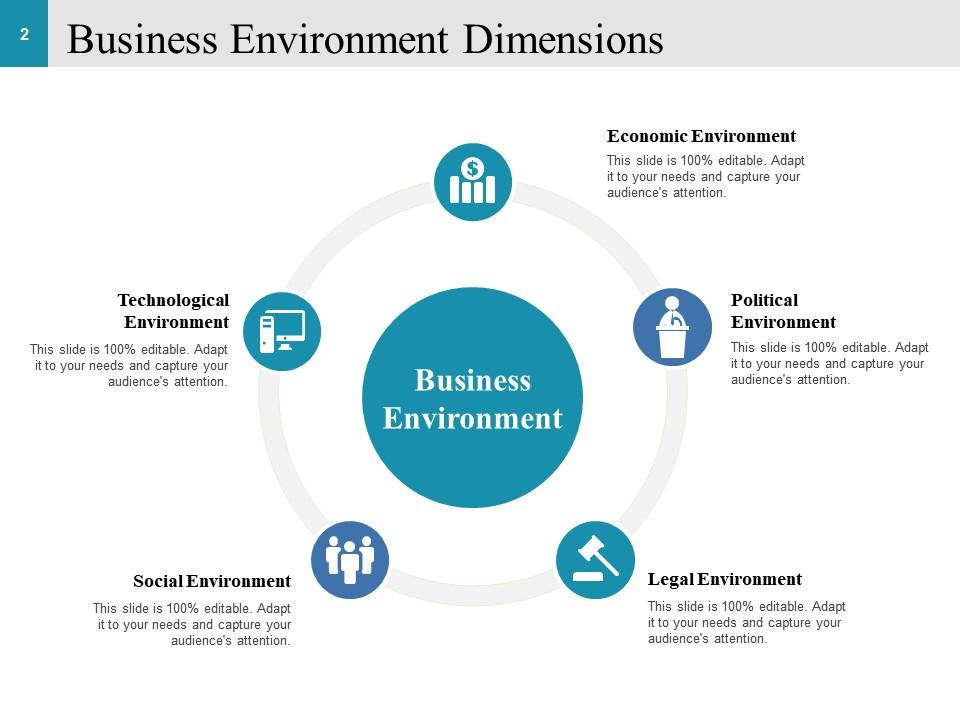
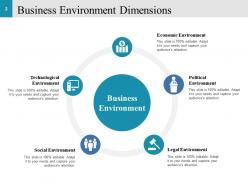
Employ this PPT Template to illustrate the business environment dimensions of your organization. Using this slide, you can highlight the various aspects that affect a business for example, Economic Environment, Political Environment, Social Environment, etc. Briefly discuss each of these to educate people about your company’s milieu. This will enable them to comprehend the structure, functioning, and key elements of your business that count.
Template 2 – Economic Environment
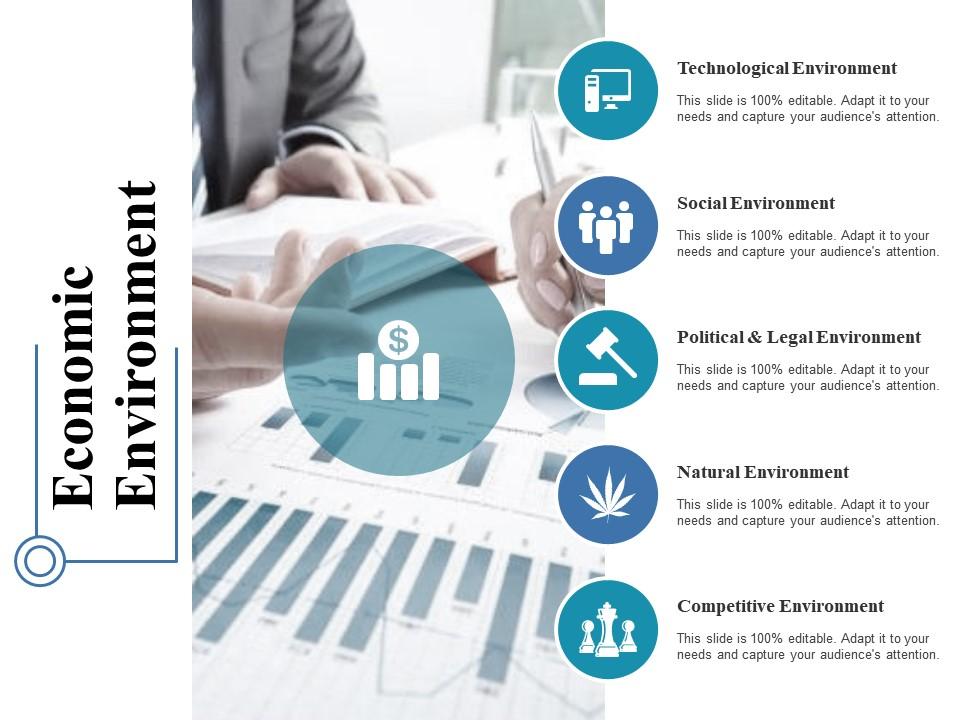
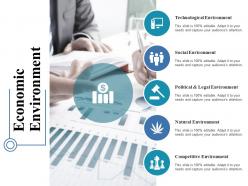
Create an effective presentation to demonstrate the economic environment of your company using our visually appealing template. Here, in this template, different factors affecting the financial situation of an organization are shown. You may use it to communicate the technological, social, political & legal, natural, and competitive environment of your workplace to the shareholders, employees, and other people interested in your business. Get this template now to captivate the attention of the best talents and top professionals for organizational growth.
Template 3 – Political Environment
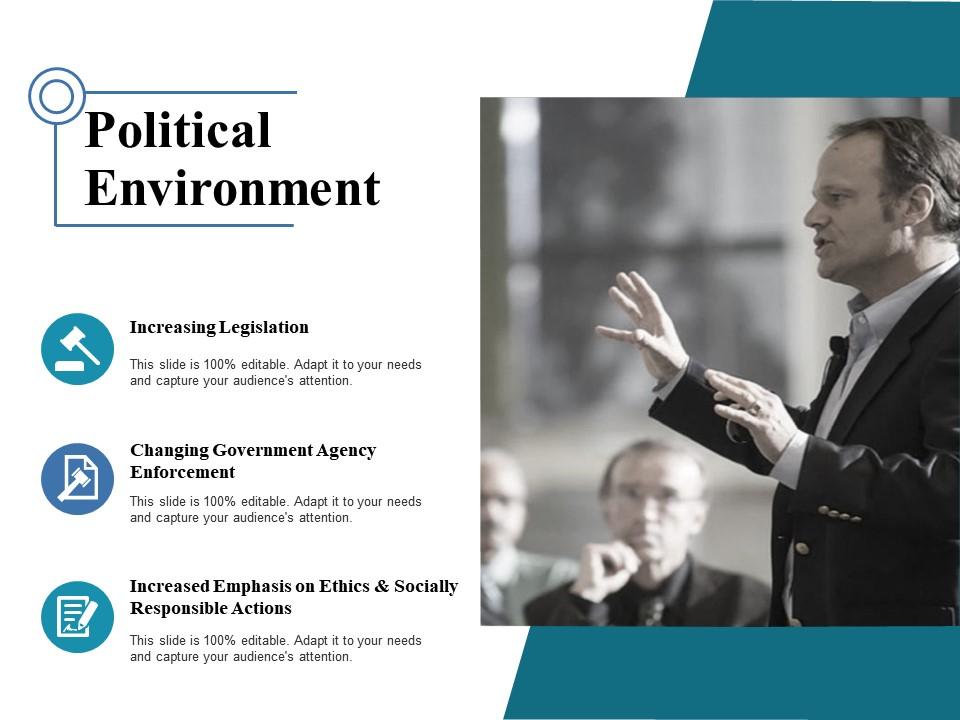
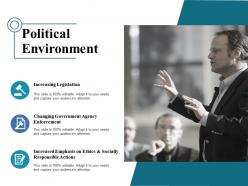
Describe the political environment of your company using this well-crafted PPT Template. Organizational culture is also determined by certain employment laws, taxation, political stability, etc., and all of these have a huge effect on the business. Deploy this specialized and impactful template to discuss political scenarios highlighting points such as increasing legislation, changing government agency enforcement, and increasing emphasis on ethics and socially responsible actions. Grab the template now!
Template 4 – Social Environment
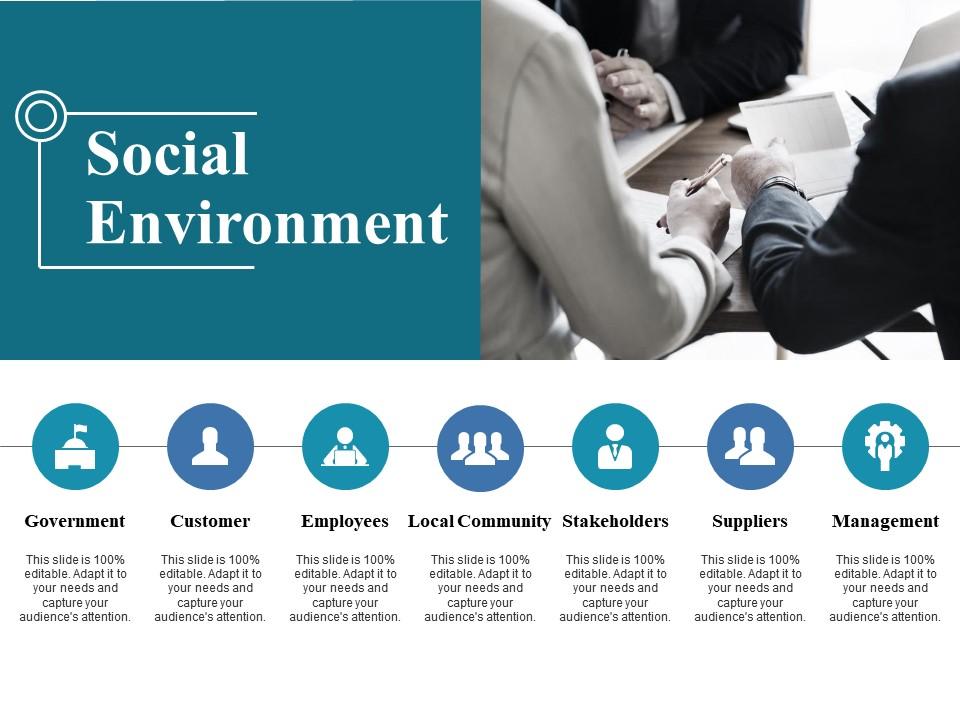
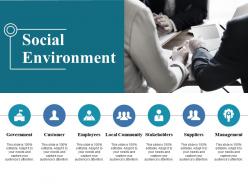
Utilize this PPT Template to illustrate the social environment within an organization. With the help of this impactful slide, you can describe the different elements that determine the organizational culture of a company, for example, Government, Customer, Employees, Local Community, Stakeholders, Suppliers, and Management. Elaborate on each of these as per your choice to share essential information and evoke people’s interest in your business. Order your template and see the difference!
Template 5 – Legal Environment
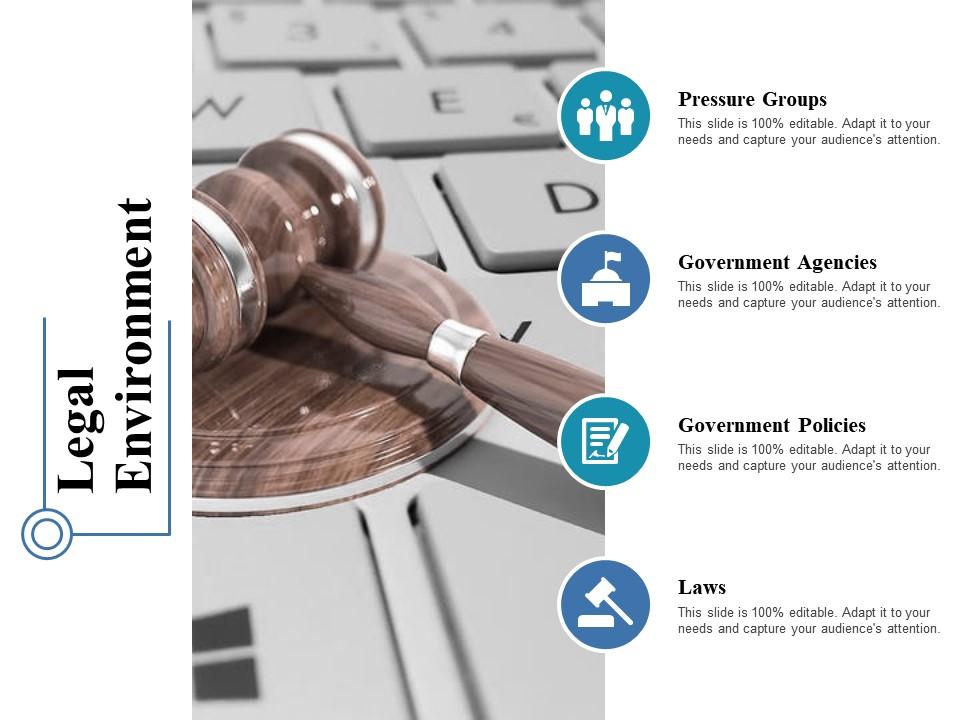
Depict the legal aspect of your workplace with this content-ready and skillfully designed template. Use this professional work of art to discuss the pressure groups, government agencies, government policies, and laws that apply to your organization, The best way to lure top shareholders and great talents into your business is to gain their trust. By mentioning the legal system of your company, you will be successful in building credibility. So, what are you waiting for? Make a wise decision and get your template now!
Template 6 – Technological Environment
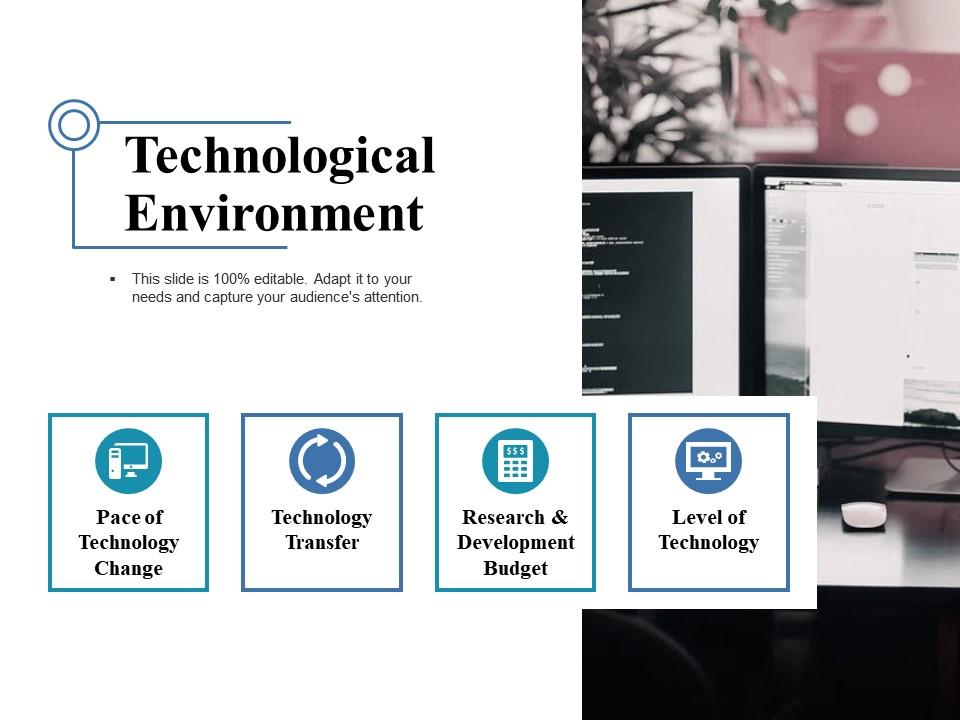
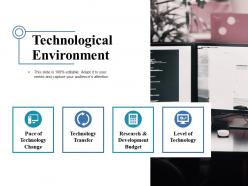
Incorporate this specialized and engaging template to showcase the technological scenario of the business. In this template, you can depict the pace of technology change, technology transfer, research and development budget and level of technology used. Make an effective and powerful presentation by utilizing this ready-to-use slide to grab the attention of the customers and shareholders. Download it now to create an impact!
Gain a Competitive Advantage with a Healthy Work Culture
“Customers will never love a company until the employees love it first” – Simon Sinek
An organization grows only when the employees feel included and motivated. Create a positive work culture by determining the current culture, defining the ideal organizational culture, setting clear goals and expectations, focusing on engaging employees, and winning the trust of the workers.
To support your effort towards staying ahead in the competition and leading the business world, we have designed the best-in-class organizational culture templates. Get the templates to seize the day!
PS Unlock the path to business excellence by analyzing the template on the data maturity curve for analytical and organizational culture. Click here!
Organizational Culture Powerpoint Presentation Slides with all 18 slides:
The authenticity of the data displayed on our Organizational Culture Powerpoint Presentation Slides is guaranteed. You can bank on the information being correct.






FAQs for Organizational Culture
So basically it's your shared values and how people actually behave day-to-day. Sure, you've got mission statements and all that formal stuff, but honestly? Watch what really happens when nobody's looking. Like how decisions get made behind closed doors, what behaviors get rewarded vs. punished, those unwritten rules everyone just knows. Communication styles matter a ton too. Your physical space plays into it - open office vs. cubicles changes everything. Leadership sets the whole vibe though. Want to figure out your culture? Listen to the stories people tell and notice what gets celebrated. That'll tell you way more than any handbook ever will.
Honestly? It's all about walking the walk, not just talking it. People notice everything you do - way more than what comes out of your mouth. You've got to reward the right stuff and shut down bad behavior fast. The vision thing matters too, but here's what nobody tells you - staying consistent is brutally hard when you're juggling a million other things. Culture shifts take forever (I'm talking months, not weeks), so you're basically reinforcing the same values every single day. Sounds simple but it'll test your patience like crazy.
Honestly, communication is like the make-or-break thing for team culture. When you're upfront with people and actually listen to what they're saying, they feel way more comfortable being themselves at work. I've literally watched teams do complete 180s just by fixing how they talk to each other - it's wild. Bad communication? That's how you get office drama and people second-guessing everything. My advice is just model what you want to see. Be straight with people but not harsh about it. Admit when you don't have answers (because who does half the time anyway?). Most importantly though - if you say you'll do something, actually follow through.
Your culture basically controls everything about retention. People stick around when they feel valued and see growth potential - pretty obvious but most companies still mess this up. I've watched entire teams flip from miserable to motivated just because leadership started actually listening. Toxic environments? They'll bleed talent faster than you can hire replacements. Here's the thing though - whatever you claim your culture is, it better be real. Employees spot fake company values instantly. Short version: ask your team what sucks and what doesn't, then actually fix the problems they tell you about.
Honestly, start with employee surveys and one-on-ones - people will usually give you the real scoop if you ask directly. Watch how meetings actually go down and what behaviors get rewarded vs. shut down. Exit interviews are where you'll hear the brutal truth since those folks have nothing to lose. Oh, and don't sleep on your turnover numbers and engagement data. Focus groups work too, though sometimes people hold back in groups. Even stupid stuff like how the office feels day-to-day tells you a lot. Mix different approaches because everyone's gonna have their own take on what it's really like there.
Honestly, culture is everything when it comes to innovation. People need to feel safe throwing out crazy ideas without getting shut down immediately. When teams can experiment and fail without blame, that's where the magic happens. But if leadership is all "we've always done it this way" - forget about it, creativity dies fast. I've watched brilliant people go quiet in toxic environments, it's wild how fast it happens. Short version: psychological safety beats fancy innovation labs every time. Maybe start by just asking your people what's actually stopping them from trying new things? You might be surprised what you hear.
Honestly, diversity initiatives can completely change your workplace culture. Fresh perspectives from different backgrounds? Game changer for problem-solving and innovation. People feel way more engaged when they can actually be themselves at work - sounds obvious but you'd be surprised how rare that is. Your retention goes up too since employees stick around when they feel heard and respected. I'd start small though - maybe inclusive hiring or employee resource groups. Even tiny changes create these crazy ripple effects that spread through the whole organization. It's wild how much impact you can have.
Look, culture won't just magically line up with your business goals - you've got to be super intentional about it. First, figure out what specific behaviors would actually drive your strategy forward. Then bake those into everything: who you hire, how you review performance, what you celebrate. Honestly, most companies totally botch this part. Don't try to change everything at once though. Pick one cultural shift that'd make the biggest impact and start there. Make your values visible in daily decisions and call out people when they nail it. It's way harder than it sounds but totally doable.
Red flags? High turnover, constant gossip, everyone tiptoeing around the boss. Blame gets thrown around instead of actually fixing problems. People can't speak up without fear, and all the real decisions happen in secret meetings. Fixing it takes forever though - leadership has to admit there's a problem first (good luck with that). Then you need actual behavior changes, not just new policies posted on the break room wall. Create spaces where people can be honest without getting fired. Celebrate teamwork over backstabbing. My advice? Start with your own team and be transparent there.
Honestly, stories beat boring mission statements every single time. Instead of slapping "we value innovation" on a poster, tell people about Sarah's wild idea that became your top product. During onboarding or team meetings, share real examples of employees actually living your values. Ask around different departments - "when did you see our values in action?" You'll get tons of material. The trick is collecting authentic stories from all levels, then dropping them into newsletters and regular conversations. Trust me, people remember stories way longer than corporate speak.
Yeah, remote work totally flips your culture. Instead of bumping into people by the coffee machine, everything becomes super planned out. Which honestly can be better - you focus more on who actually delivers vs who just shows up. But the relationship stuff gets weird without those random conversations. Your managers have to trust people way more since they can't hover anymore. I've seen companies either get way tighter because their values actually matter, or completely fall apart if proximity was the only thing holding them together. Schedule some casual video calls though - you need that human stuff to survive.
Look, culture isn't some touchy-feely thing HR made up. It genuinely drives your numbers. Strong culture = people actually stick around, work harder, and don't hate Mondays. Plus you'll execute faster and adapt when things go sideways (which they will). Companies with solid cultures consistently crush their competitors financially - the data's pretty clear on this. My old boss used to ignore culture completely and wondered why nothing ever got done. Don't make that mistake. Track it like any other metric and invest in it. Sounds boring but it'll move your bottom line more than you think.
Honestly, you've gotta bake adaptability right into your company DNA from day one. Reward people for trying new stuff - even when it doesn't work out. Too many places claim they want innovation but then freak out over any "mistakes." Set up regular check-ins with your team and keep an ear to the ground about what's happening in your market. The whole trick is making change feel totally normal instead of this big scary thing. Oh, and celebrate those small pivots! They're actually wins, not signs you're failing at something.
Honestly, those little company rituals matter way more than people think. They're basically what turns a bunch of coworkers into an actual team. You know how every office has that one weird tradition nobody remembers starting? That stuff creates inside jokes and shared memories. New people figure out the vibe faster when there are consistent things everyone does together. Makes your values feel real instead of just words on a poster. Plus quarterly celebrations give everyone something to look forward to - even if they're kinda cheesy. If you want stronger culture, start some traditions that actually match what you care about.
Don't just dump culture stuff in a welcome packet and hope for the best. Before their first day, send culture-focused materials that actually matter. Pair them with culture ambassadors who aren't just going through the motions. First week should include storytelling sessions - honestly, stories stick way better than PowerPoint slides ever will. Have long-timers share real examples of how your culture plays out day-to-day. Then do culture check-ins at 30, 60, and 90 days to see what's actually landing. The whole point is making culture something they experience, not just hear about in meetings.
-
Unique design & color.
-
Thanks for all your great templates they have saved me lots of time and accelerate my presentations. Great product, keep them up!