


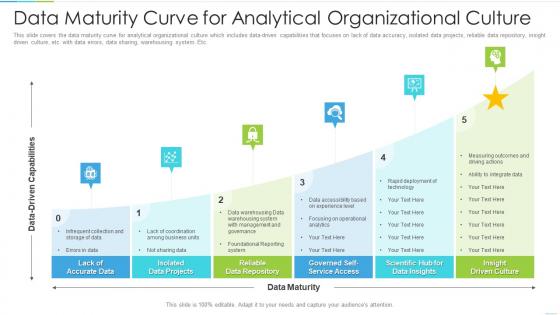
Data maturity curve for analytical organizational culture




Try Before you Buy Download Free Sample Product
 Impress Your
 Audience
 100%
100% Editable
 Save Hours
 of Time


Our Data Maturity Curve For Analytical Organizational Culture are topically designed to provide an attractive backdrop to any subject. Use them to look like a presentation pro.
People who downloaded this PowerPoint presentation also viewed the following :
Data maturity curve for analytical organizational culture with all 2 slides:
Use our Data Maturity Curve For Analytical Organizational Culture to effectively help you save your valuable time. They are readymade to fit into any presentation structure.
FAQs for Data maturity curve for
Most companies go through five stages: Basic (messy, reactive data), Developing (some processes but inconsistent), Defined (standardized practices), Managed (good governance, data-driven decisions), and Optimized (predictive stuff, self-service analytics). Honestly, forget what your strategy docs claim you're doing. Look at reality instead - do people actually trust your data? Can teams get what they need without jumping through hoops? Are decisions based on real insights or just whoever's loudest in the meeting? Quick tip: map out your biggest pain points first. Don't try skipping stages - it never works.
Okay so first thing - be brutally honest about where you're at right now. Like, what's your data governance situation? How's the quality? What tools do you have and can your team actually use them well? Map out maybe 3-4 levels you want to reach over the next 18-24 months. Trust me, don't try to do everything at once because that's how projects die. Start with quick wins - clean up your most important datasets or get some basic dashboards working. Build each phase on the previous one. Make sure each step actually delivers value to the business. Getting leadership excited early is huge, and honestly those small wins really help keep everyone motivated.
Just focus on the basics first - missing values, duplicates, stuff like that. Don't overthink it. I've watched too many teams go crazy trying to track like 20 different metrics right off the bat and they just burn out. Pick maybe 3-5 things that actually move the needle for your business. Once you've got those down, then you can get fancy with consistency checks between systems and anomaly detection. The advanced validity rules and all that? Save it for later when you're not drowning in data fires every week. Trust me on this one.
Culture is honestly everything here. Without leadership that actually uses data themselves, your team will just ignore the numbers and stick with gut instincts. I've seen this play out so many times - people don't trust what they don't see modeled from the top. The magic happens when questioning decisions with data becomes normal, not threatening. Teams need to feel safe saying "hey, what if we look at this differently?" Quick win? Start celebrating when people make good data-driven calls. Sounds simple but it works way faster than forcing new processes on everyone.
Training your team is honestly make-or-break for data maturity. I've seen companies blow tons of cash on analytics tools that just sit there collecting dust because nobody knows how to use them right. Your people need to learn how to ask good questions and actually interpret what the numbers mean - not just stare at dashboards. Skip the boring one-size-fits-all workshops though. Figure out where your biggest knowledge gaps are first, then do role-specific training that actually matters to what people do daily. Oh, and don't make it a one-time thing. Data stuff changes too fast for that.
Honestly, most companies get this completely backwards and wonder why nobody touches their expensive dashboards. Start with what you're actually trying to accomplish - growing revenue, cutting costs, keeping customers happy, whatever. Then work backwards to figure out what data questions would help. Your data team should be sitting in on strategy meetings so they get the "why" behind requests. Otherwise you end up building cool stuff that doesn't matter. Map your big goals to trackable metrics first, then worry about the infrastructure. Simple test: can you connect your data projects directly to business results? If not, you're probably solving the wrong problems.
Honestly, the worst part is usually your data being a total mess - scattered everywhere, inconsistent formats, the whole nightmare. Leadership pushes back hard when they can't see immediate ROI. Plus your legacy systems probably hate talking to each other, and good luck finding people who actually know what they're doing with this stuff. Oh, and everyone will resist changing their workflows because, you know, humans. I'd say start super small though. Get a few quick wins first, then wave those success stories around to get more budget and executive backing. Works way better than trying to boil the ocean right away.
Honestly, AI and advanced analytics are like having a really demanding boss for your data - they won't tolerate messy stuff. You'll need to clean up formats and quality controls because bad data makes these tools look ridiculous. The upside? They find connections you'd never spot and handle boring tasks automatically. Once you see better results, you'll actually want to invest more in your data setup (weird how that works). My advice: pick one specific use case that actually matters to your business and let that drive your cleanup efforts. Way easier than trying to fix everything at once.
Honestly, think of data governance like building blocks for getting your data house in order. You'll want clear rules about who owns what and basic quality checks first. The smart move? Don't go crazy complex right away - I've watched companies crash and burn trying to do everything at once. Start with simple stuff then add the fancy lineage tracking later as you grow. Pick something flexible though, because what works at your size now might not cut it in two years. The framework should grow with you, not trap you in some rigid box.
Honestly, start with cloud storage - AWS S3 or Azure work great. Then grab a data warehouse like Snowflake or BigQuery. For visualization, Tableau and Power BI are solid choices, but here's what everyone forgets - get data cataloging tools early so you don't lose track of your stuff later (trust me on this one). Your team needs Python or SQL skills, no way around it. Oh, and governance tools like Collibra will save you headaches down the road. Pick one strong tool per category instead of going crazy with options. Much better approach.
Honestly? Getting departments to actually work together is a game-changer for data stuff. Like, marketing suddenly realizes sales has all this customer info they've been dying for. IT figures out what tools people actually want instead of whatever shiny thing caught their eye last week. Plus you catch weird data problems way faster when everyone's looking at the same numbers. Oh and those annoying data silos that make everything a pain? They basically disappear. I'd start super simple though - find one metric both teams genuinely care about and just focus on tracking that better together.
Honestly, start with culture or you'll be fighting uphill battles forever. Get your executives actually excited about data, not just writing checks. Run some small pilot projects first - show people the wins before asking for the big stuff. Data literacy training is huge too. Half your team probably doesn't even know what they don't know yet. And seriously, set up governance early because fixing that mess later is like untangling Christmas lights. I learned that one the hard way. This whole thing's more marathon than sprint anyway. Keep checking how you're doing and pivot when stuff isn't working.
Look, compliance actually helps speed up your data game instead of slowing it down. When GDPR or SOX auditors show up, you can't just improvise - you need real data governance and quality controls in place. This forces you to build proper lineage tracking, access controls, and retention policies. Here's the cool part: once these systems exist for compliance, your whole organization gets cleaner data and more trust as a side effect. I'd start by matching your compliance needs against whatever data gaps you have. Makes for a solid roadmap, honestly.
Honestly, it's pretty different depending on your company size. Most small businesses just wing it with spreadsheets at first - which isn't necessarily bad since you can pivot quickly without dealing with ancient systems. Meanwhile, big companies usually already have data teams and fancy tools set up. The trade-off is interesting though - enterprises have way more budget for software and hiring, but small businesses can actually implement changes faster. If you're small, go for the quick wins and cheap solutions first. Big companies can afford to build out proper strategies right away. Just work with whatever situation you're in.
Look, good data systems mean you can actually make decisions fast instead of sitting around guessing. Clean, reliable data lets you pivot quickly and back up your calls with real evidence. But messy, inconsistent data? You're basically shooting in the dark. I've watched entire teams argue for weeks over stuff that decent data would've settled in a couple hours - it's honestly painful to see. Once you get your data house in order, you can automate the easy decisions and spend time on the big strategic moves that actually matter.
-
Excellent template with unique design.
-
The Designed Graphic are very professional and classic.
-
Great designs, Easily Editable.