Cycle of data analytics framework

Rating:
93%
Cycle of data analytics framework
Slide 1 of 5
Favourites Favourites

Try Before you Buy Download Free Sample Product

Audience Impress Your
Audience
Editable 100%
Editable
Time Save Hours
of Time
The Biggest Sale is ending soon in
0
0
:
0
0
:
0
0
Rating:
93%
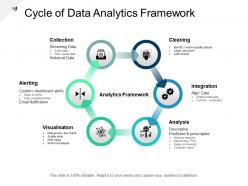
Presenting this set of slides with name - Cycle Of Data Analytics Framework. This is a six stages process. The stages in this process are Analytics Architecture, Analytics Framework, Data Analysis.

FAQs for Cycle of

So basically you've got five main steps: figure out what problem you're solving, gather your data, clean it up, analyze it, then share what you found. Honestly, data cleaning is going to eat up way more time than you expect - like 70% of your work, no joke. Once you've done your analysis, you interpret everything and present it to whoever needs to see it. Then boom, more questions pop up and you're back at it again. Oh, and seriously nail down exactly what problem you're tackling first. Trust me on this one - it'll save you from wandering into random dead ends later.

Honestly, it's all about your industry and what you actually need the data for. Healthcare's got crazy strict rules around patient records and clinical stuff. Retail companies are obsessed with tracking every purchase and how customers use their apps - loyalty programs are goldmines for that. Manufacturing? They're pulling sensor data from machines and watching supply chains like hawks. Tech companies basically collect everything users do - clicks, A/B tests, you name it. The trick is figuring out what regulations you're stuck with and what decisions you're actually trying to make. Otherwise you're just hoarding random data.

Honestly, data cleaning makes or breaks everything. Bad data = useless results that'll mess up decisions. Missing values, duplicates, weird outliers - if you skip fixing these, your whole analysis goes sideways. I totally bombed a project last year because of this! Different date formats or random typos in categories? Yeah, that stuff breaks your models and charts. You'll probably spend like 60-80% of your time just cleaning before the fun analysis part starts. Oh, and write down what you fixed - future you will thank me when someone asks how you got your results.

So EDA is like being a detective with your data. You're hunting for patterns, weird outliers, missing stuff - basically getting to know what you're dealing with. It's tempting to jump straight into fancy models, but trust me, don't. This exploration phase shows you which variables actually matter and how they connect. Think house hunting - you wouldn't buy without checking out the neighborhood first, right? I usually spend way longer here than planned, but it's worth it. Saves you from building garbage models later when you realize your data was messier than expected.

Honestly, looking at endless spreadsheets makes me want to take a nap. Charts and graphs are a lifesaver because you'll catch patterns and weird outliers right away instead of hunting through rows of numbers. Your team can understand complex stuff in seconds vs you having to explain everything. Interactive dashboards with colors and different sizes make the whole story way more interesting - people actually remember it. Oh, and you might spot data problems or random connections you'd totally miss otherwise. I always start basic with bar or line charts, then get fancier if needed.

So for collecting data, you've got APIs, web scrapers, survey tools - depends what you're working with. Python and pandas are amazing for cleaning stuff up (seriously, pandas is like half my life now). SQL handles database queries really well, then Python or R for the heavy statistical lifting. Excel works fine too if you're keeping it simple. Tableau and Power BI are solid for visualizations, or matplotlib if you're coding it. Oh, and don't overthink the tools - sometimes the basic approach is actually the right one. Just match whatever you pick to your data and who's gonna see it.

Honestly, the hardest part is fighting your own brain - it loves finding patterns that aren't actually there. Data overload is real too; you'll drown in numbers pretty quickly. Mix-ups between correlation and causation happen all the time, plus you're dealing with messy datasets and weird outliers constantly. Oh, and stakeholders? They usually want you to "prove" what they already think is true, which is... fun. Without proper business context, your analysis is basically pointless anyway. Trust me on this - always question your first take and grab someone else to sanity-check your work.

So ML mostly happens in the "Model Building" and "Analysis" parts of the data cycle. You'd use it after cleaning your data to spot patterns, make predictions, or classify stuff. Honestly, algorithms are way better than us at finding complex relationships in huge datasets - it's kinda humbling. Supervised learning works great for predictions, unsupervised helps you discover hidden patterns. Oh, and there's reinforcement learning for optimization problems too. Just make sure your data quality is decent first. Otherwise you're basically teaching the algorithm to be confidently wrong, which is... not ideal.

Okay so first thing - get proper consent and don't let anyone's personal info leak anywhere. That stuff matters way more than people realize. Watch out for bias too, because algorithms can really screw over certain groups without you even noticing. Document your approach upfront so you have some boundaries to stick to. Be honest about what your methods can and can't do. Every step, just ask yourself "is this gonna hurt someone?" Also think about how people might twist your results later - that happens more than you'd think. Transparency is your friend here.

Honestly, don't wait until the end to check your data quality - that's a recipe for disaster. Profile your data first so you know what mess you're dealing with. Then build validation rules right into your collection process. Trust me, I wasted like 3 weeks once analyzing complete garbage data because I skipped this step! Set up automated tests and document where everything comes from so you can actually trace problems. Oh, and make sure someone owns each dataset - can't just dump it all on IT. Regular audits help too.

Three things to track really. Business impact first - did revenue go up, costs drop, customer satisfaction actually improve? Technical stuff matters too: model accuracy, data quality, processing speed. Time-to-insight is critical because stakeholders get antsy waiting around. Then there's adoption - are people using your dashboards or just ignoring them? Honestly, connecting technical wins to real business results is what separates good projects from ones that get axed. Define success upfront so you're not desperately trying to prove value later when budget reviews hit.

Honestly, stakeholder input can totally flip your whole analytics game plan. They'll question how you framed the problem or point you toward data sources you missed. Mid-analysis, they might push back on your methods - which is annoying but helpful. Sometimes they'll see your charts and be like "nope, this isn't what we need at all." Better to know that early than waste time! They catch business context you're blind to. Don't wait until the end to get their thoughts. Quick check-ins after each phase let you pivot before you've gone too far down the wrong path.

So descriptive analytics is basically looking at what already happened - like "oh crap, sales tanked 15% last quarter." Pretty straightforward stuff. Predictive analytics tries to figure out what's coming next based on all that historical data you've got. Honestly, most people jump straight to the fancy predictive stuff, but you really need descriptive down first. How can you predict anything if you don't even understand what went wrong (or right) before? Once you've got that foundation, predictive helps with the big decisions - inventory, hiring, where to blow your marketing budget.

Start documenting everything now - problem statement, data sources, your methodology, findings. Trust me, I've watched so many people skip this step and kick themselves later. Capture your assumptions and any data quality headaches you run into. Screenshots of important visualizations are clutch. Use version control for code and maybe just keep a simple project log going. The whole point is so someone else (or you in 6 months when you've forgotten everything) can actually understand what happened without digging around forever. Set up that shared folder today and update as you go - seriously, don't put this off.

Honestly, just pick one big dataset that actually connects to what you're trying to accomplish - don't try to boil the ocean here. Figure out which tools can handle the volume without crashing your system (been there). Work through your normal analytics process but expect to find patterns you'd never spot in smaller data. Build everything step by step around that one source first. The whole point is getting specific insights you can act on, not creating some fancy dashboard that looks impressive but tells you nothing useful. Most companies drown in data they don't need anyway.

Ratings and Reviews

93% of 100
Review Form
Write a review
Most Relevant Reviews
  1. 80%

    by Roberts Roberts

    Qualitative and comprehensive slides.
  2. 100%

    by Donte Duncan

    Excellent Designs.
  3. 100%

    by Darrick Simpson

    I discovered this website through a google search, the services matched my needs perfectly and the pricing was very reasonable. I was thrilled with the product and the customer service. I will definitely use their slides again for my presentations and recommend them to other colleagues.

3 Item(s)

per page: