


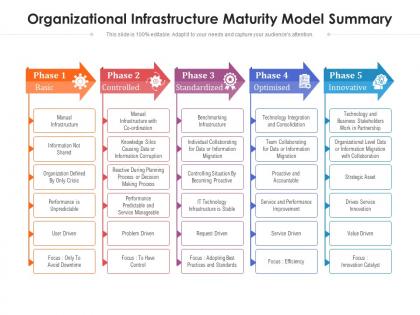
Organizational infrastructure maturity model summary




Try Before you Buy Download Free Sample Product
 Impress Your
 Audience
 100%
100% Editable
 Save Hours
 of Time


Our Organizational Infrastructure Maturity Model Summary are topically designed to provide an attractive backdrop to any subject. Use them to look like a presentation pro.
People who downloaded this PowerPoint presentation also viewed the following :
Organizational infrastructure maturity model summary with all 2 slides:
Use our Organizational Infrastructure Maturity Model Summary to effectively help you save your valuable time. They are readymade to fit into any presentation structure.
FAQs for Organizational infrastructure
So there are 5 levels that stack on top of each other. Initial is basically chaos - no real processes. Repeatable means you've got some docs down. Defined is when everything's standardized org-wide. Then Managed kicks in where you're actually tracking performance metrics. Finally Optimized - that's continuous improvement mode. Each step gives you way more control and predictability. Companies that try skipping levels? Total disaster every time I've seen it. Here's the thing though - you gotta be brutally honest about where you actually are right now, not where leadership thinks you should be. Then just focus on climbing to that next rung.
Start with something like CMMI or whatever framework fits your industry - there's tons of them out there. Talk to people from different departments since they're probably all over the place maturity-wise. Surveys and interviews work great, but honestly? Skip just asking the bigwigs. Your frontline people know what's actually happening day-to-day. If you've got budget, an outside consultant can tell you hard truths without worrying about politics. Process docs help too, though half of them are probably outdated anyway. Main thing is don't kid yourself about where you really stand versus where you wish you were.
Pick 3-5 metrics max that actually connect to your business goals - don't try measuring everything. Process consistency scores work great, plus employee skill assessments and real outcome improvements. Track stuff like how standardized things are, competency levels, whether you're hitting better results. Time-based ones are solid too - cycle times, incident response speeds, that kind of thing. Honestly, maturity checklists aren't useless but they're not the whole picture either. Get your baseline measurements now, then check progress quarterly. That way you'll know if you're actually improving or just doing busy work.
Honestly, culture will make or break your maturity progress. I've watched teams with perfect processes on paper completely fail because nobody wanted to admit mistakes or try anything new. Leadership has to buy into transparency first. If people are scared to experiment or share what went wrong, you're stuck at square one no matter what framework you implement. Look at how your team actually handles failure and knowledge sharing right now. Do they adapt well to change? Psychological safety is huge here - way more important than most people realize. Fix those cultural issues before expecting any maturity model to work. Otherwise you're just putting lipstick on a pig.
Honestly, leadership makes or breaks the whole thing. They control the budget and set the tone - if they're not on board, you're screwed. I've watched teams bang their heads against the wall because executives just wouldn't commit. Good leaders actually jump in and get their hands dirty instead of just telling everyone else to change. They fund training, create space for people to mess up and learn, and actually care about process improvements. Oh, and psychological safety is huge - teams won't take risks if they're afraid of getting blamed. Get your leadership team to understand why this stuff matters for your company specifically, then you'll see real progress.
Yeah, tech definitely helps speed things up. Data analytics tools show you where you actually are vs where you think you are - most companies get a reality check there, honestly. Automation handles the boring repetitive tasks so your people can work on actual improvements. Digital platforms break down those annoying silos between departments too. My advice? Don't go crazy with a million different tools that don't talk to each other. Pick one solid platform first and expand from there. Integration is everything or you'll just create more headaches for yourself.
Honestly, the worst part is people thinking you're just adding more bureaucracy to their lives. Nobody wants to be "assessed" - can't blame them there. Leadership buy-in is make-or-break too. Different departments will implement it totally differently, which screws everything up. Oh, and good luck keeping momentum after month three when everyone's buried in regular work again. I'd start small with whoever's actually interested. Skip the company-wide rollout initially - that's where most people crash and burn. Explain why you're doing it constantly (like, more than feels normal), then show off some quick wins to prove it's not just corporate nonsense.
First thing you'll want to do is figure out where each department actually sits on your maturity model right now. Get department heads talking to each other about their roadmaps - this is where most places totally blow it because everyone just does their own thing. Set up shared metrics so IT, HR, ops, and whoever else are actually aiming for the same targets. Regular cross-functional check-ins help track if you're moving in the right direction together. Oh, and definitely do quarterly sessions to course-correct when things inevitably get messy.
Honestly, continuous improvement is what gets you from one maturity level to the next - otherwise you're just stuck where you are. Each level means better processes and outcomes, but you only get there by finding your weak spots and fixing them systematically. Can't just implement something once and call it done (trust me, I've seen companies try). Maturity models are all about growing over time. Without regularly measuring and tweaking your processes, you're missing the whole point. My advice? Pick one process and start reviewing it consistently - that's where real progress happens.
Get feedback from everywhere - employees, managers, outside assessments. You'll want to see where you think you're at versus actual reality. Surveys work great. So do focus groups and tracking real performance metrics. Trust me, the results will probably shock you (they always do). Don't do massive overhauls though - that's just asking for trouble. Pick one problem area that keeps coming up in feedback and test fixes there first. You can tweak your criteria or add missing pieces as you go. Way easier than trying to fix everything at once.
Look into what frameworks already exist in your space first - no point starting from scratch. Talk to tons of stakeholders to really get their pain points. The thing that kills most models? Vague criteria for each level. Keep it to 4-5 levels max or people's eyes glaze over. Include metrics that practitioners actually care about, not just generic stuff. Oh, and definitely pilot it with a few organizations before you finalize anything. Their feedback on whether the progression feels doable is make-or-break for getting buy-in later.
Think of the maturity model as your innovation GPS - it shows you exactly where you can experiment without breaking everything. Most innovation dies because teams are stuck putting out fires, but when you're more mature, those resources get freed up. Here's what I'd do: find your worst-performing areas first. Those are usually blocking innovation anyway, so fixing them gives you quick wins. Then look at companies one level ahead of you - see what actually works for them instead of just throwing darts at the wall. It's way better than random experimentation, honestly.
Look, when your processes are all over the place, you're basically handing your competition free wins. They're out there making smart moves based on actual data while you're scrambling to fix whatever broke today. It's frustrating but true - without solid systems, you'll always be dealing with quality problems and missed deadlines. Everything costs more when it's chaotic. But here's the thing: you don't need to fix everything overnight. Pick your most important processes first. Document them, then actually measure what your customers care about. Those quick consistency wins add up faster than you'd think.
Honestly, benchmarks are like having a cheat sheet for what actually works. You can see how the best companies in your space operate vs where everyone else gets stuck. Without them, you're basically making up what "mature" looks like - which is pretty risky if you ask me. Plus stakeholders trust your model way more when it's based on real market data instead of just theory. I'd start by digging into what the top performers do differently. That becomes your anchor point for each maturity level. Saves you from a lot of guesswork.
Okay so three things really matter here: training for your specific skill gaps, getting teams to work together better, and actually tracking what's working. Don't spread yourself too thin - figure out what you're missing and go deep on that. Process standardization is honestly boring as hell but it's what separates the pros from everyone else running around like headless chickens. Get your leadership on board early since culture changes are slow. Map where you are now, then pick maybe 2-3 things that'll move the needle. Trying to fix everything at once is a recipe for burnout.
-
Presentation Design is very nice, good work with the content as well.
-
Informative presentations that are easily editable.
-
Wonderful templates design to use in business meetings.