

Infrastructure Maturity Model And IT Capability Maturity Model For Software Development Process




Try Before you Buy Download Free Sample Product
 Impress Your
 Audience
 100%
100% Editable
 Save Hours
 of Time


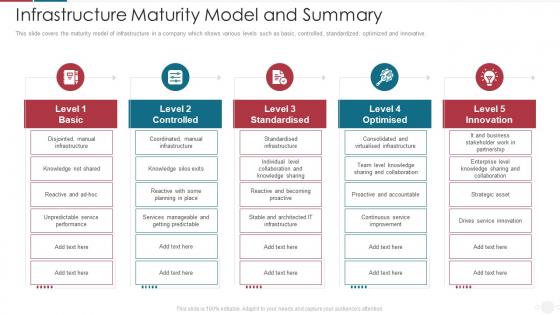
This slide covers the maturity model of infrastructure in a company which shows various levels such as basic, controlled, standardized, optimized and innovative.
People who downloaded this PowerPoint presentation also viewed the following :
Infrastructure Maturity Model And IT Capability Maturity Model For Software Development Process with all 6 slides:
Use our Infrastructure Maturity Model And IT Capability Maturity Model For Software Development Process to effectively help you save your valuable time. They are readymade to fit into any presentation structure.






FAQs for Infrastructure Maturity Model And IT Capability Maturity Model For
Key components of an Infrastructure Maturity Model include governance frameworks, technology architecture assessments, operational processes, security protocols, and performance metrics. These components work together by establishing standardized evaluation criteria, enabling systematic infrastructure improvements, and providing clear roadmaps for advancement, with many organizations finding that structured maturity models deliver enhanced operational efficiency and strategic competitive advantage.
Organizations assess their current infrastructure maturity level through comprehensive audits evaluating automation capabilities, scalability measures, security frameworks, monitoring systems, and governance processes. These assessments typically involve benchmarking against industry standards, analyzing operational efficiency metrics, and identifying gaps in technology integration, with many enterprises finding that structured maturity models ultimately deliver clearer roadmaps for strategic infrastructure investments.
Infrastructure Maturity Models deliver enhanced visibility into IT capabilities, streamlined resource allocation, reduced operational risks, and strategic roadmapping for technology investments. Through systematic assessment frameworks, organizations achieve better cost management, improved service reliability, and accelerated digital transformation initiatives, with many enterprises finding that structured maturity approaches ultimately deliver competitive advantage and measurable operational efficiency.
The Infrastructure Maturity Model facilitates technology adoption by providing structured assessment frameworks, standardized implementation pathways, and clear progression benchmarks that guide organizations through systematic upgrades. Through defined maturity levels, companies can strategically prioritize investments, minimize deployment risks, and align technology initiatives with business objectives, ultimately enabling smoother transitions and measurable improvements in operational efficiency.
The model improves operational efficiency by identifying infrastructure gaps, standardizing processes across departments, and automating routine maintenance tasks, while reducing costs through strategic resource allocation and preventive maintenance scheduling. Organizations using maturity models streamline their IT operations, minimize system downtime, and optimize hardware investments, with many enterprises finding that structured infrastructure planning delivers up to 30% cost savings annually.
Stakeholder engagement serves as a critical enabler across all Infrastructure Maturity Model levels, ensuring alignment between technical capabilities, business objectives, and organizational readiness for transformation. Through structured communication, feedback mechanisms, and collaborative planning, organizations achieve smoother infrastructure transitions, reduced resistance to change, and ultimately stronger adoption rates, with many enterprises finding that engaged stakeholders accelerate maturity progression significantly.
The Infrastructure Maturity Model helps identify capability gaps by systematically assessing current infrastructure against standardized benchmarks across domains like security, scalability, automation, and governance. Through detailed evaluation frameworks, organizations can pinpoint specific weaknesses in their technology stack, resource allocation, and operational processes, ultimately enabling targeted improvements that enhance performance and competitive positioning.
Metrics for Infrastructure Maturity Model progress include availability percentages, mean time to recovery, automation coverage ratios, security compliance scores, and cost per service unit. These measurements enable organizations to track operational efficiency improvements, evaluate resource optimization across different maturity stages, and demonstrate tangible business value through reduced downtime and enhanced service delivery capabilities.
Organizations use infrastructure maturity models to systematically assess current capabilities, identify strategic gaps, and create roadmaps that directly support business goals through structured transformation phases. By benchmarking against model criteria, companies can prioritize investments in areas like cloud adoption, automation, and scalability that enhance operational efficiency, reduce costs, and accelerate service delivery, ultimately delivering competitive advantage.
Organizations implementing an Infrastructure Maturity Model face challenges including resistance to change, resource constraints, skill gaps, integration complexities, and alignment difficulties across departments. While these obstacles can slow progress, many companies find that phased implementation approaches, strategic training investments, and executive sponsorship help overcome barriers, ultimately delivering improved operational efficiency and competitive positioning.
Industry standards significantly influence Infrastructure Maturity Model development by providing established frameworks, compliance requirements, and best practices that shape assessment criteria and progression pathways. Organizations in healthcare, financial services, and manufacturing find that aligning their models with standards like ISO 27001, COBIT, and ITIL delivers consistent benchmarking, regulatory compliance, and structured improvement roadmaps, ultimately enhancing operational credibility and strategic infrastructure advancement.
**INPUT**: What best practices can be adopted when transitioning between maturity levels? **OUTPUT**: Best practices include comprehensive baseline assessments, phased implementation approaches, stakeholder engagement strategies, continuous monitoring frameworks, and change management protocols. These methodologies streamline transitions by minimizing operational disruptions, ensuring resource alignment, and maintaining service continuity, with many organizations finding that structured advancement delivers improved efficiency and competitive positioning.
The Infrastructure Maturity Model addresses emerging technologies through adaptive frameworks that evaluate cloud adoption, automation capabilities, AI integration, and digital transformation readiness across organizational levels. Through structured assessments, organizations identify technology gaps, prioritize strategic investments, and develop implementation roadmaps, with many enterprises finding that systematic maturity evaluations accelerate innovation adoption while minimizing operational risks.
Successful Infrastructure Maturity Model implementations include financial institutions streamlining data centers, healthcare organizations optimizing network reliability, and manufacturing companies enhancing operational efficiency through strategic automation. These organizations achieve reduced operational costs, improved service delivery, and enhanced scalability by systematically progressing through maturity levels, with many finding that structured advancement delivers competitive advantages and measurable ROI.
Organizations ensure continuous improvement through regular maturity assessments, stakeholder feedback integration, performance metrics monitoring, and iterative optimization cycles. By establishing dedicated improvement teams, implementing automated monitoring systems, and conducting quarterly reviews, companies across sectors like manufacturing and financial services can systematically identify gaps, prioritize enhancements, and maintain competitive advantage through evolving infrastructure capabilities.
-
Easily Editable.
-
I discovered this website through a google search, the services matched my needs perfectly and the pricing was very reasonable. I was thrilled with the product and the customer service. I will definitely use their slides again for my presentations and recommend them to other colleagues.