


Five Levels Of Capability Maturity Model




Try Before you Buy Download Free Sample Product
 Impress Your
 Audience
 100%
100% Editable
 Save Hours
 of Time


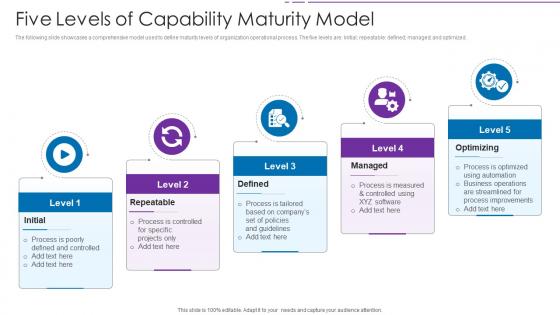
The following slide showcases a comprehensive model used to define maturity levels of organization operational process. The five levels are Initial repeatable defined managed and optimized.
People who downloaded this PowerPoint presentation also viewed the following :
Five Levels Of Capability Maturity Model with all 6 slides:
Use our Five Levels Of Capability Maturity Model to effectively help you save your valuable time. They are readymade to fit into any presentation structure.





FAQs for Five Levels Of
The core components of CMM include process areas, maturity levels, goals, practices, and key performance indicators that define organizational capabilities. These components work together by establishing structured frameworks, measuring process effectiveness, and enabling systematic improvements across departments, with many organizations finding that this integrated approach delivers enhanced operational efficiency and sustainable competitive advantage.
The CMM framework facilitates process improvement by establishing standardized maturity levels, providing systematic assessment tools, and creating structured roadmaps for organizational advancement. Through progressive implementation across departments, companies systematically eliminate inefficiencies, reduce project failures, and enhance quality control, with many software development firms and manufacturing organizations finding that CMM adoption ultimately delivers measurable competitive advantages and operational excellence.
The five CMM levels are Initial (ad-hoc processes), Repeatable (basic project management), Defined (standardized processes), Managed (quantitative process control), and Optimizing (continuous improvement focus). These levels enable organizations to systematically enhance software development capabilities, with many companies finding that progressing through each stage delivers improved project predictability, reduced costs, and ultimately sustained competitive advantage in increasingly complex development environments.
The Capability Maturity Model focuses on organizational maturity progression through defined process levels, while Six Sigma emphasizes statistical quality control and defect reduction through data-driven methodologies. CMM provides a structured roadmap for process evolution across entire organizations, whereas Six Sigma targets specific problem-solving projects, with many companies finding that combining both frameworks delivers comprehensive operational excellence and sustainable competitive advantage.
Organizations measure CMM maturity through structured assessments evaluating process documentation, implementation consistency, measurement practices, and improvement mechanisms across five levels. These evaluations examine project management capabilities, quality assurance procedures, and organizational training programs, with many companies finding that regular maturity assessments enable strategic resource allocation, streamlined operations, and enhanced competitive positioning.
Common implementation challenges include resistance to change, inadequate resource allocation, insufficient training and expertise, unrealistic timelines, and lack of senior management commitment. Organizations often struggle with cultural shifts required for process standardization, while simultaneously managing daily operations, with many finding that phased approaches and dedicated change management teams significantly improve adoption rates and long-term success.
Organizations successfully transition between maturity levels by establishing clear process documentation, investing in comprehensive staff training, and implementing robust measurement systems to track progress. Through systematic gap analysis and phased implementation approaches, companies in manufacturing, healthcare, and financial services streamline operations, reduce variability, and enhance quality outcomes, ultimately delivering improved project success rates and operational efficiency.
Employee training plays a critical role in CMM compliance by ensuring teams understand standardized processes, quality requirements, documentation protocols, and continuous improvement methodologies across all maturity levels. Through comprehensive training programs, organizations enhance process adherence, reduce errors, and accelerate maturity progression, with many companies finding that well-trained employees drive faster CMM certification and sustainable operational excellence.
CMM integration with Agile methodologies involves adapting traditional maturity processes to iterative development cycles, maintaining continuous improvement frameworks, and establishing cross-functional accountability structures. Organizations achieve this by implementing lightweight documentation practices, embedding quality gates within sprints, and creating feedback loops that satisfy both Agile velocity requirements and CMM process discipline, ultimately delivering faster releases while maintaining organizational maturity standards.
CMM progress evaluation relies on process performance metrics, defect density rates, schedule adherence measurements, cost variance analysis, and customer satisfaction scores. These metrics enable organizations to track their maturity evolution across manufacturing, software development, and healthcare sectors, with many finding that consistent measurement ultimately delivers enhanced operational efficiency and sustainable competitive advantage.
Smaller organizations can leverage CMM by implementing targeted process improvements that enhance operational efficiency, reduce project risks, and establish scalable quality standards without overwhelming resources. Through structured approaches to documentation, training, and workflow optimization, small businesses achieve improved client satisfaction, reduced rework costs, and competitive positioning against larger firms, ultimately enabling sustainable growth and market credibility.
Industries like aerospace, defense contracting, financial services, healthcare IT, and automotive manufacturing have successfully implemented CMM, achieving significant operational improvements. Boeing, Lockheed Martin, and JPMorgan Chase reported 20-50% reductions in project delays, enhanced quality control, and streamlined development processes, with many organizations finding that higher maturity levels deliver measurable competitive advantages and cost savings.
CMM helps in risk management and quality assurance by establishing standardized processes, implementing systematic quality controls, and creating predictable project outcomes through defined maturity levels. Organizations using CMM frameworks can identify potential risks earlier, maintain consistent delivery standards, and reduce project failures, with many software development companies and financial services firms finding that higher maturity levels significantly minimize operational risks while enhancing overall product quality.
NASA's Space Shuttle software program achieved CMM Level 5, reducing defect rates by over 90% and significantly improving mission-critical reliability through disciplined processes. Similarly, Motorola's implementation across multiple divisions streamlined development cycles, enhanced quality control, and delivered substantial cost reductions, with many technology organizations finding that structured maturity frameworks ultimately accelerate project delivery while minimizing operational risks.
Future CMM trends include AI-enhanced process automation, cloud-native maturity frameworks, DevOps integration, agile-CMM hybrid models, and continuous assessment platforms. These evolutions enable organizations to maintain structured improvement while adapting to rapid technological change, with many enterprises finding that modernized CMM approaches deliver faster innovation cycles and enhanced competitive advantage.
-
Designs have enough space to add content.
-
The templates are easy to get, and the chat customer support is excellent.