

Infrastructure maturity model





Try Before you Buy Download Free Sample Product
 Impress Your
 Audience
 100%
100% Editable
 Save Hours
 of Time


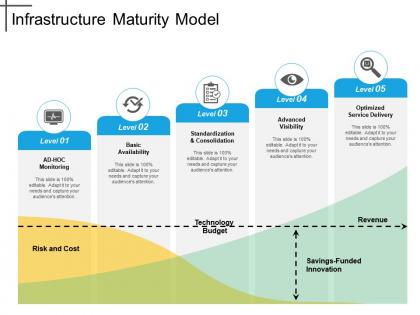
Are you finding difficulties in outlining a PPT presentation on infrastructure management within a limited time? Do not panic! SlideTeam is a leading PowerPoint templates company who has come up with a predesigned infrastructure maturity model PowerPoint template design crafted by highly intelligent graphics designers’ team. While keeping the consumer requirements in mind, our designers have crafted this infrastructure maturity framework template design. This stunning business capability maturity model PPT template slide comprises of the icon of a computer screen, anti-clockwise rotating arrows with a check mark, notepad, eye, and a magnifying glass has been deployed to make this unique presentation slides that will help you in grabbing the focus of the viewers. The template design reflects five stages which are AD-HOC monitoring, essential availability, standardization and consolidation, excellent visibility, and optimized service delivery. Each step has been provided with enough space so that you can describe each level thoroughly. You can use this template to explain the concept of business maturity model, and capability maturity model integration. Hurry up and download this amazing infrastructure maturity model presentation slide. Go across with our Infrastructure Maturity Model. They will effectively bridge the gap.
People who downloaded this PowerPoint presentation also viewed the following :
Infrastructure maturity model with all 5 slides:
Highlight external factors with our Infrastructure Maturity Model. Attempt to analyze the impact they can have.




FAQs for
So there's basically four stages your infrastructure goes through: reactive (stuff breaks, you fix it), managed (you've got some monitoring going), optimized (actually planning ahead with automation), then innovative where tech starts making you money. Timelines are all over the place though. Tech companies blast through these in maybe 2-3 years. Healthcare and government? Decades, because regulations are a nightmare. Manufacturing companies honestly just camp out in managed mode forever - I've seen it so many times. Finance usually skips around because compliance forces their hand. You're way better off comparing yourself to companies in your actual industry instead of trying to keep up with some startup.
Start with a framework like ITIL or COBIT - or just make your own covering automation, monitoring, disaster recovery, security, and change management. Most teams think they're way more mature than they really are, which is honestly hilarious. Get each team to self-assess first, then have someone external validate those scores. The reality check is brutal but necessary. Also look at hard metrics: how often you deploy, recovery times, incident rates. That gap between what people think vs. actual performance? That's your roadmap right there.
Automation is what pushes your infrastructure from amateur hour to actually mature. You're cutting out all those manual processes that break at the worst times - no more provisioning servers when you should be sleeping. Teams get way more done when they're not constantly putting out fires. Honestly, repetitive tasks are soul-crushing anyway. Focus on automating your biggest pain points first, like deployments and monitoring. The time you save lets everyone work on stuff that actually moves the needle instead of just keeping things from falling apart.
Look, your tech setup basically dictates what moves you can make as a business. Still stuck with old systems and doing everything manually? Good luck keeping up with competitors who can launch products fast or make decisions based on actual data. It's honestly like showing up to a race with a horse and buggy. Better infrastructure means you can pivot when needed, scale up operations, try new things, and react to market shifts way faster. I'd figure out where you actually stand on the tech maturity scale - because I bet it's either opening doors or slamming them shut for your strategy, and you might not even realize it yet.
Focus on automation percentage, MTTR, and deployment frequency first - those are your bread and butter. Infrastructure uptime and security response times matter too. The toil ratio is honestly my favorite metric because it shows how much time you're wasting on boring repetitive stuff instead of actual problem-solving. Resource utilization and cost per service will keep leadership happy, especially when they start freaking out about the AWS bill. Don't try to track everything at once though. Pick 3-4 that match your current headaches and build from there.
Honestly, new tech actually speeds up how mature your infrastructure gets - weird but true. It forces you to build things more modularly since you need that flexibility to plug in whatever shiny new tool comes next. AI stuff is the perfect example - everyone's suddenly realizing their data setup is kind of a mess lol. But that's actually good! Each time you try adopting something new, it shows you exactly where your current system breaks down. I've learned to think of every emerging technology as like a health checkup for your infrastructure rather than just another thing to slap on top.
Ugh, the resistance is real - people hate change and will cling to whatever they're doing now. Plus your team probably doesn't know the new tech, so everything takes forever. Money's always tight too, especially when you're asking for budget on stuff that won't show results right away. I swear the "why fix what works" crowd ruins more projects than bugs do. Oh, and good luck untangling all those legacy systems without breaking something else. My advice? Pick your most annoying problem first and solve that. Nothing beats early wins for getting people on board.
Dude, stakeholder buy-in is HUGE for infrastructure projects. Like, I can't stress this enough - you'll have the most brilliant technical plan ever, but if leadership and your actual users aren't on board? Dead in the water. People need to feel invested from day one or they just won't adopt anything new. I've watched so many good roadmaps crash and burn because teams skipped this part (honestly kind of painful to see). Keep everyone in the loop with regular updates. Listen when they complain about stuff. Show them real wins along the way. Otherwise you're just pushing changes nobody actually wants.
Netflix killed it going from mailing DVDs to streaming globally - that's like the textbook example. Capital One ditched their old banking setup for cloud-first too. Spotify's another good one, scaling from tiny startup to millions of users streaming simultaneously. What worked for all of them? Heavy automation investment, full DevOps adoption, and honestly just gutting old systems when they needed to start fresh. That last part's scary but sometimes you gotta do it. I'd say first figure out where your infrastructure actually stands maturity-wise, then just pick one thing to improve instead of trying to fix everything at once.
So there's a bunch of good options for mapping infrastructure maturity. I-CMM is probably the most well-known one, plus NIST has cybersecurity maturity tiers that work pretty well. COBIT's decent if you're more focused on IT governance stuff. Oh, and DORA metrics are solid for deployment practices - their yearly reports are actually interesting, not just boring corporate nonsense. Most of these use 1-5 scales from "total chaos" to "we've got our act together." Pick whichever one matches your biggest headaches right now, figure out where you stand, then build a plan from there.
Look, if your infrastructure is a mess, you're basically handing attackers the keys. Outdated systems and missing patches? That's like leaving your front door wide open. Better infrastructure gives you actual visibility into what's happening - you can spot threats and respond fast. Honestly, most people skip this step and jump straight to buying expensive security tools. Bad move. You can't protect what you don't understand or can't even see properly. Start with figuring out what you've actually got running first. Standardized, well-documented systems make finding vulnerabilities way easier.
Honestly, automation and standardization will save your ass more than anything else. Automate deployments, monitoring, scaling - whatever you can. Infrastructure as Code isn't optional anymore. Get your observability set up early too (seriously, future you will be grateful when everything's on fire at 2am). CI/CD needs to be rock solid from the start. Oh and make sure your team actually gets the tools, not just copying configs from Stack Overflow. Pick one thing, nail it completely, then move on. Don't try to fix everything at once - that's how you burn out.
Look, compliance is basically like having that one friend who makes you clean your room before they come over. Your infrastructure has to get its act together fast - proper docs, audit trails, change management, all that boring but necessary stuff. Can't just throw things together and hope they work anymore. Auditors will call you out on sloppy setups every time. The upside though? Use those requirements as your upgrade checklist instead of fighting them. You'll end up with way better monitoring, disaster recovery plans, and standardized processes. It's annoying but honestly speeds up your whole maturity timeline.
Honestly, moving to the cloud is like getting a huge head start on modern infrastructure. All that automation and monitoring stuff you'd normally spend months building? It's already there. The cloud providers have done the heavy lifting on security and disaster recovery - which is a relief because that stuff can be a nightmare to get right. Your team starts thinking differently too, working with infrastructure-as-code because that's just how things work up there. Short sentences hit different sometimes. Try migrating just one workload first and watch how it changes your whole approach to infrastructure. It's pretty wild how quickly the mindset shift happens.
Honestly, most companies mess up because they want to jump straight to the fancy tech stuff without fixing their basic processes first. Bad move. You'll also see teams working in their own little bubbles instead of getting everyone on board - that's where projects go to die, trust me. People hate change if they don't get why you're doing it in the first place. Oh, and leadership saying they support something but not actually putting money behind it? Classic mistake. Start small, write down what works, and make sure your bosses are willing to invest real resources.
No Reviews