


Content strategy maturity model





Try Before you Buy Download Free Sample Product
 Impress Your
 Audience
 100%
100% Editable
 Save Hours
 of Time


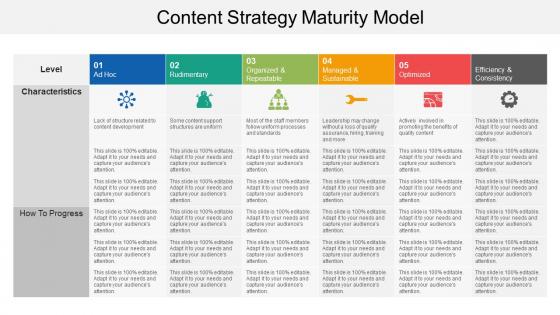
Do you want to build up an inventive and expert approach to represent your business content strategy? Here is our content strategy maturity model PowerPoint template slide. A 7x3 dimension table has been used to create this PPT template outline. This content management maturity framework presentation template slide contains an icon of diverging, rudimentary, arrows, team communication, wrench, globe, and speedometer that makes the design self-explaining and impressive. This content planning maturity framework presentation slide highlights important aspects which are Ad Hoc, rudimentary, organized and repeatable, managed and sustainable, optimized, and efficiency and consistency. Enough space has been provided so that you can explain each aspect in a more explicit way. Using this content strategy PowerPoint slide, you can create a presentation on various topics such as data management, information architecture, content development, business analysis, digital marketing, web development, marketing ideas, content planning and more. Deploy this editable content marketing model PPT template and leave a remarkable influence on the audience. Give them a dose of the latest in Business Education . Generate a global outlook with our Content Strategy Maturity Model.
People who downloaded this PowerPoint presentation also viewed the following :
Content strategy maturity model with all 5 slides:
Establish your impressive credentials with our Content Strategy Maturity Model. Give them an inkling of your expertise.

FAQs for Content
Okay so here's the deal - you need four things nailed down. Know your audience inside and out, like what actually keeps them up at night. Keep your brand voice consistent (harder than it sounds tbh). Distribution is where most people mess up - post where your people are, not where you wish they were. Track everything with real metrics tied to business goals. I'd start by looking at what you're already doing. Then figure out the biggest gap between your current stuff and what your audience is craving. Oh and don't try to be everywhere at once right away - you'll burn out fast.
Think of personas as your cheat sheet for content creation. They'll show you what to write about and how to say it. Got a busy marketing manager who checks LinkedIn during lunch? Skip the 10-page reports and go for quick, digestible posts instead. Honestly, personas saved me from that whole "let's appeal to everyone" mess - which never works anyway. I keep mine pinned to my desk because they're super helpful during brainstorming. Before posting anything, just double-check: would my persona actually care about this? Game changer.
Google Analytics is your best friend for website stuff - tracks everything about who's visiting and what they're doing. For social media, Hootsuite or Sprout Social work great for measuring engagement. Mailchimp handles email metrics like open rates pretty well too. Honestly? Don't go crazy with tools at first. I made that mistake and got totally overwhelmed trying to track everything. Focus on what actually moves the needle for you - conversions, leads, whatever your main goal is. Start simple with maybe 3-4 key numbers you check regularly. Once you've got that down, then maybe add something fancier like SEMrush.
I'd say check your content strategy quarterly, but do monthly quick reviews too. Things move crazy fast online - what killed it in January might be bombing by June. Every 3-4 months, dig into your metrics, see if your audience changed, scope out competitors. Monthly stuff can just be lighter, like "how'd last month go?" Don't overthink it though. If engagement suddenly tanks or something big shifts in your industry, screw the schedule and jump on it. Oh, and set actual calendar reminders or you'll definitely forget. Trust me on that one.
Think of SEO like GPS for your content - it shows you what to write about so people actually find your stuff. Look up keywords your audience searches for, then create posts answering those questions. I used to skip this step completely and couldn't figure out why nobody read my posts! Find 3-5 main keywords in your niche first. Then plan content around what people are actually asking about those topics. The trick is making search engines happy while still writing something genuinely useful. Don't just stuff keywords everywhere though - that's super obvious and annoying.
Stories stick because our brains are wired for them, not boring feature lists. You'll remember fairy tales from when you were five, but what about that article you read yesterday? Exactly. When you tell stories about real customers solving problems, people actually care. It makes complex stuff easier to understand too. Like, way easier than explaining technical features for twenty minutes straight. Find your customers' biggest headaches first. Then show how someone just like them fixed the same problem with your thing. Honestly, it works better than any fancy marketing trick I've seen.
Don't just copy-paste the same stuff everywhere – that's social media suicide. LinkedIn wants those professional insights and longer posts. Twitter's all about quick, punchy takes. Instagram and TikTok? Visual first, obviously. I cringe when I see companies posting boring corporate headshots on TikTok like what are you even doing? Facebook's kinda in between, community stuff works well there. Yeah posting times matter but engaging authentically matters way more. Honestly just pick 2-3 platforms where your people actually are and get really good at those first.
Honestly, templates are a game-changer because people scan visuals way faster than reading paragraphs. Your branding stays consistent, which makes you look more professional – nobody trusts messy slides, you know? They help break down complicated stuff into smaller pieces that actually make sense. Plus you can use colors and icons to guide people's eyes where you want them to go. I'd make 3-5 different templates for whatever content you're always creating. Way better than starting from scratch every time and wondering why your presentations look amateur.
Look, you gotta track the basics first - time on page, bounce rate, social shares. That stuff tells you if people actually give a damn about what you wrote. Organic search traffic and click-throughs matter too, obviously. But honestly? The only numbers that really count are conversions. Email signups, demo requests, whatever your actual goal is. I see so many people obsessing over page views when they should be watching what drives real business results. Set up some Google Analytics goals for the actions that matter, then check monthly to see which content actually works. Don't get sucked into vanity metrics!
Map your content goals straight to what the business actually needs. Like if retention is the problem, focus on onboarding stuff instead of just trying to get new customers. I learned this the hard way - used to create content without talking to anyone else (oops). Check in with sales and product teams regularly. They know what's working. Audit everything you've got and cut the fluff that doesn't serve your real goals. Oh, and track metrics that actually matter to leadership, not just engagement numbers that look pretty in reports.
Don't try making content for literally everyone - you'll end up connecting with nobody. Research your audience first, then set clear goals. Consistency is huge too. I swear, brands will post daily for two weeks then vanish completely. Figure out your unique angle instead of copying competitors all day. Also, repurpose your best stuff! That one post can become a video, carousel, story... whatever. Honestly the whole thing falls apart without solid content pillars. Start there, know exactly who you're talking to, then build your calendar around those basics.
UGC is honestly a game-changer for scaling your content without burning out your team. When your audience creates testimonials, reviews, and social posts, it feels way more authentic than the polished stuff brands usually put out. Plus you're getting content from potentially thousands of people instead of just your small internal team. The trick is giving people clear reasons to participate and some basic guidelines so you don't end up with total garbage. I'd start with your most active community members first – give them specific challenges or prompts to work with. Then you can repurpose everything across different channels and save a ton on production costs.
Honestly, most people get hung up on tiny content tweaks when they should be thinking format changes instead. Like, take a blog post and turn it into a carousel for Instagram. Or chop up that webinar into bite-sized videos. The trick is matching content to where your people actually spend time - so maybe that LinkedIn article becomes a Twitter thread, you know? I always try to pull 3-4 different angles from one original piece. Oh, and definitely look at your best content from the past few months first. Way easier to repurpose stuff that already worked than starting fresh.
Honestly, working with other teams totally changes your content game. Your sales team knows every single objection customers throw at them. Product folks understand what features actually matter. And customer service? They're basically talking to your audience all day long - they probably know them better than marketing does, which is kinda humbling. I always pull these people into quarterly planning sessions now because otherwise you're just guessing at what people want. It's wild how much better your content gets when you're not working in a bubble. Way more targeted and useful.
Honestly, you've gotta jump on short-form video if you haven't already - it's literally everywhere. AI content tools are getting scary good too. Interactive stuff like polls keeps people engaged way better than static posts. Oh and voice search is blowing up because apparently we're all too lazy to type now lol. User-generated content beats corporate messaging every time, plus everyone expects brands to actually care about sustainability these days. Personalization is huge but don't go overboard and make it creepy. I'd pick maybe two of these and test them out next quarter - you can't do everything at once.
No Reviews