


Organizational team building program powerpoint presentation slides




Try Before you Buy Download Free Sample Product
 Impress Your
 Audience
 100%
100% Editable
 Save Hours
 of Time


Our Organizational Team Building Program Powerpoint Presentation Slides are topically designed to provide an attractive backdrop to any subject. Use them to look like a presentation pro.
People who downloaded this PowerPoint presentation also viewed the following :
Content of this Powerpoint Presentation
Slide 1: This is the opening slide of “Organizational Team Building Program”. Add your company name here.
Slide 2: Here is a slide to share your agenda. Focus on aspects like the effective team structure, inculcating leadership skills, enhancing bonds between team members and monitoring team’s performance.
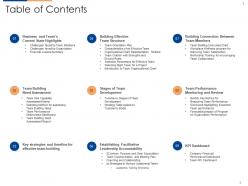
Slide 3: This slide contains the Table of Contents. Highlight the titles of your discussion like Challenges faced by the organization and team members, skill capability assessment, team building exercises, KPI dashboards etc. Add subheadings corresponding to each of these title pointers.
Slide 4: In this PPT slide, introduce the first title of your Table of Contents: Business and Team’s Current State Highlights. Discuss the highlights, challenges and financial losses summary here.
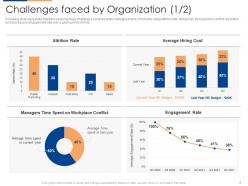
Slide 5: Use this dashboard slide to graphically demonstrate the challenges faced by your organization. Display the attrition rate, average hiring cost, time spent on workplace conflict and engagement rate graphically using this excel linked slide.
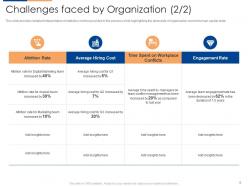
Slide 6: Use this slide in continuation of the “challenges enlisting” title. Share the detailed interpretation of statistics metrics provided in the previous slide highlighting the downside of the organization's current human capital state here.
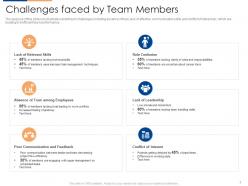
Slide 7: The purpose of this slide is to illustrate current team challenges including absence of trust, lack of effective communication skills and conflict of interest etc. These lead to inefficient team performance.
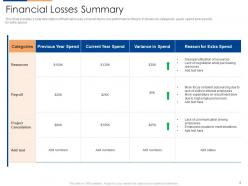
Slide 8: This slide provides a brief description of financial losses occurred due to non-performance of team. It shows key categories, yearly spend and reasons for extra spending.
Slide 9: In this PPT slide, focus on the second aspect of your table of content: Assessment needed in team building. Introduce the importance of methods and observation dashboard.
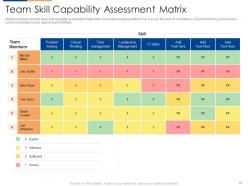
Slide 10: This slide contains a team skill capability assessment matrix with score rating ranging between 1 to 4 as per the level of competency. Each member is scored as per current competency level against each skill type.
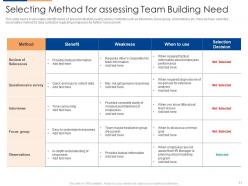
Slide 11: This slide seeks to accurately identify levels of present situations using various methods such as interviews, focus groups, observations etc. Here we have selected an observation method for data collection regarding employees for further assessment.
Slide 12: This slide provides an overview of statistics related to current team performance based on the observation method selected in the previous slide for data collection. It involves team conflict status, planned vs actual project status, leadership status and communication gap status.
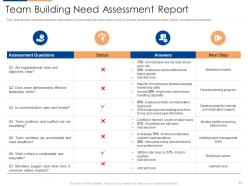
Slide 13: This slide depicts a detailed report to determine if a team building need exists or not. It involves assessment questions, status, answers and the next step.
Slide 14: Use this slide to introduce the third title of this presentation, the key strategies and timeline for effective team building.
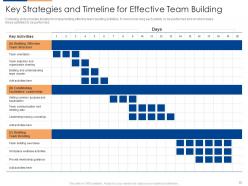
Slide 15: Use this slide to share the timeline for implementing effective team building activities. Cover how long and on which dates these activities will be performed.
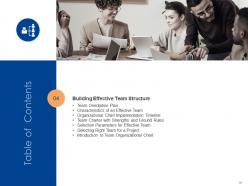
Slide 16: Introduce the fourth heading of your presentation on how to build an effective team structure in this PPT slide. Highlight the importance of characteristics, timeline implementation and ground rules here.
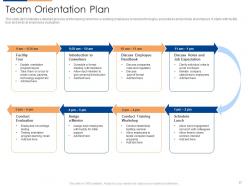
Slide 17: This slide demonstrates a detailed process of introducing new hires or existing employees to new technologies, procedures and policies at the workplace. It starts with a facility tour and ends at an employee's evaluation.
Slide 18: Illustrate the key characteristics required to build an effective team in this slide. Discuss the clear vision and purpose, shared commitment, clear roles and responsibilities, trust and mutual accountability here.
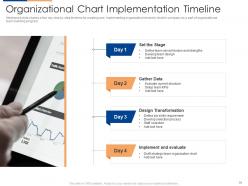
Slide 19: Use this slide to share a four-day step by step timeline for creating and implementing organization hierarchy charts in a company as part of an organizational team building program.
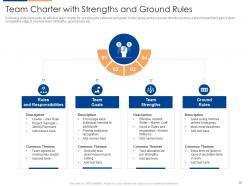
Slide 20: Use this slide to represent an effective team charter for providing the rationale and goals for the group. State a necessary direction to drive a team forward and gain a clear competitive edge in this slide including team strengths, ground rules etc.
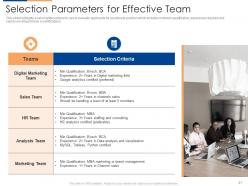
Slide 21: This slide highlights a set of written criteria to use to evaluate applicants for a particular position which includes minimum qualification, experience required and hands-on relevant tools or certifications.
Slide 22: This slide portrays major components such as the team size, selection and exclusion criteria, team composition and recruitment process to be focused for building an effective project team.
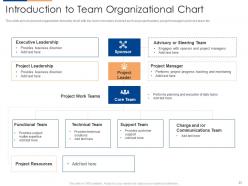
Slide 23: This slide aims to present an organization hierarchy chart with key team members involved such as the project leaders, project managers and core team etc.
Slide 24: Use this slide to highlight the fifth aspect of the Table of contents of this presentation, the Stages of Team Development.
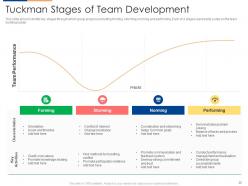
Slide 25: This slide aims to identify key stages through which group progress including forming, storming, norming and performing. Each of 4 stages represents a step on the team building ladder
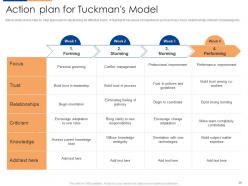
Slide 26: This slide covers the step by step approach for developing an effective team. It highlights key areas of importance such as focus, trust, relationships, criticism, knowledge etc.
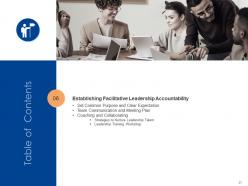
Slide 27: In this PPT slide, highlight the sixth heading of this presentation, i.e., Establishing Facilitative Leadership Accountability. Focus on accountability, purpose and the need for conducting leadership training workshops.
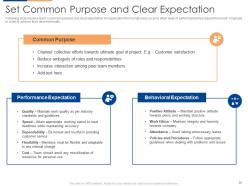
Slide 28: Discuss the team’s common purpose and clear expectation of organization from employees in this slide. Elaborate their need in attaining the standard level of performance from each employee in order to achieve their desired results.
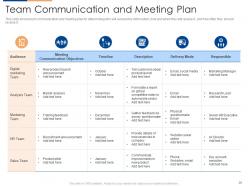
Slide 29: This slide shows the team communication and meeting plans for determining who will receive this information, how and when they will receive it, and how often they should receive it.
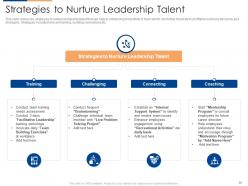
Slide 30: This slide covers the key strategies to nurture leadership talent that can help in enhancing productivity of a team. Thiscan further translate to profitable business decisions and strategies. Strategies included here are training, building connections etc.
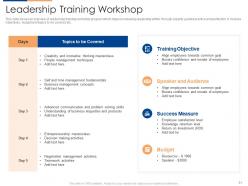
Slide 31: This slide shows an overview of leadership training workshop program which helps in releasing leadership within through expertly guided practice and perfection. It involves objectives, budget and topics to be covered etc.
Slide 32: Present this seventh heading of the table of contents to focus on building connections between the team members in this slide.
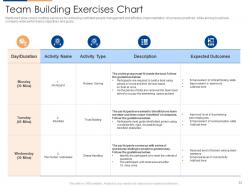
Slide 33: Mentioned slide covers multiple exercises for achieving confident people management and effective implementation of company practices, while aiming to achieve company-wide performance objectives and goals.
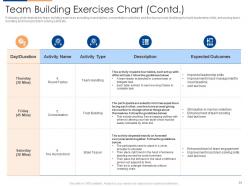
Slide 34: Following slide depicts key team building exercises including round tables, concentration activities and the human knot challenge to build leadership skills, enhance team bonding and hone problem solving skills etc.
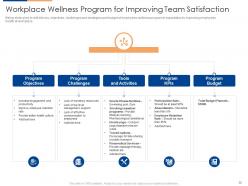
Slide 35: Below slide aims to drill into the key objectives, challenges and strategies and budget of employees, wellness program in expectation to improving employees’ health at workplace.
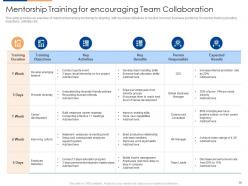
Slide 36: This slide provides an overview of mentorship training workshops for aligning with business initiatives or resolving common business problems. It includes training duration, objectives, activities etc.
Slide 37: Highlight the eighth aspect of your presentation in this slide to discuss team performance and review. Identify metrics and study the impact of training programs in the follow-up slides.
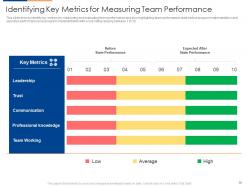
Slide 38: This slide aims to identify the key metrics for measuring and evaluating team performance. It also highlights the team performance state before program implementation and expected performance post program implementation, with score rating ranging between 1 to 10.
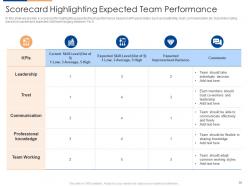
Slide 39: In this slide we provide a scorecard for highlighting the expected team performance based on KPI parameters such as leadership, trust, communication etc. It provides ratings based on current and expected skill level ranging between 1 to 5.
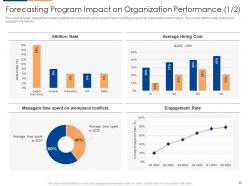
Slide 40: This slide displays detailed forecasting statistics for anticipating the impact of team building programs on organization performance. This covers attrition rate, hiring cost, engagement rate etc.
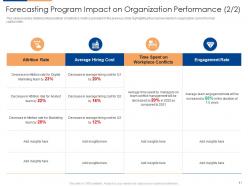
Slide 41: This slide provides a detailed interpretation of the statistics metrics provided in the previous slide highlighting the improvements in the organization 's current human capital state.
Slide 42: Highlight the ninth aspect of your discussion involving metrics and KPI dashboards in this PPT slide.
Slide 43: This slide highlights the KPI dashboard exhibiting overall improvement in the financial performance of the company as the consequences of program implementation.
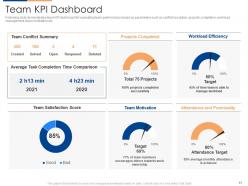
Slide 44: This slide demonstrates the team KPI dashboard for evaluating team performance based on parameters such as conflict resolution, project completion, workload management, team motivation etc.
Slide 45: This slide presents the Icons for quick accessibility and usage in this Organizational Team Building Program PowerPoint presentation.
Slide 46: This slide marks the beginning of additional slides to follow that comprises achievements, key takeaways, assessments, charts and contact details.
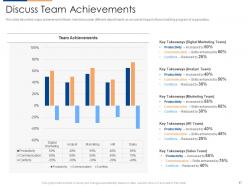
Slide 47: This slide describes major achievements of team members under different departments as an overall impact of the team building program of the organization.
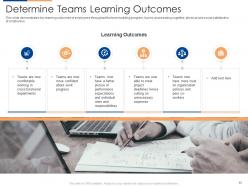
Slide 48: This slide demonstrates the key learning outcomes of employees throughout the team building program. It aims at assessing cognitive, physical and social satisfaction of employees.
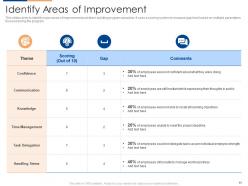
Slide 49: This slide aims to identify major areas of improvement post team building program execution. It uses a scoring system to measure gap level based on multiple parameters focused during the program.
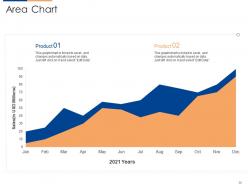
Slide 50: This slide comprises an excel-linked area chart to compare annual sales for two products simultaneously.
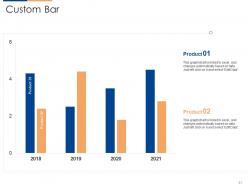
Slide 51: This slide presents a Custom Bar chart to compare the characteristics of two products over the years.
Slide 52: This is the ‘About Us’ slide. Highlight your characteristic features, target audience and distinct clients in this slide.
Slide 53: This slide provides the Mission for the entire company. This includes the vision, the mission, and the goal.
Slide 54: This slide shows the key members of your team with their name, designation, and photo.
Slide 55: This is another handy additional slide to highlight the four core principles, units or functions of your company that complete it, in a creative puzzle format.
Slide 56: This slide contains Post It Notes that can be used to express any brief thoughts or ideas.
Slide 57: This slide provides a Venn diagram that can be used to show interconnectedness and overlap between various departments, projects etc.
Slide 58: Share your monthly, two-monthly or three-monthly plan with this slide.
Slide 59: This is a timeline slide to share your growth and milestones in a creative way.
Slide 60: Use this slide to boast your achievements and future plans using a roadmap.
Slide 61: This is a Thank You slide where details such as the address, contact number, email address are added.
Organizational team building program powerpoint presentation slides with all 61 slides:
Use our Organizational Team Building Program Powerpoint Presentation Slides to effectively help you save your valuable time. They are readymade to fit into any presentation structure.





FAQs for Organizational team building program
Dude, team building actually works when it's done right. People stop just coexisting and start genuinely collaborating - the difference is crazy obvious once you see it. Better communication happens naturally. Trust builds up too, which means folks feel safe throwing out weird ideas that sometimes turn into brilliant solutions. Problem-solving gets way better because suddenly everyone's voice matters. Oh, and people actually stick around longer since they don't feel isolated at work. Honestly? Just start with regular check-ins or grab coffee together. Sounds basic but it builds the foundation for everything else.
Honestly, team activities work because they get people actually talking to each other. You know how some coworkers never really click? Collaborative stuff breaks that awkwardness down. People start bouncing ideas around more naturally when they've solved puzzles together or whatever. It helps everyone figure out different communication styles too – like who's the quiet thinker versus who talks through problems out loud. Once people feel comfortable, they'll actually speak up in real meetings instead of staying silent. I'd say try a monthly challenge that forces collaboration. You'll notice the difference pretty quickly in how they interact day-to-day.
Leadership totally sets the tone for collaboration - if you don't walk the walk, your team won't either. Model the open communication you want to see. Ask more questions in meetings and actually listen to different viewpoints. Create that psychological safety where people feel heard. I've watched teams crash and burn because their leaders preached teamwork but hoarded all the credit themselves - such a waste. Focus on celebrating group wins over individual ones. Oh, and facilitate those cross-functional projects where departments actually have to work together. Consistency matters way more than one-off team building stuff.
Honestly, it's all about mixing things up since everyone on your team is wired differently. Your analytical people will love problem-solving challenges, while creative types gravitate toward workshops and brainstorming stuff. I'd rotate between competitive games, skill-sharing sessions, and just casual hangouts - though fair warning, some people absolutely despise forced team bonding! Survey your team first to see what they actually want. Short activities work better than those painful all-day retreats. Social events let introverts and extroverts connect in their own ways. The trick is variety over time rather than cramming everything into one awkward session.
Honestly, start with just 2-3 things you actually care about - don't go crazy tracking everything. Employee engagement scores and retention rates give you solid numbers to work with. But the softer stuff matters just as much, maybe more? Like how people actually talk in meetings or whether they're joining optional team events. Cross-department projects are a good tell too - when teams work well together, those usually go smoother. Pulse surveys help you catch issues early. Oh, and see how often people give each other props or shoutouts. That's usually a pretty good sign things are clicking. Pick metrics that match what you're trying to fix first.
Honestly, ditch the boring icebreakers and try stuff people actually want to do. Online escape rooms are surprisingly fun, or maybe virtual cooking where everyone makes the same recipe. Keep it optional though - forced team bonding is the worst. Rotate times so you're not always screwing over one timezone (learned that the hard way). Cap sessions at 45 minutes because nobody needs more Zoom time. Mix in some problem-solving games alongside the social stuff. Start with one thing monthly and just ask what people liked. Their feedback tells you way more than guessing what'll work.
Honestly, the biggest pain is when people think it's just corporate BS and don't buy in. Getting everyone's schedules to align is a nightmare too. Then you've got activities that have nothing to do with your actual problems - like trust falls when what you really need is better communication about deadlines. Some folks will just phone it in even if they show up. Oh, and icebreakers? Yeah, most people would rather be literally anywhere else. Pick stuff that actually relates to work challenges you're facing, and be upfront about why you're doing it instead of some vague "team building" excuse.
Honestly, team building works because people actually get to know each other beyond just "that person from accounting." When your coworkers feel more human to you, everything gets less awkward and way more collaborative. Plus work becomes genuinely more fun - which sounds cheesy but it's true! Job satisfaction goes up because people feel like they're part of something instead of just grinding through tasks. The trick is picking activities your team will actually enjoy. Like, don't drag introverts to karaoke if they'd rather do a cooking class or something.
Honestly, team building works because it hits some pretty basic psychological buttons. When people tackle challenges together, you get this "cooperative interdependence" thing happening - basically everyone stops seeing each other as competition. Plus doing stuff outside the office lets personalities shine through (who knew Jim from accounting was actually funny?). Shared experiences like that release oxytocin and build trust. The vulnerability of trying new things together? That's gold for psychological safety. My advice: pick activities that actually require working together, not just awkward icebreakers that make everyone cringe.
Honestly, just ask your team what they actually want first - send out a quick survey about preferences and accessibility stuff. Trust me, some people love those cheesy icebreakers while others (like me) would rather hide under a rock. Mix things up with different activity types - throw in collaborative problem-solving but also give people quiet reflection time. Cultural backgrounds matter too, and you've got introverts, extroverts, remote people, in-person folks... it's a lot to juggle. The trick is variety within each session so everyone gets their moment to actually contribute without feeling weird about it.
Yeah, cross-functional teams definitely work for innovation. Different departments think about problems totally differently - your marketing person sees user pain points while engineering thinks about what's technically possible. When they actually talk to each other (instead of just emailing), cool stuff happens. People get way more comfortable pitching crazy ideas once they know each other as actual humans, not just "Kevin from IT." My old company did monthly cross-department brainstorming sessions and honestly? Some of our best products came from those random conversations. The finance person would mention budget constraints and suddenly someone else would suggest a completely different approach.
Oh this is tricky but totally doable! Skip the whole-group sharing thing - nobody wants to be put on the spot like that. Instead try small groups or mix up who works together so it's not just the usual office cliques. Problem-solving stuff works way better than those weird trust-fall activities (honestly who thought those were a good idea?). Give people different ways to jump in since some folks need thinking time while others just blurt out ideas. Creative projects are solid too because everyone's got different strengths. Send out a quick survey after to see what actually worked!
Honestly, it really depends on your team's personality and how much you can spend. We use Slack for messaging and Miro for brainstorming sessions - both are pretty solid. Asana helps keep projects organized too. For team building, escape rooms are always a hit, or maybe cooking classes if people are into that. My team actually bonded most during those awful late-night pizza sessions (don't tell my boss lol). Oh, and those personality tests like StrengthsFinder? They're weirdly helpful for figuring out how everyone works. Just start with something simple and see what clicks.
Honestly, I'd go with quarterly for most teams - gives you enough time to build momentum without people getting sick of it. Monthly works too if you've got a smaller crew. Nobody wants to hear about trust falls every other week, trust me on that one. Bigger companies should probably stick to quarterly major events and just throw in some casual stuff throughout the year. Start there and see how your team responds. Consistency beats going overboard every time. You just need regular chances for people to actually connect when they're not stressed about deadlines.
Honestly, escape rooms are perfect for this - people naturally have to work together or they're stuck. Cooking challenges work too, way better than those awkward trust exercises nobody wants to do. Volunteering somewhere feels more genuine and meaningful. Improv classes are surprisingly good for breaking down walls between departments. Even video game tournaments can work if you set up teams right. The trick is finding stuff where everyone brings different skills to the table. Just don't pick activities where people end up working alone in the same space - that defeats the whole point.
-
Amazing product with appealing content and design.
-
Thanks for all your great templates they have saved me lots of time and accelerate my presentations. Great product, keep them up!
-
Excellent design and quick turnaround.
-
Amazing product with appealing content and design.