

Organization Structure Powerpoint Presentation Slides





Try Before you Buy Download Free Sample Product
 Impress Your
 Audience
 100%
100% Editable
 Save Hours
 of Time


The Organization Structure PowerPoint Presentation Slides contains a set of pre-designed templates that help to showcase the hierarchical structure of the company. The hierarchical structure PowerPoint template presents teams and departments roles and responsibilities. Using team structure PPT slide you can explain to people where they fit in the organization, what their responsibilities. Users can describe the reporting structure, divisions, and roles. Organizational design ppt slides enable customers to make presentations on functional structure, divisional structure, project matrix, matrix structure, team structure, and organizational architecture, etc. This contains editable slides where you can put your own text. This creative project matrix PPT template helps to communicate how information flows from one department to another. Download the organizational structure presentation graphics to explain the roles and responsibilities of employees. Advocate being generous with our Organization Structure Powerpoint Presentation Slides. Give a convincing account of all the blessings.
People who downloaded this PowerPoint presentation also viewed the following :
Content of this Powerpoint Presentation
Slide 1: This is an introductory slide for Organization Structure. Write Your Company Name and begin with clarity.
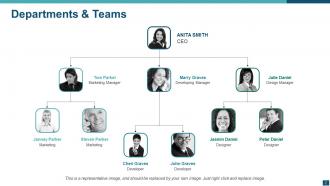
Slide 2: This slide showcases Departments & Teams in hierarchy form to be presented.
Slide 3: This is Our team slide with name, designation and text boxes to state information.
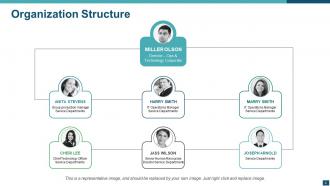
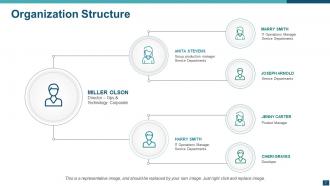
Slide 4: This is an Orgnaization Structure slide to present different departments and teams with name and designation to fill.
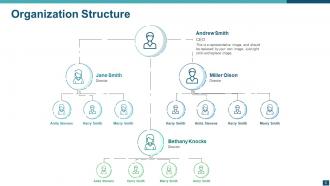
Slide 5: This is also an Orgnaization Structure slide to present different departments and teams with name and designation to fill.
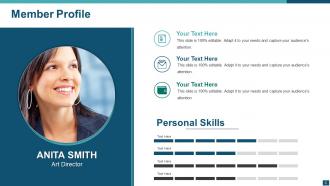
Slide 6: This slide showcases Member Profile to be displayed.
Slide 7: This slide shows Organization Structure for different teams, roles and responsibilities.
Slide 8: This slide also shows Organization Structure for different teams, roles and responsibilities.
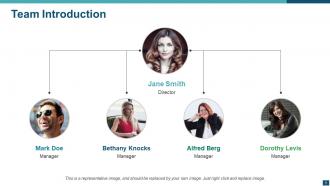
Slide 9: This is a Team Introduction slide with text and image boxes to state relevant information.
Organization Structure Powerpoint Presentation Slides with all 9 slides:
In business you have to be always ready to attack. Professionally created readymade Organization Structure Powerpoint Presentation Slides are a handy tool for those emergency presentations.


FAQs for Organization Structure
You basically want clear reporting lines so people know who they answer to. Define everyone's roles properly - I can't tell you how many companies I've watched implode because nobody knew who was supposed to make which decisions. Communication channels matter too, obviously. Your span of control should make sense for your size. A 20-person startup can't run like IBM, you know? And honestly, whatever structure you pick needs to actually fit your culture and goals. Don't just copy what worked somewhere else. Oh, and review it regularly as you grow - what works now probably won't scale.
Honestly, your team structure makes a huge difference in how people feel about work. Clear roles? Everyone knows what they're doing and who to bug when stuff goes wrong. But pile on too many managers and people get stuck waiting around for basic decisions - super annoying. I've watched that tank morale more times than I can count. Flat structures sound cool but sometimes leave people wandering around clueless. You want that middle ground where there's enough support without the bureaucratic nightmare. Just make sure everyone actually understands their role from day one.
Yeah so flat structures are pretty sweet for quick decisions - way less red tape to cut through. Your team gets more freedom and can actually talk to the big bosses directly. Communication doesn't get all garbled going through a million managers either. The downside though? Scaling gets weird fast. Career progression becomes this murky thing since there aren't clear steps up the ladder. Some people honestly thrive with structure and get lost without it. Really depends if your company vibe can handle everyone having more responsibility dumped on them.
So matrix structures pull people from different departments onto project teams - way better for getting everyone talking. Your marketing and tech people actually collaborate daily instead of working in silos. Yeah, it's confusing at first because people don't know who they report to. But honestly? Once teams figure it out, decisions happen faster and knowledge gets shared like crazy. You just have to nail down roles and communication from the start. Otherwise it turns into a total mess instead of smooth teamwork - learned that one the hard way at my last job.
Think about it this way - your company culture is basically the DNA of your structure. Collaborative, trusting workplaces? They go flat with fewer bosses and tons of cross-functional teams. But rigid, control-freak cultures build these massive hierarchies with like 15 layers of management (okay maybe not 15 but you get it). It's honestly just like how your personality shapes your apartment - some people want everything open, others need walls everywhere. When you're redesigning stuff, just ask: does this actually fit how we want people to work together? Pretty simple test.
Honestly, tech is breaking down all those old-school corporate hierarchies. Remote work changed everything - now you've got teams collaborating in real-time without needing to go through five different managers first. I mean, look at Slack. Your junior dev can literally message the CEO about a bug. Wild, right? Companies are shifting toward these network-style structures where info actually flows instead of getting stuck in bureaucratic bottlenecks. Decision-making's way more spread out now too. The trick is building your org around how people actually want to work with these tools, not forcing outdated structures.
So basically, centralized means the big bosses make all the calls. Decentralized? Teams get to decide stuff themselves. Centralized gives you consistency but man, everything moves like molasses since you need approval for literally everything. Decentralized is super flexible and fast - teams can pivot quickly. But honestly, sometimes you end up with everyone doing their own thing and it gets messy. I'd think about what matters more to you guys - having tight control and everyone on the same page, or being able to move fast and let teams run with ideas. That should tell you which way to go.
So your org structure totally controls who gets to decide what and how quickly stuff happens. Flat structures? Decisions move fast since there aren't a million approval layers, but teams can end up doing completely different things. With hierarchies you get better control and everyone's aligned - though man, they're slow as hell when you need to pivot quickly. Really depends on what kind of decisions you're making most. Fast-moving market means too many layers will absolutely destroy you. But if compliance is huge for you, those checkpoints actually save your butt. I'd look at where you're getting the worst bottlenecks right now.
Honestly, I'd focus on decision-making speed first - how long does it take to actually get stuff approved? That's usually where you feel the pain most. Employee engagement and retention rates are solid indicators too. If people are bailing or seem miserable, your structure probably sucks. Communication flow between teams matters a lot (though this one's harder to measure). Track productivity and maybe span of control ratios if you're feeling fancy. Don't go crazy measuring everything though. Pick 2-3 that match your biggest headaches and check them quarterly. Start simple.
Start with just one team as a test run - don't go company-wide right away. Cut out some of those middle management layers (honestly, half of them just slow things down anyway). Build cross-functional teams that can actually make decisions without needing approval from everyone and their mom. Give people real ownership over their projects. The culture shift takes time though - you can't just announce it Monday and expect magic by Friday. Pick one department, see what bombs or works great, then roll out the good stuff everywhere else. Baby steps work better than trying to revolutionize everything at once.
So it really depends on what kind of business you're in. Tech startups go flat - everyone just reports to the founder until things get messy and they realize they need more structure. Manufacturing and hospitals? They're all about that traditional hierarchy because safety regulations don't mess around. Creative agencies do this matrix thing where people bounce between projects, which honestly sounds chaotic but somehow works. Finance companies usually split into divisions for different services. The main thing is figuring out how fast you need decisions made and what regulatory hoops you'll have to jump through.
Honestly, flat structures usually win for innovation - less bureaucracy means people can actually try stuff without waiting forever for approvals. But there's a catch... too flat and everything becomes total chaos. Hierarchical companies slow things down with all those sign-offs, though they're better at focusing resources when they need to. Here's what I'd do: find where ideas get stuck in your current process and fix those spots first. Maybe set up some cross-functional teams or give people dedicated time to innovate. You don't need to overhaul everything - just create clearer paths for good ideas to move forward.
Honestly, start by figuring out where things actually get stuck - not where managers think they do. Talk to everyone, especially the people doing the day-to-day work since they know what's really broken. Don't change everything at once though, that's just chaos waiting to happen. Pick one department to test stuff first. Communication is huge here - like, tell people way more than you think you need to. Oh and definitely plan in phases with a timeline, but stay flexible because nothing ever goes according to plan anyway.
Honestly, you're gonna hit three big problems: decisions crawl at a snail's pace, communication gets messy, and nobody knows who they actually report to. Simple stuff that should take minutes ends up bouncing between layers for weeks. People either duplicate work or think someone else has it covered - both are annoying as hell. I watched one team spend half their time just mapping out who does what instead of actually working. My take? Keep things flat but not so flat that accountability goes out the window. You still need someone clearly owning the important stuff.
Dude, remote work totally breaks the old "manager hovering over your shoulder" thing - which honestly was annoying anyway. You'll need way clearer job roles now since people can't just wander over with random questions. Teams have to actually function on their own instead of depending on constant check-ins. The whole hierarchy shifts from being about who sits where to who actually knows their stuff and can make decisions. Communication between departments becomes super critical too. I'd look at your current reporting structure and figure out what's actually useful vs what existed just because everyone was in the same building, you know?
-
I discovered this website through a google search, the services matched my needs perfectly and the pricing was very reasonable. I was thrilled with the product and the customer service. I will definitely use their slides again for my presentations and recommend them to other colleagues.
-
Great quality product.