


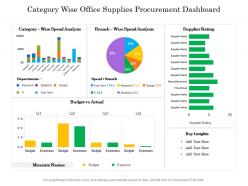
Category wise office supplies procurement dashboard





Try Before you Buy Download Free Sample Product
 Impress Your
Audience
 100%
Editable
 Save Hours
of Time


Our Category Wise Office Supplies Procurement Dashboard are topically designed to provide an attractive backdrop to any subject. Use them to look like a presentation pro.
People who downloaded this PowerPoint presentation also viewed the following :
Category wise office supplies procurement dashboard with all 2 slides:
Use our Category Wise Office Supplies Procurement Dashboard to effectively help you save your valuable time. They are readymade to fit into any presentation structure.

FAQs for Category wise office
Key metrics should include spend analysis by category, supplier performance ratings, inventory turnover rates, cost per employee, contract compliance percentages, and delivery timeframes. These metrics enable procurement teams to identify cost-saving opportunities, optimize supplier relationships, and streamline ordering processes, with many organizations finding that comprehensive dashboard visibility reduces procurement costs by 15-20% while improving operational efficiency.
A procurement dashboard enhances office supplies spending visibility by consolidating purchase data, tracking vendor performance, identifying cost trends, and highlighting budget variances in real-time. Through automated reporting and visual analytics, organizations can monitor category spending, detect unusual purchasing patterns, and optimize supplier relationships, while finance teams gain transparent oversight that enables strategic cost control and informed procurement decisions.
Effective visualizations include inventory heat maps showing stock levels by category, order timeline charts tracking procurement cycles, spend analysis bar graphs, supplier performance scorecards, and real-time dashboard gauges for critical supplies. These visual tools streamline procurement decisions by highlighting usage patterns, identifying cost-saving opportunities, and preventing stockouts, with many organizations finding that comprehensive dashboards reduce ordering inefficiencies while optimizing inventory management.
Integrating real-time data enhances office supplies procurement dashboards by providing instant inventory visibility, automated reorder triggers, and dynamic supplier performance tracking. This enables procurement teams to prevent stockouts, negotiate better contracts based on current usage patterns, and streamline purchasing decisions, with many organizations finding that real-time insights reduce supply costs by 15-20% while improving operational efficiency.
A centralized procurement dashboard delivers enhanced visibility, streamlined ordering processes, better spend control, standardized vendor relationships, and improved budget tracking across departments. Through real-time analytics and automated workflows, organizations achieve significant cost reductions, eliminate duplicate orders, and ensure consistent supply availability, while procurement teams gain strategic oversight that enables bulk purchasing advantages and more efficient resource allocation.
Predictive analytics in office supplies procurement dashboards utilizes historical usage patterns, seasonal trends, employee headcount changes, and budget cycles to forecast future inventory requirements. Through machine learning algorithms, organizations can anticipate supply shortages, optimize reorder timing, and reduce carrying costs, with many companies finding that automated forecasting delivers 20-30% cost savings while ensuring seamless operations.
A procurement dashboard identifies cost-saving opportunities through spend analytics, vendor performance comparisons, usage pattern tracking, contract compliance monitoring, and demand forecasting capabilities. These insights enable organizations to negotiate better rates, consolidate suppliers, eliminate unnecessary purchases, and optimize inventory levels, with many companies finding that data-driven procurement strategies reduce office supply costs by 15-20% annually.
User experience drives procurement dashboard design through intuitive navigation, streamlined workflows, and clear data visualization that reduces training time and minimizes errors. When dashboards prioritize UX principles like simplified ordering processes, personalized interfaces, and mobile accessibility, organizations enhance employee adoption rates, accelerate procurement cycles, and ultimately deliver cost savings while improving operational efficiency across departments.
Automated alerts enhance procurement dashboard effectiveness by providing real-time notifications for low inventory levels, budget thresholds, contract renewals, and delivery delays. These systems enable procurement teams to proactively manage supply chains, prevent stockouts, and optimize purchasing timing, while reducing manual monitoring tasks and ensuring seamless office operations across organizations.
Implementation challenges include data integration complexities, employee resistance to new systems, initial setup costs, vendor coordination difficulties, and ensuring accurate real-time inventory tracking. While these obstacles require strategic planning and change management, organizations typically find that streamlined procurement processes, reduced costs, and enhanced visibility ultimately deliver significant operational efficiency and competitive advantage.
Collaborative tools within procurement dashboards enhance communication by enabling real-time messaging, shared document editing, centralized vendor correspondence, automated workflow notifications, and integrated task management systems. These features streamline coordination between procurement teams, suppliers, and stakeholders by reducing email chains, accelerating approval processes, and maintaining transparent audit trails, ultimately delivering faster procurement cycles and improved supplier relationships.
Essential KPIs include cost per unit trends, supplier delivery performance, order cycle times, budget variance tracking, and inventory turnover rates. These metrics enable procurement teams to identify cost-saving opportunities, optimize supplier relationships, and streamline ordering processes, with many organizations finding that regular monitoring reduces supply costs by 15-20% while improving operational efficiency.
A procurement dashboard assists compliance by providing real-time budget tracking, automated policy alerts, and spending visibility across departments and vendors. Through centralized monitoring, organizations streamline approval workflows, identify budget overruns before they occur, and ensure purchases align with pre-approved supplier contracts, ultimately delivering enhanced financial control and operational transparency while minimizing unauthorized spending.
**INPUT**: What technologies or software platforms are best suited for developing an effective office supplies procurement dashboard? **OUTPUT**: Effective office supplies procurement dashboards leverage technologies including cloud-based ERP systems, business intelligence platforms like Tableau or Power BI, API integrations, and automated workflow tools. These platforms streamline procurement by centralizing vendor management, automating reorder processes, and providing real-time spend analytics, with many organizations finding that integrated solutions deliver significant cost savings and operational efficiency. [Word count: 58 words]
User feedback can be incorporated through regular surveys, usability testing sessions, analytics review, and direct stakeholder interviews to identify pain points and improvement opportunities. Many organizations implement feedback loops where procurement teams, department managers, and end-users collaborate on dashboard refinements, ultimately delivering enhanced user experiences, streamlined ordering processes, and improved operational efficiency across departments.
-
Unique research projects to present in meeting.
-
Unique design & color.
-
Attractive design and informative presentation.