

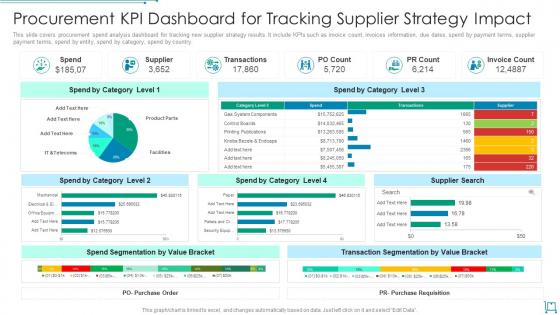
Procurement kpi dashboard for tracking supplier strategy impact




Try Before you Buy Download Free Sample Product
 Impress Your
 Audience
 100%
100% Editable
 Save Hours
 of Time


This slide covers procurement spend analysis dashboard for tracking new supplier strategy results. It include KPIs such as invoice count, invoices information, due dates, spend by payment terms, supplier payment terms, spend by entity, spend by category, spend by country.
People who downloaded this PowerPoint presentation also viewed the following :
Procurement kpi dashboard for tracking supplier strategy impact with all 7 slides:
Use our Procurement KPI Dashboard For Tracking Supplier Strategy Impact to effectively help you save your valuable time. They are readymade to fit into any presentation structure.





FAQs for Procurement kpi dashboard for tracking
Cost savings is the obvious one - track actual dollars, not just percentages. Supplier performance matters too (quality, delivery, compliance stuff). Procurement cycle time shows how fast your team moves from requests to POs. Oh, and contract compliance rate - because people going rogue and buying whatever they want will totally wreck your negotiated deals. I've seen it happen way too often. Start with those four metrics and you'll get a pretty decent picture of what's working and what isn't. They're not fancy but they work.
Look, you gotta connect your procurement metrics to what the executives actually give a damn about - revenue, margins, customer happiness, whatever keeps them up at night. Don't just measure random "cost savings" stuff. If they're expanding into new markets, track how fast you can get suppliers onboard or diversify your vendor base. Most procurement folks I know are tracking metrics that leadership never even sees, which is honestly kind of tragic. Have real conversations with the business leaders about their priorities. Then translate that into procurement numbers that clearly show you're moving the needle on results that matter.
Honestly, automation is a total lifesaver for tracking procurement KPIs. You'll stop making those annoying manual errors and actually see your metrics in real time. Why waste hours digging through different systems when dashboards can instantly pull up spend data, supplier performance, contract stuff - all of it. AI catches patterns you'd probably miss too, like when suppliers are about to become a headache. Everything gets way more accurate. I'd start with whatever KPIs you're doing by hand right now and see if your platform can handle those automatically first.
Check your KPIs every quarter - seriously, don't skip this. Things change so fast now that metrics from six months back can be completely useless. COVID taught me that lesson when our cost-saving targets suddenly made zero sense! First, see if they still match what your company actually cares about. Then think about external stuff hitting your suppliers. Honestly, just ask your stakeholders what's stressing them out lately - that's usually where you'll find your next important metric. Oh, and set those calendar reminders or you'll forget.
Look at your past performance first - that's your reality check. Don't just throw out fancy numbers that sound impressive. Stretch goals are good, but if they're totally unrealistic your team will just give up. Been there! Get your stakeholders involved when you're setting these targets. Pick 3-5 metrics max - seriously, tracking everything is a waste of time. Focus on what actually moves the needle for your business. Oh, and build in some wiggle room for when the market goes sideways or supply chains get weird. Align with bigger company goals too, obviously.
Honestly, you gotta use both types or you're screwing yourself over. Hard numbers like cost savings and cycle times are obvious must-haves. But don't ignore the softer stuff - relationship quality, how innovative your suppliers are, that kind of thing. I've watched teams nail every metric then act shocked when suppliers start ghosting them. Set up regular feedback sessions with your suppliers alongside the usual dashboards. Maybe aim for like 60/40 split between hard data and qualitative stuff? Oh and definitely review both in your monthly meetings - not just the numbers that make you look good.
Look, KPIs don't have to be this scary report card thing that ruins relationships. Your suppliers actually want to know what you're measuring - it beats the guessing game they're usually stuck playing. Set targets together instead of springing them on people (nobody likes that surprise gotcha moment). Focus on the partnership stuff too, like how much they're helping with innovation or problem-solving. That shifts everything from transactional to actually working together. Oh, and share your dashboard with them! Ask what they think about the metrics. Trust me, transparency beats secrecy every time when you're trying to build real partnerships.
Set up a dashboard everyone can actually access and speak their language. Finance wants cost savings numbers. Operations needs delivery stats. Marketing? They just want their stuff on time lol. Monthly meetings work great - show how your procurement wins help their goals. Like supplier quality affecting production or contract stuff reducing legal headaches. Visual data is key here. Honestly, start small with one KPI that hits multiple departments as a test run. Make it about business outcomes they care about, not just procurement jargon. You'll be surprised how much more they'll pay attention.
Honestly, it depends on your budget situation. Coupa, Ariba, or Jaggaer are the go-to platforms most procurement teams swear by - they've got those built-in dashboards that track everything automatically. But if money's tight? Excel or Google Sheets can totally work with some pivot tables thrown in. Sometimes the simple approach actually gets more people on board anyway. Power BI and Tableau sit nicely in the middle if you want better visuals without dropping serious cash on a full suite. My take? Start with whatever tools you already have access to. You can always upgrade later once you figure out which metrics actually matter to your team.
So I'd set up basic KPIs around delivery times, quality, and cost stuff. On-time delivery rates are huge - also track defect percentages and if they're sticking to your pricing. Response times are honestly my favorite metric though, tells you everything about how they handle problems. Monthly reviews work for most suppliers, quarterly if they're not super critical. Don't go crazy tracking tons of metrics - pick like 3-5 that actually impact your day-to-day operations. Build simple scorecards that help you decide on renewals instead of drowning in data you won't use anyway.
Honestly, most people just measure way too much stuff and get buried in spreadsheets. Classic mistake right there. You end up tracking whatever's easiest instead of what actually helps - like counting how many POs you sent versus whether your suppliers are any good. Also, tons of companies pick metrics that sound important but don't connect to what the business needs. Then they collect all this data and... never look at it again lol. My advice? Pick maybe 4-5 things that genuinely matter to your goals first. You can always add more later.
Honestly, your KPI data is like having a GPS for all your procurement mess. Track stuff like cycle times and supplier performance - you'll start seeing patterns everywhere. Pick maybe 3-5 metrics that actually matter to your goals (don't go crazy with too many). Check them monthly. I've watched teams have total lightbulb moments just from looking at their spend analytics regularly. Use it to figure out which suppliers are killing it and which process steps are sucking up way too much time. Compare against industry benchmarks too. It's wild how much clearer everything gets once you have the numbers in front of you.
Cost savings is what gets procurement teams noticed by the C-suite. Track both hard savings (actual price cuts from negotiations) and soft savings (dodging price increases). Here's where most teams mess up though - they get lazy with documentation. You need solid baseline costs with timestamps, and don't count the same savings twice. Honestly, I've seen people claim credit for the same contract win three different ways. Set up year-over-year tracking plus initiative-specific wins. Makes budget meetings way easier when you can actually show your impact with real numbers.
So procurement's getting way more complicated these days. Companies can't just go with the cheapest option anymore - stakeholders want to see stuff like supplier diversity numbers, carbon footprint tracking, and fair labor scores. Honestly, it's about time. You'll probably need to start measuring things like local sourcing percentages and how many suppliers have ethical certifications. The waste reduction metrics are pretty big too. My advice? Don't overwhelm yourself - pick maybe 2 or 3 sustainability KPIs that actually match what your company cares about and start there.
First thing - figure out where you stand compared to industry benchmarks. That's your starting point. Review your KPIs every quarter because honestly, things change fast in procurement and what mattered last year might be irrelevant now. Don't get caught up tracking stuff just because it's easy to measure (I've made that mistake before). Focus on metrics that actually move the needle for your business. Get your stakeholders involved in defining success - their support makes everything smoother. Oh, and set up automated dashboards so you're not stuck pulling reports manually each month.
-
Design layout is very impressive.
-
Easily Understandable slides.