


Security operation centre powerpoint presentation slides




Try Before you Buy Download Free Sample Product
 Impress Your
 Audience
 100%
100% Editable
 Save Hours
 of Time


Our security operation center PPT template focuses on performing present scenario assessment and projecting potential security threats and security practices to mitigate them. This security operation assessment PPT slideshow walks you through prerequisites for firms for effective SecOps implementation. SlideTeam has designed this security operation functions PPT theme to help you develop a security operation center for your organization. It helps consolidate the strategies for handling insider attacks and reinforces incident management activities. Structured on extensive research, our security operation center framework PPT theme lays the foundation for building a contingency plan for threat handling in SecOps. Besides this, it also derives various technologies for an effective SecOps process. To serve as a holistic resource, this PPT offers a security and operational tasks maintenance checklist, various metrics to measure SecOps system performance, and impact analysis. Make it your ally in handling your security operations. Download our security operation center architecture PPT set today.
People who downloaded this PowerPoint presentation also viewed the following :
Content of this Powerpoint Presentation
Slide 1: This title slide introduces the Security Operation Centre. Add the name of your company here.
Slide 2: This slide contains the Table of Contents. It includes - Present Scenario Assessment, Moving Towards Security Operations Collaboration, Security Operations Implementation Timeline, etc.
Slide 3: This is a table of content slide introducing the Present Scenario Assessment.
Slide 4: This slide presents How Security Concerns Affect Firm in Present Times. It portrays information regarding the concerns that are currently existing in the organizations. It is essential for top-level management to keep a check on existing concerns as they have a severe impact on a firm’s growth in terms of huge financial losses and bad public image.
Slide 5: This slide presents Analyzing Various Threats Faced by Firm. It portrays information regarding the various threats that are faced by firms at present times with their cause of the threat, risks associated with threats, the occurrence of threats, and monetary loss to the firm.
Slide 6: This slide presents the Current Challenges Faced by Firms while Implementing SecOps. It portrays information regarding the present challenges faced by firms while implementing the SecOps system including budget constraints, absence of a pool of talent and expertise, and lack of essential tools.
Slide 7: This is a table of content slide introducing the Moving Towards Security Operations Collaboration.
Slide 8: This slide presents the Prerequisites for Effective SecOps Implementation. It portrays information regarding the prerequisites that are essential for effective implementation of SecOps in terms of development and operations team, etc.
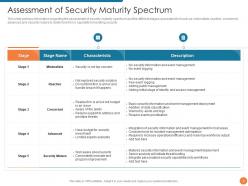
Slide 9: It portrays information regarding the assessment of the security maturity spectrum and the different stages associated with it such as minimalists, reactive, concerned, advanced, and security mature to determine a firm’s capability in handling security.
Slide 10: This is a table of content slide introducing the Security Operations Implementation Timeline.
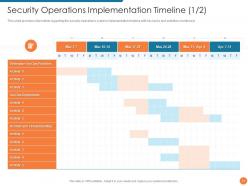
Slide 11: This slide presents the Security Operations Implementation Timeline (1/2). It provides information regarding the security operations system implementation timeline with key tasks and activities mentioned.
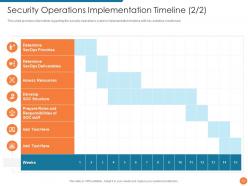
Slide 12: This slide presents the Security Operations Implementation Timeline (2/2). It provides information regarding the security operations system implementation timeline with key activities mentioned.
Slide 13: This is a table of content slide introducing the Developing Security Operations Centre.
Slide 14: This slide presents the Overview of the Security Operations Centre. It provides information regarding the overview of the security operations center associated with the firm’s business units, management, steering committee, external and internal system.
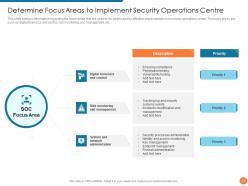
Slide 15: This slide presents Determine Focus Areas to Implement Security Operations Centre. It portrays information regarding the focus areas that are needed to be addressed for effective implementation of the security operations center. The focus areas are such as digital forensics and control, risk monitoring and management, etc.
Slide 16: This slide presents the Role of the Security Operations Centre in Security Operations. It portrays information regarding the role of the security operations center in SecOps and how firms behave before, after, and towards SecOps implementation.
Slide 17: This slide presents the Developing Security Operations Centre (SOC) Structure. It provides information regarding the development of the facility as a security operations center, which is built so that security staff will monitor enterprise systems, protect them against security breaches and consistently identifies and mitigates security risks.
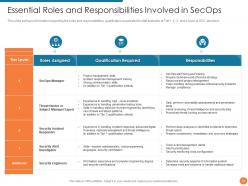
Slide 18: This slide presents the Essential Roles and Responsibilities Involved in SecOps. It portrays information regarding the roles and responsibilities, qualifications associated with staff available at Tier 1, 2, 3, and 4 levels at SOC structure.
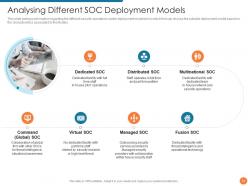
Slide 19: This slide presents the Analysing Different SOC Deployment Models. It portrays information regarding the different security operations center deployment models from which firms can choose the suitable deployment model based on the characteristics associated with the Models.
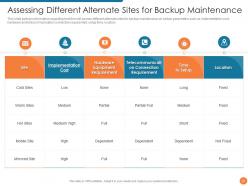
Slide 20: This slide presents the Assessing Different Alternate Sites for Backup Maintenance. It portrays information regarding how the firm will assess different alternate sites for backup maintenance on certain parameters such as implementation cost, hardware, and telecommunication connection requirement, setup time, location.
Slide 21: This is a table of content slide introducing the Handling Insider Attack.
Slide 22: This slide presents the Insider Attacker Method and Behaviour Assessment. It portrays information regarding the insider attacker assessment in security operations systems by addressing the method they use to attack and analyze insider behavior.
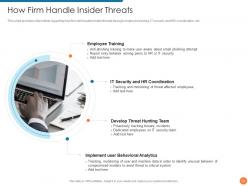
Slide 23: This slide presents the Implement user Behavioral Analytics. It provides information regarding how the firm will handle insider threats through employee training, IT security, and HR coordination, etc.
Slide 24: This is a table of content slide introducing the Incident Management.
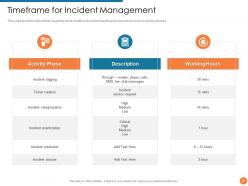
Slide 25: This slide presents the Timeframe for Incident Management. It provides information regarding the entire duration of the incident handling process which occurs in various phases.
Slide 26: This slide presents the Selecting Suitable Security Incident Management Software. It will help the firm in selecting suitable automated incident management software which will handle existing security and privacy issues and predict upcoming incidents. The firm will choose effective software with features such as automated workflows, a centralized platform, etc.
Slide 27: This is a table of content slide introducing the Contingency Plan for Threat Handling in SecOps.
Slide 28: This slide presents the Contingency Plan for Threat Handling. It portrays an information contingency plan for handling threats with the help of technical equipment that assist contingency solution and considerations.
Slide 29: This is a table of content slide introducing the Various Technologies for the Effective SecOps processes.
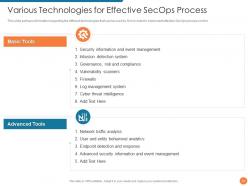
Slide 30: This slide presents the Various Technologies for Effective SecOps processes. It portrays information regarding the different technologies that can be used by firms in order to implement an effective SecOps process in the firm.
Slide 31: This is a table of content slide introducing the Security and Operational Tasks Maintenance Checklist.
Slide 32: This slide presents the Security and Operational Tasks Maintenance Checklist. It provides information regarding the security and operational task maintenance checklist with activities mentioned that will be performed on a daily, weekly, monthly, or quarterly basis.
Slide 33: This is a table of content slide introducing the Various Metrics to Measure SecOps System
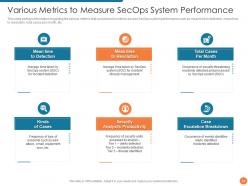
Slide 34: This slide presents the Various Metrics to Measure SecOps System Performance. It portrays information regarding the various metrics that are considered in order to assess SecOps system performance such as mean time to detection, mean time to resolution, total cases per month, etc.
Slide 35: This is a table of content slide introducing the Cost Associated with SecOps Implementation.
Slide 36: This slide presents the Budget for Effective SecOps System Management. The firm has prepared the budget for managing security – operational system management. It also provides information about the software used and the duration required for implementation.
Slide 37: This slide presents the SecOps Staff Training Plan with Cost. The employees will require training which will play important role in their development. The training will be given by experts in various fields and will not be free, and charges will cost the firm per employee.
Slide 38: This is a table of content slide introducing the Impact Analysis.
Slide 39: This slide presents the Facilities Offered by Successful Implementation. It portrays information regarding the various facilities that are offered by the successful implementation of SecOps in the organization in terms of malware detection, phishing detection, investigations by HR, risk mitigation, etc.
Slide 40: This slide presents the Impact of Effective Security Management. It portrays information regarding how the firm is successful in handling security issues/events and is able in reducing the occurrence of events.
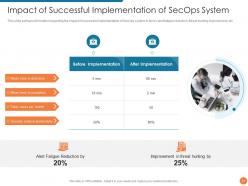
Slide 41: This slide presents the Impact of the Successful Implementation of the SecOps System. It portrays information regarding the impact of successful implementation of the SecOps system in terms of alerts fatigue reduction, threat hunting improvement, etc.
Slide 42: This is a table of content slide introducing the Dashboard.
Slide 43: This slide presents the Determine Security Risks Dashboard. It provides information regarding the dashboard which is used to track and monitor various security risks and threats identified.
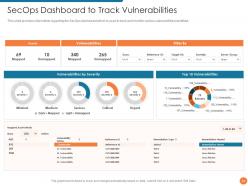
Slide 44: This slide presents the SecOps Dashboard to Track Vulnerabilities. It provides information regarding the SecOps dashboard which is used to track and monitor various vulnerabilities identified.
Slide 45: This is the Security Operation Centre - Icons Slide.
Slide 46: This slide presents the Additional Slides.
Slide 47: This slide shows a Stacked Bar that compares 2 products’ data over a timeline of financial quarters.
Slide 48: This slide shows a Line Chart that compares 2 products’ data over a timeline of months.
Slide 49: This slide provides the Mission for the entire company. This includes the vision, the mission, and the goal.
Slide 50: This slide shows the members of the company team with their name, designation, and photo.
Slide 51: This slide provides a Venn diagram that can be used to show interconnectedness and overlap between various departments, projects, etc.
Slide 52: This slide contains Post-It Notes that can be used to express any brief thoughts or ideas.
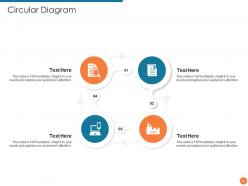
Slide 53: This slide presents a Circular Diagram and the components that make up a project or concept.
Slide 54: This is the Puzzle slide to showcase the parts that make up a concept whole.
Slide 55: This slide presents a Magnifying Glass to give more details about the individual steps in a project.
Slide 56: This is a Thank You slide where details such as the address, contact number, and email address are added.
Security operation centre powerpoint presentation slides with all 56 slides:
Use our Security Operation Centre Powerpoint Presentation Slides to effectively help you save your valuable time. They are readymade to fit into any presentation structure.





















FAQs for Security operation centre
So a SOC is like your company's security command center. Analysts there watch your networks around the clock, looking for threats and dealing with incidents when they pop up. Picture it as a digital security guard that never sleeps - though honestly, those poor analysts definitely run on way too much coffee. They're constantly hunting for sketchy activity and investigating alerts. When something goes sideways, they're your go-to team for fixing it. Pretty cool job actually, they also study attack patterns to catch new threats early.
So a SOC is like your regular IT security team but cranked up to 11. They're watching everything 24/7 instead of just setting up defenses and walking away. Your typical IT security folks focus on stuff like patches and policies - the prevention side. But SOC analysts? They're actively hunting for threats as they happen. It's honestly like the difference between installing security cameras and actually having someone watch them all night. The round-the-clock monitoring is what sets them apart - these teams literally don't sleep. If you're handling sensitive data or need compliance coverage, you'll probably want that kind of setup.
Honestly, start with nailing down your processes first - incident response playbooks, escalation stuff, communication flows. Then build your tech stack around that foundation. Team structure should be tiered: Level 1 handles initial alerts, Level 2 digs deeper, Level 3 tackles the really nasty incidents. For tech, you'll need SIEM, threat intel feeds, forensic tools. Automation is crucial or you'll get buried in false positives - learned that one the hard way. Oh, and don't forget decent monitors and chairs for your analysts. Sounds silly but they're staring at screens all day.
Focus on MTTD and MTTR first - how fast you catch stuff and respond to it. False positives are huge too because your analysts will lose their minds chasing fake alerts. I'd also track escalation rates and what percentage of events you're actually investigating vs just hoarding data. The money metric though? Business impact. Show how much damage or downtime you prevented. Honestly, pick 3-4 that actually matter to your boss and track those consistently. Don't go crazy with dashboards nobody looks at.
So first thing - get a good SIEM platform since that's basically your command center for all security data. You'll also want endpoint detection tools and network monitoring stuff. Threat intel feeds are clutch for staying on top of new attacks. SOAR platforms honestly make your life way easier by automating responses (I can't stress this enough). Oh, and grab vulnerability scanners plus incident response tools for when shit hits the fan. The tricky part is making sure everything talks to each other. Siloed tools are useless. Pick your SIEM first - it'll basically dictate everything else you buy.
You'll definitely need technical stuff like network protocols, SIEM tools, and log analysis - oh and MITRE ATT&CK framework is huge right now. But honestly? The soft skills are where most people struggle. Being able to think through patterns in tons of messy data, writing reports that don't suck, staying cool when everything's on fire. Communication is massive since you're constantly explaining threats to people. I'd start messing around with common SIEM platforms and grab some sample logs to practice on. The incident response procedures will come with experience, but get the basics down first.
Your SOC basically runs like a three-tier system when shit hits the fan. Level 1 folks do the initial triage and basic containment stuff. More complex issues get bumped up to Level 2 for deeper digging, then Level 3 handles the really nasty threats that need senior people. It's kinda like tech support but for cyber attacks, honestly. Each handoff includes all the context and evidence so nothing gets dropped. Critical incidents skip the normal queue entirely - which is smart because who has time for that? The trick is having your escalation triggers documented ahead of time so your analysts aren't winging it under pressure.
Dude, threat intel is what saves your SOC from going insane with alerts. You'll actually understand WHY something sketchy is happening - like oh, this network traffic matches that campaign targeting our sector. Makes prioritizing so much easier. Without it you're just playing whack-a-mole with random suspicious stuff. My advice? Start with feeds specific to your industry first. Generic threat intel just creates more headaches honestly - learned that the hard way. It transforms how you tune detection rules too. Way better than flying blind and hoping you catch the important stuff.
Dude, automation is honestly where it's at for SOCs. Your analysts are probably drowning in repetitive stuff - threat detection, incident workflows, basic remediation. Once you automate that grunt work, they can actually focus on the interesting investigations that need real thinking. No more alert fatigue burnout, which is huge. Automated playbooks keep your responses consistent too, which is nice when you're dealing with the same threats over and over. I'd say start small though - pick something straightforward like malware detection first. Don't try to automate everything at once or you'll just create new headaches for yourself.
Dude, SOCs are absolutely swamped right now. Alert fatigue is killing these teams - they literally can't keep up with all the noise. Remote work made everything worse by expanding attack surfaces, and honestly? Attackers are getting scary good with AI and these sneaky living-off-the-land tactics. Finding decent analysts is nearly impossible these days. You've got tool sprawl everywhere creating blind spots, plus threats hiding in encrypted traffic that nobody can see. My advice? Automate the boring stuff and let your actual humans focus on real threats. Otherwise you'll burn everyone out.
So your SOC needs to talk to everyone, basically. They'll work with IT on vulnerabilities, HR watches for insider threats, and legal keeps them compliant. The really good ones? They're more like business consultants who happen to do security. Business ops helps them figure out what's actually critical - can't protect everything equally, right? Communication is huge though. Set up regular check-ins and clear escalation paths with each department. Oh, and make sure other teams feel like they're part of security too, not just the SOC's job. When everyone's invested, things run way smoother.
Think of it as your digital security guard that never sleeps. Real-time monitoring catches weird stuff happening before it becomes a nightmare - way better than finding out about breaches from pissed off customers weeks later. You can't just peek at your network occasionally and cross your fingers. Automated alerts will ping you when something actually suspicious goes down, plus it keeps you compliant with all those annoying regulations. Honestly, the visibility alone is worth it since you'll finally know what your actual attack surface looks like. Set thresholds so you're not getting woken up at 2am for nothing.
Honestly, the documentation side is such a headache but you can't skip it. Your SOC needs continuous monitoring that tracks everything for whatever regs hit you - GDPR, HIPAA, SOX, the usual suspects. Regular audits become your best friend, plus keeping detailed incident logs. Most teams I know use automated reporting tools that map your security stuff to regulatory frameworks, which saves tons of time. You'll want to figure out which regulations actually apply first, then work backwards to align your SOC processes. The whole "proving due diligence" thing during audits is where this really pays off.
Pick one person to run the show and stick with it - analysts investigate, incident commander makes decisions. Use Slack or whatever, but for the love of god don't let people start side conversations everywhere. I've seen teams completely fall apart because half the updates were in email and half in chat. Document stuff as it happens with templates you've already set up. Quick updates every 15-30 minutes keep everyone sane. Oh, and figure out your escalation rules NOW - like when exactly you're gonna wake up your boss at 2am. Trust me, you don't want to debate that during an actual incident.
Dude, forget signature-based detection - APTs will walk right past that stuff. You need behavioral analytics and UEBA to catch weird activities that don't match normal patterns. Train your analysts on advanced investigation techniques too. Honestly, the biggest shift is going proactive instead of just sitting around waiting for alerts. Set up regular threat hunting sessions where your team actively digs through the network looking for compromise signs. Oh, and definitely get some solid threat intelligence feeds running. It's way more work upfront but you'll actually catch these sneaky bastards before they own your entire network.
-
Presentation Design is very nice, good work with the content as well.
-
Illustrative design with editable content. Exceptional value for money. Highly pleased with the product.