


Security Guard Service Company Profile Powerpoint Presentation Slides




Try Before you Buy Download Free Sample Product
 Impress Your
 Audience
 100%
100% Editable
 Save Hours
 of Time


A company profile describes all the relevant elements of a business, which helps the investors and stakeholders evaluate the business value and performance. Check out our professionally designed Security Guard Service Company Profile PowerPoint presentation. Firstly, the profile covers the executive summary, corporate overview highlighting security guard services with quality and certifications, global presence, corporate, industrial, educational institute, hospital, commercial and residential building, retail, shopping complex, and additional security services. Additionally, it includes the team communication layout, weapon and logistics vehicle details, staff recruiting criteria and training center, employee and staff welfare policies, crisis management team, employees rules and regulations, company approach, and business model canvas. Moreover, it covers the timeline, organization chart, management team, government and private sector clients, client reviews, awards, and accolades. At last, this profile emphasizes the revenue and net profit, revenue by customer type, sales by region and services, EBITDA, competitive and SWOT analysis with CSR initiatives and case study. Get access to our powerful company profile template now.
People who downloaded this PowerPoint presentation also viewed the following :
Content of this Powerpoint Presentation
Slide 1: This slide introduces Security Guard Service Company Profile. State Your Company Name and begin.
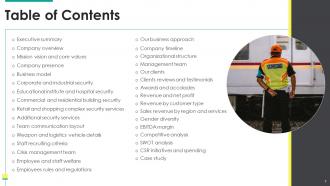
Slide 2: This slide presents Table of Content for the presentation.
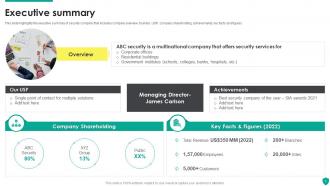
Slide 3: This slide displays executive summary of security company.
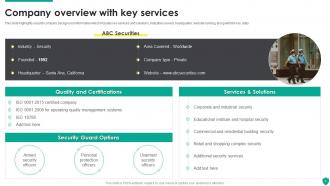
Slide 4: This slide represents security company background information.
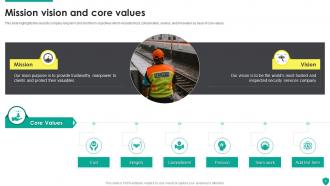
Slide 5: This slide showcases security company long term and short term objectives.
Slide 6: This slide shows security guard and manpower services company.
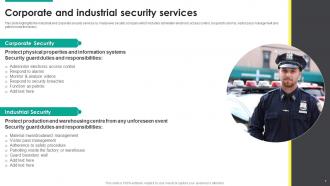
Slide 7: This slide presents industrial and corporate security services by manpower security company.
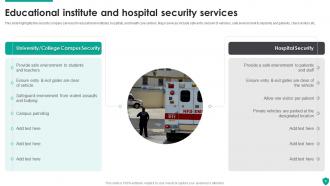
Slide 8: This slide displays Educational institute and hospital security services.
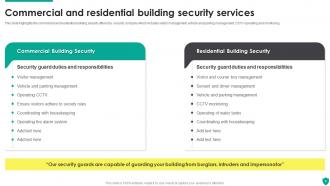
Slide 9: This slide represents Commercial and residential building security services.
Slide 10: This slide showcases Retail and shopping complex security services.
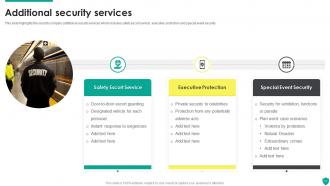
Slide 11: This slide shows security company additional security services.
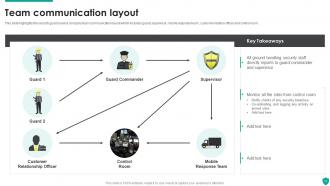
Slide 12: This slide presents security guard service company team communication layout.
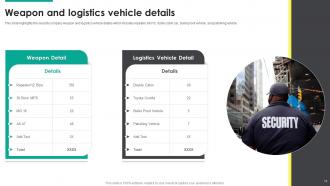
Slide 13: This slide displays Weapon and logistics vehicle details.
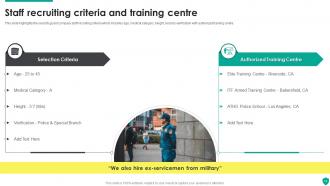
Slide 14: This slide represents security guard company staff recruiting criteria.
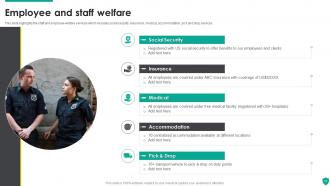
Slide 15: This slide showcases staff and employee welfare services.
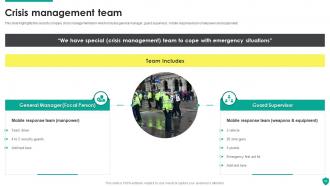
Slide 16: This slide shows security company crisis management team.
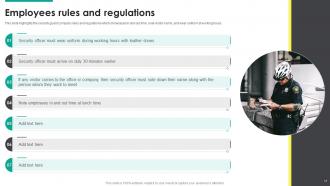
Slide 17: This slide presents security guard company rules and regulations.
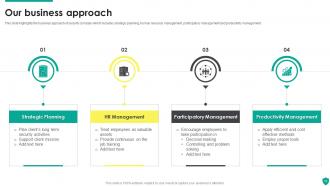
Slide 18: This slide displays business approach of security company.
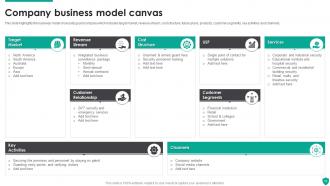
Slide 19: This slide represents business model of security guard company.
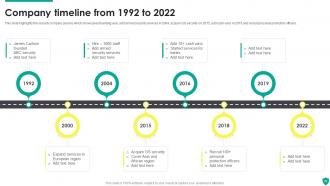
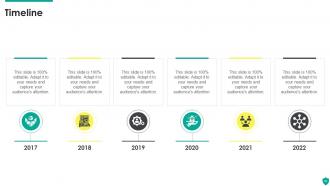
Slide 20: This slide showcases Company timeline from 1992 to 2022.
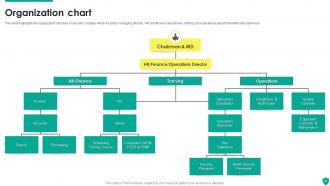
Slide 21: This slide shows organization structure of security company.
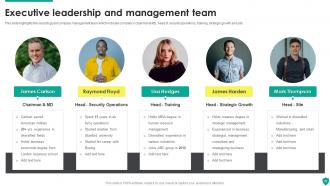
Slide 22: This slide presents Executive leadership and management team.
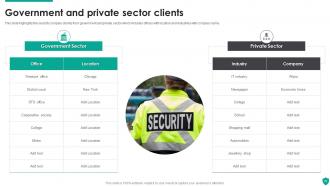
Slide 23: This slide displays Government and private sector clients.
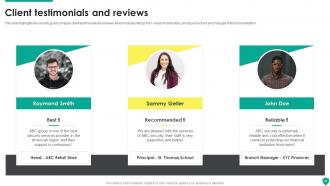
Slide 24: This slide highlights the security guard company client testimonials and reviews.
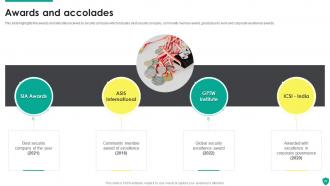
Slide 25: This slide represents awards and allocates received by security company.
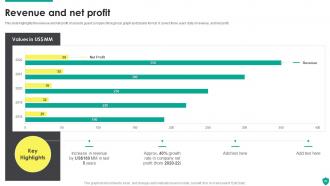
Slide 26: This slide showcases revenue and net profit of security guard company.
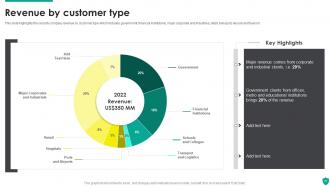
Slide 27: This slide shows security company revenue by customer type.
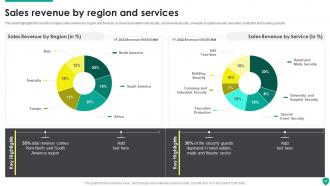
Slide 28: This slide presents Sales revenue by region and services.
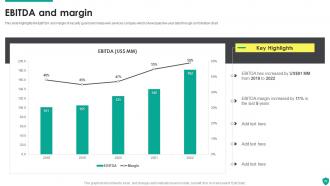
Slide 29: This slide displays EBITDA and margin of security guard and manpower services company.
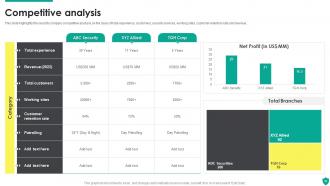
Slide 30: This slide represents security company competitive analysis.
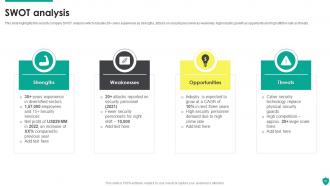
Slide 31: This slide showcases security company SWOT analysis.
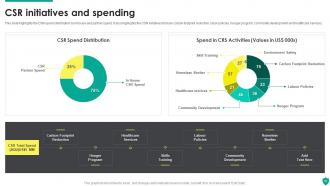
Slide 32: This slide shows CSR spend distribution by inhouse and partner spend.
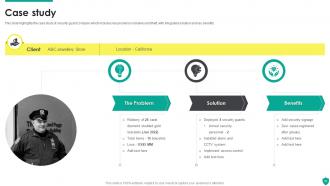
Slide 33: This slide presents case study of security guard company.
Slide 34: This slide displays Icons for security guard service company profile.
Slide 35: This slide is titled as Additional Slides for moving forward.
Slide 36: This is Our Mission slide with related imagery and text.
Slide 37: This is About Us slide to show company specifications etc.
Slide 38: This is Our Team slide with names and designation.
Slide 39: This is Our Goal slide. State your firm's goals here.
Slide 40: This slide shows Post It Notes. Post your important notes here.
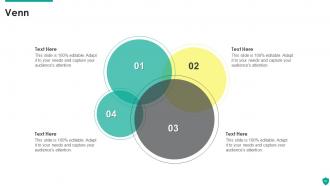
Slide 41: This slide depicts Venn diagram with text boxes.
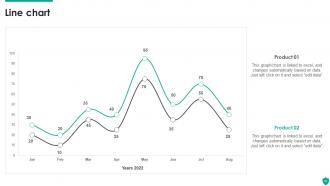
Slide 42: This slide describes Line chart with two products comparison.
Slide 43: This is a Timeline slide. Show data related to time intervals here.
Slide 44: This is a Thank You slide with address, contact numbers and email address.
Security Guard Service Company Profile Powerpoint Presentation Slides with all 49 slides:
Use our Security Guard Service Company Profile Powerpoint Presentation Slides to effectively help you save your valuable time. They are readymade to fit into any presentation structure.








FAQs for Security Guard Service Company Profile
So it really depends on where you end up working, but you'll be doing surveillance and monitoring who comes in and out. Patrols are a big part of it too. Retail means dealing with shoplifters and crowds - honestly not my favorite. Corporate gigs are more about access control and making sure nobody walks off with expensive equipment. Healthcare can get intense because you might have to handle upset patients or family members. Oh, and you'll respond to whatever emergencies pop up. The trick is figuring out what each place actually needs from you security-wise.
Yeah so security companies totally tailor everything to what industry they're working with. Retail gets loss prevention people who can spot shoplifters and deal with crazy crowds - Black Friday is like their Super Bowl honestly. Corporate places need guards who know access control and visitor stuff, completely different vibe. Residential is more about patrols and getting to know the people living there. They even hire different personality types depending if you need someone friendly for customers vs. someone watching a warehouse all night.
So first thing - you'll need state licensing, that's just how it works and every state's different. Basic security training covers the usual stuff like legal limits, emergencies, writing reports. CPR and First Aid are pretty much expected everywhere now. If they're carrying weapons, obviously firearms training is required. Some guards get extra certs for specific places like hospitals or stores. Oh and defensive tactics training is becoming more common too. Just make sure everything's current - expired licenses will bite you in the ass later. Ongoing training keeps everyone sharp.
Honestly, tech has been a total game-changer for security guards. Real-time communication systems and mobile apps mean instant incident reporting - no more paperwork delays. Your guards can access surveillance feeds directly on their phones now, which is pretty cool. Body cameras are huge too, clients eat that stuff up for accountability. GPS tracking helps you see where guards actually are (we've all had those lazy patrol concerns, right?). The integration with smart buildings is wild - guards control access, lighting, alarms all from one screen. Even small tech upgrades make guards way more efficient. Worth looking into for sure.
Look, security guards are literally your go-to people when things go sideways. They're trained to size up situations fast and get everyone out safely. Plus they know every exit and weird hallway in your building - way better than Karen from accounting who's been there 10 years, lol. They'll handle headcounts, lock things down, and deal with cops or firefighters so you don't have to. Just make sure they've got current contact info and know your evacuation routes. Trust me, it's a game changer when stuff hits the fan.
First thing - make sure they're actually licensed and insured. Sounds boring but trust me, you don't want to deal with that headache later. Check what kind of training they give their guards because some companies literally just hand people a uniform and call it good. Online reviews are helpful, but also ask for references you can call. I'd swing by their office if you can - you get a way better sense of how professional they really are. Oh, and definitely ask about background checks and drug testing for their guards. Any decent company won't hesitate to tell you their whole screening process.
So obviously armed guards have guns and unarmed don't, but there's more to it. Armed security costs way more and needs special licenses - they're mainly for high-risk places like banks or jewelry stores. Unarmed works perfectly fine for most stuff though. Retail, offices, events - you just need someone visible who can handle basic problems. Honestly? Most businesses don't actually need armed guards at all. I'd say start with your budget and real risk level first. My cousin's store uses unarmed and it's been great. Go unarmed unless there's a specific reason not to.
Honestly, having security guards around makes a huge difference. People see someone in uniform and suddenly think twice about causing trouble - it's pretty effective. Your guards can watch entrances, walk around the property, and jump on problems before they blow up. Employees feel way more relaxed too, which I think is underrated. Plus if something serious happens, trained guards know how to handle it until cops or paramedics show up. Oh, and if you're thinking about hiring security, figure out your weak spots first - that'll help you decide where to focus.
Look, your security guards aren't cops - they can't just go around arresting people or searching bags without permission. They're basically there to watch stuff and call the real police when things get sketchy. Yeah, they can detain someone if they think a crime happened, but any force has to match the actual threat level. I'd honestly focus on training them that their main job is observing and reporting incidents. You'll want clear rules about citizen's arrests and property stuff. Most situations? Just call law enforcement instead of letting your team try to handle it themselves.
Honestly, it's pretty straightforward - just have the guards work with what you've already got. They can watch your cameras, handle alarm responses, follow whatever protocols you're using now. During training, walk them through your specific systems (most security companies deal with this stuff all the time anyway). Guards give you that human touch cameras can't - like actually talking to people or making judgment calls when weird stuff happens. I'd start by figuring out exactly where they fit in your current setup and what systems they'll need access to. Way better than trying to reinvent everything from scratch.
Dude, get some decent scheduling software first - makes shift swaps way less of a headache. Cross-train everyone on different posts because trust me, people will call out at the worst times. Always keep your minimum coverage numbers locked down for each spot. Oh and build in some buffer time between shifts! Nothing worse than guards rushing through handovers and missing important stuff. Having backup plans ready is huge too. The scheduling part honestly stressed me out more than anything when I started managing teams. Just communicate changes fast and you'll be fine.
Look, customer feedback is basically your cheat sheet for figuring out what's actually going wrong. Your clients see stuff you miss - like if guards are being weird with visitors or skipping important checks. Yeah, some feedback hurts to hear, but it's pure gold for fixing training gaps. I've seen companies totally ignore this and wonder why they keep losing contracts. Use what they tell you to shuffle guard assignments around and tweak your procedures. The key is setting up regular check-ins with clients and actually doing something about their complaints. That's how you keep them happy and your business growing.
Honestly, being a security guard is way more complex than people realize. You're dealing with false alarms constantly, plus actual sketchy situations where you've got to make split-second decisions with barely any info. Then there's the boring stretches - and staying sharp during those quiet hours is harder than it sounds. Weather sucks sometimes, shifts drag on forever, and backup? Good luck with that. Oh, and you'll be handling difficult people who are either genuinely dangerous or just having the worst day ever. Communication skills are huge though. Mental alertness too, even when absolutely nothing's happening for hours.
Honestly, cultural sensitivity training is a game-changer for security teams. Your guards will actually connect better with different communities instead of accidentally pissing people off - which happens way more than it should. When they get how different cultures communicate, they're not misreading situations or escalating things unnecessarily. People trust security staff who respect them, so you'll get way more cooperation. Oh, and diverse teams catch security risks that others totally miss. I'd start by figuring out where your current team's knowledge gaps are, then build training around that.
So the big thing right now is guards working with AI stuff - smart cameras, drones, all that tech. They're not getting replaced, just working alongside it. Remote monitoring is everywhere now too, where one guard watches like 5 different sites from a control room. Companies really want people who get both physical security AND cyber threats these days. The workforce is getting older so there's actually decent opportunities if you can adapt to the tech side. Honestly, some clients still think a robot can just handle everything but that's not reality yet. Focus on being tech-savvy and you'll be solid.
-
Stunning collection! With a wide variety of options available, I was able to find a perfect slide for my presentation. Thank you, SlideTeam!
-
Incredibly beautiful designs that will help you get noticed! These eye-catching templates are perfect for corporate presentations that can be altered to fit any occasion or taste.